By: Esha Karam ’21 and Halle Greenbaum ’21
May 15, 2020
As we sit at home with school cancelled for the rest of the year, it’s easy to feel like no other student could have ever known what this feels like. But, 102 years ago, students just like us were faced with the same predicament. Their school, Peabody Demonstration School, was shut down, and their city, Nashville, Tennessee, was facing a pandemic.
1918 was not an easy year to live through. The country was in the middle of World War I, and a deadly virus was spreading rapidly among cities throughout the world: the Spanish Influenza.
While the first wave of the influenza in the spring of 1918 was mild, the second wave of the pandemic took a more deadly turn. First observed in parts of Europe, America, and Asia, the flu spread rapidly around the world, likely worsened by travelling soldiers.
In Nashville, rumors of community spread began in late September. Since a structured system for reporting instances of the flu was not put into place, it’s difficult to approximate the exact number of cases in the city. However, some health officials estimated that there were as many as 15,000 cases by October 5. Two days later, Davidson County officially closed schools after theaters and non-essential venues had closed their doors. By October 8, all public gathering places in Nashville shut down.
Unlike our current situation, the Spanish Flu pandemic died down fairly quickly. Within a week of closures, hospitals reported less patients, and by October 21, there were no new cases reported.
By November 1, health officials declared the pandemic was over in Nashville. Schools reopened, agreeing to shorten Thanksgiving and Christmas breaks to make up for lost time. In total, Nashville had 40,000 cases and 392 deaths.
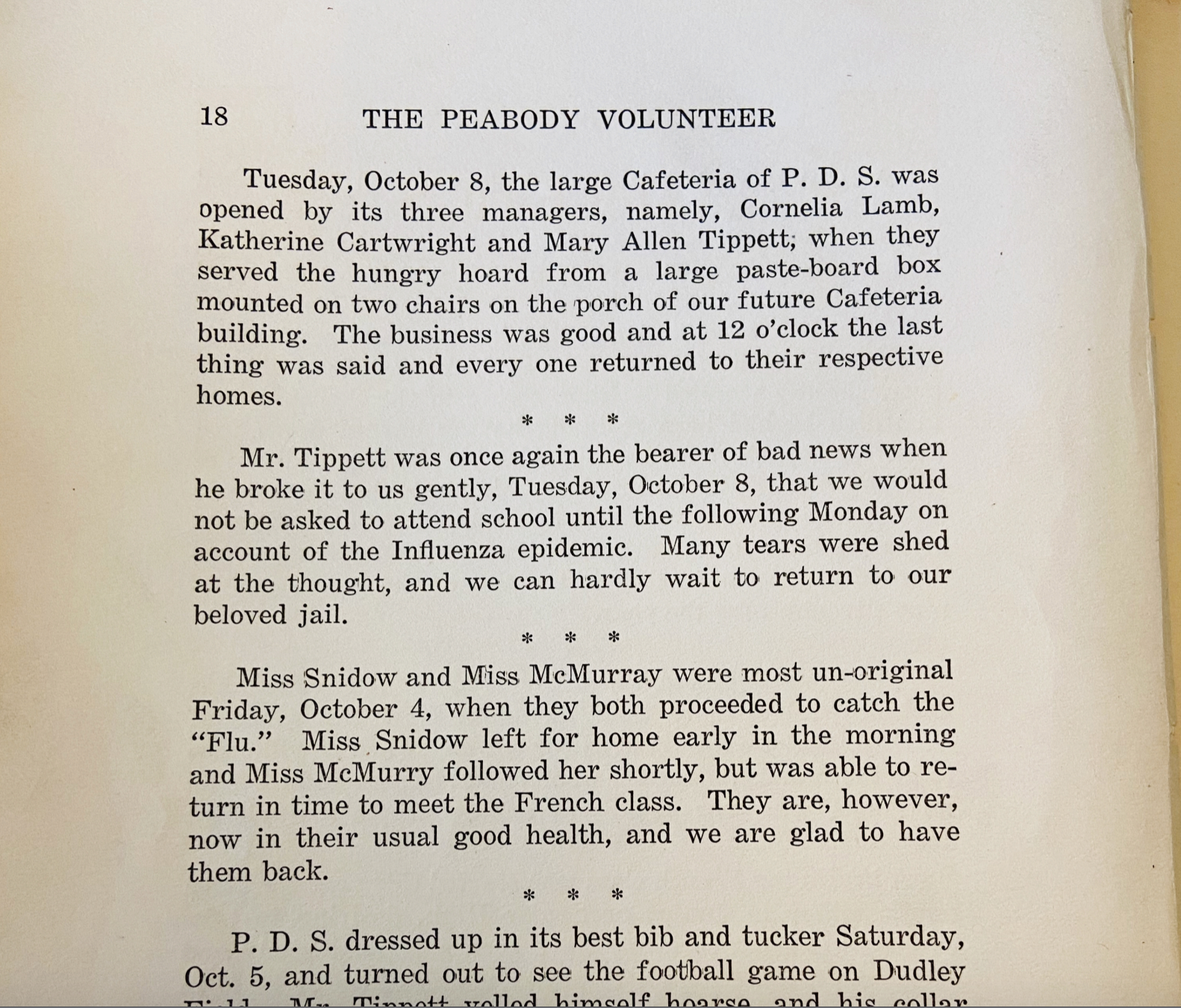
Interestingly, the predecessor to USN’s very own Peabody Press, titled The Peabody Volunteer, was in its nascent stage during the flu pandemic.
Much like our own writers are currently doing, the writers of that student publication penned their thoughts and observations on the world around them to share with students.
While these pages only reflect the students’ experiences before and after their school shutdown (apparently students couldn’t write and share articles digitally in 1918), their words provide a window into what it was like to live through a similar situation in a different era.
Most notably, The Peabody Volunteer highlights individual encounters with the Spanish Influenza, going as far as naming those who had contracted the disease.
“Four members of the junior class have been quite ill for some weeks with the Influenza, Martha Wesley Hart, Will Kirkman, Reba Zander, and Ernest Davis,” the paper reported.
While this public announcement is certainly a departure from the emphasis on privacy in our own times, the paper doesn’t stop there.
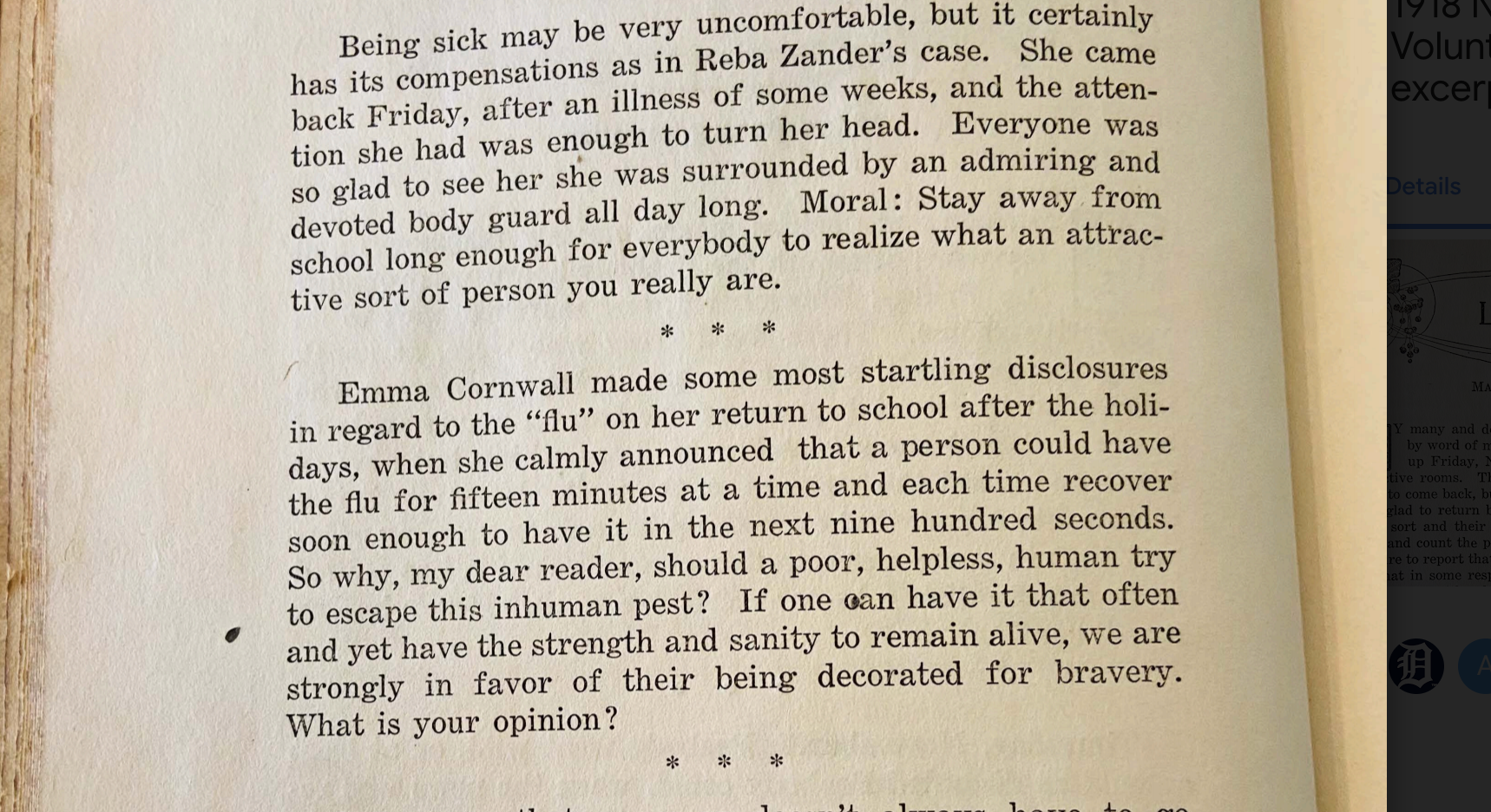
One student detailed the “compensations” that Reba Zander was awarded upon her return. “Moral: Stay away from school long enough for everybody to realize what an attractive sort of person you really are,” they wrote.
The details about specific people don’t stop at those who were personally infected.
Although there was no Twitter, Instagram, Snapchat, or even televised news during the 1918 pandemic, the spread of misinformation and ‘fake news’ was still very much alive.
The Peabody Volunteer cites an Emma Cornwall as saying “… that a person could have the flu for fifteen minutes at a time and each time recover soon enough to have it in the next nine hundred seconds.”
Reading this claim seems ridiculous and rather silly, but it is the same thing that is happening all over the news today regarding the Coronavirus.
On April 24, President Trump also made a claim similar to that of Emma Cornwall with the same sense of absurdity.
At his daily briefing he said, “I see the disinfectant that knocks it out in a minute, one minute. And is there a way we can do something like that by injection inside or almost a cleaning? As you see, it gets in the lungs, it does a tremendous number on the lungs, so it would be interesting to check that.”
And however preposterous the claim sounded, people still listened. Despite the difference of a hundred years, fake news still has the same effect of giving people false information that they continue to publicize and spread.
We are undoubtedly living through history. But, there is some small comfort in knowing that a century ago, there were students just like us. Students who were stuck at home with nothing else to do but “count the pictures on the wall.” Students who were desperate “to return to [their] beloved jail.” Students who were frustrated by the “ban on amusements of every sort.” Students who were undoubtedly living through history.