There are 50+ high school faculty and staff, and likely just as many stories beyond these! If you have any tips or stories you’d like us to cover, please email [email protected].
As students, we often seem to forget that our teachers do not sleep at school. It’s easy to imagine them grading papers and tests underneath harsh fluorescent lights for hours after we leave. However, USN’s high school faculty come from numerous countries, states, colleges, and backgrounds. Here, I’ve gathered some wild facts and stories from your favorite teachers’ pasts:
Mr. Flatau and his celebrity dormmate
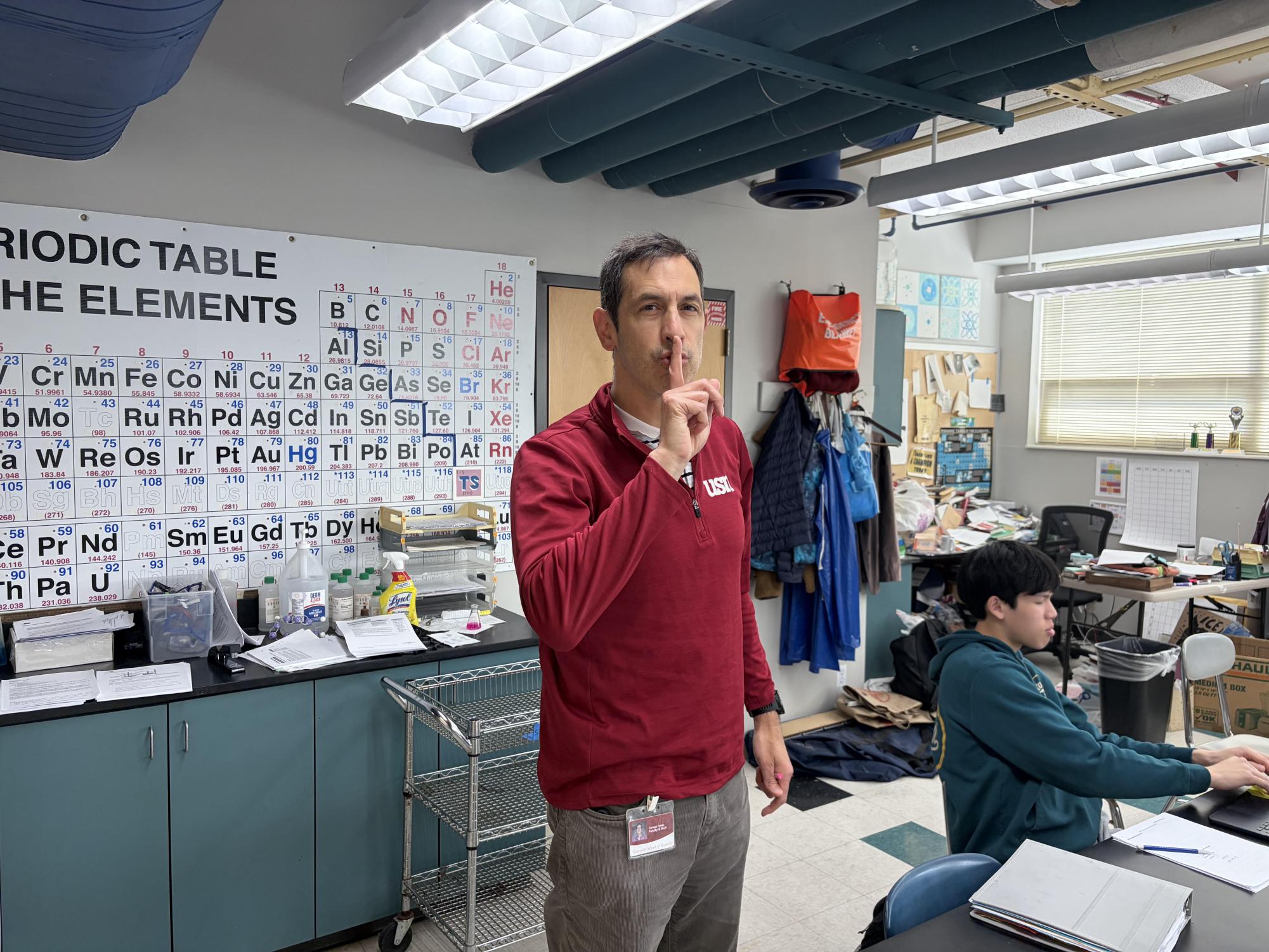
When beloved science teacher George Flatau was at Duke University, he shared a dorm with TV personality Travis Stork. Stork was on Season 8 of “The Bachelor” in 2006, and was a host of “The Doctors,” a daytime talk show which aired from 2008 to 2020.
Flatau noted that despite having 25 women compete for his affection on The Bachelor, in college stork was notorious for having bad luck with the ladies.
“His nickname in college was ‘Fumble,’ because he tended to be so bad at dating,” said Flatau.
(Henry Knowles)
Tamara Berthel and the reservoir baboon
Before becoming USN’s resident AP Biology master and 9th and 10th grade dean, Ms. Berthel lived in South Africa, where she worked with the University of Cape Town.
Berthel lived on a plot of old diamond-mining land, which had been converted into a game farm. Throughout her year in South Africa, she was studying bird reproductive behavior.
“When I got there [to South Africa], I sat down in a room full of men and they were concerned that I was an American woman. They were afraid I was going to try and pet the lions and that I would have no common sense out in the field… I quickly changed their minds about that,” said Berthel.
Berthel’s days would start at 4:30 in the morning when she would put up nets to catch birds and band them.
“There are lots of meerkat mounds out in the Kalahari, so oftentimes I would have breakfast out by the meerkat mounds, and they’d come out and stand up and look at me,” said Berthel.
While some of the critters she encountered were friendly, some were not so much.
(Henry Knowles)
“There were lots of venomous snakes… Probably the scariest of beasts that I ran into out there would have either been the wildebeest or the ostriches. Ostriches are really deadly, and they can actually kick you with their toenail and eviscerate you,” said Berthel.
At her base in South Africa, there was no running water, so they collected water for showering in huge barrels.
“Before you took a shower, you always had to make sure there was enough water in these big, large swimming pool size vats to be able to get shampoo out of your hair,” said Berthel. “One day, we went out to check the water supply, and a baboon had fallen into our water supply and died.”
“We didn’t have water for a while,” joked Berthel.
Dr. Hansen and his time as a Mormon
Not only is Provo, Utah, home to Brigham Young University, but it is also the birthplace of English teacher Michael Hansen.
Like 82% of the population of Provo, Hansen grew up in The Church of Jesus Christ of Latter-day Saints, or the Mormon Church as it’s known colloquially.
“Growing up Mormon in my era is kind of boring. I mean, what my Mormon childhood was like is what a lot of religious childhoods are like,” said Hansen.
While Hansen stopped attending church around age 15 and is no longer a believer, he still identifies as a Mormon and notes that certain aspects of the religion interest him greatly.
“[People] don’t often hear about some of the sacred texts that I find most interesting. There’s a book called The Book of Abraham that Joseph Smith translated from Egyptian Papyrus that he purchased from a looter late in his life,” said Hansen.
While Smith had no knowledge of how to translate such texts accurately, his translation was extremely detailed and fascinating.
“I like to think that he was doing something, that he was doing something that prophets do, which is like looking into a very strange collection of symbols and seeing visions, you know, and that book is particularly weird,” said Hansen. “This is where things like plural marriage [polygamy] start to become talked about… but the things that are most interesting to me in this text are the kind of cosmology of Mormonism.”
“There’s this really intricate set of late career visions that Joseph Smith had that I just find really compelling, not because I believe them per se in any strict or scientific way, but because I’m sort of proud of that weird heritage that I have,” reflected Hansen.
Growing up in such a predominantly Mormon town, Hansen never viewed his religion as particularly distinctive. However, in the South, people are quick to ask questions.
“I think only in the South would it be thought of as something exotic. I think it is thought of that way. Here. I get a lot of questions like, ‘so what’s that like?’” said Hansen.
When he turned 12, Hansen gained a certain level of priesthood, which allowed him to go to restricted areas of the temple where he had not been able to go previously.
“There’s a room where they have a baptismal font, and they literally read dead people’s names off of the screen as they baptize you, as a surrogate for them, because they believe that there are people who never were baptized by full immersion, who are waiting somewhere for bodies to be dunked,” said Hansen.
Hansen himself was used as a surrogate for around 70 people.
“A person with the Melchizedek priesthood who’s above 18, a man, not a woman, dunked me as each new name came up on the screen,” said Hansen.