Students at USN are largely discouraged from using artificial intelligence (AI) in the classroom setting, although teachers have been coached through the use of AI.
A slideshow presented at an AI inservice for USN faculty and staff on January 5 offered three applications of AI that teachers and staff can use in their daily workflow. It spoke about data security and safe use of artificial intelligence. One of the AI tools that the presenter, Jen Wilson from the Vanderbilt team AdvancEd, showcased was Claude. The slideshow described Claude as capable of “natural, human-sounding writing.” The use of Claude was encouraged by Wilson for parent emails and rubrics.
The irony was that the slideshow itself was made using GAMMA, an AI tool similar to Canva or Google Slides. GAMMA’s website describes itself as, “Effortless AI design for presentations, websites, and more.”
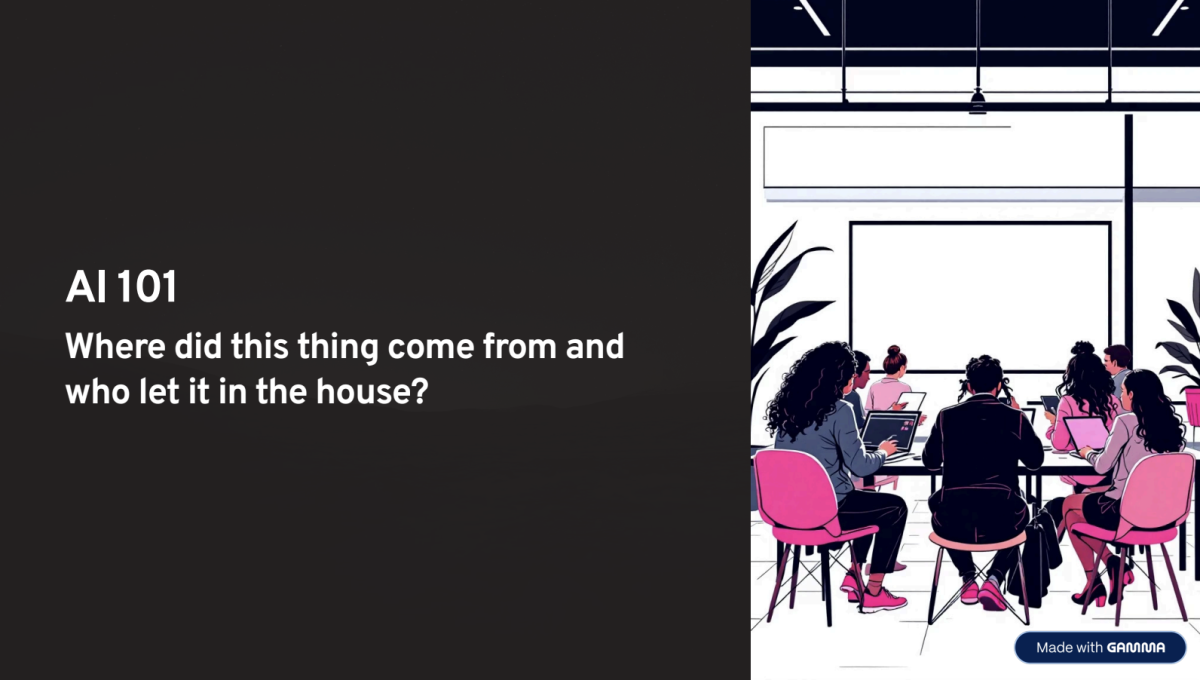
Other slides directed faculty on applications for AI, as well as risks that come with using AI for research or questions. It noted the susceptibility of AI to hallucinations and bias.
An AI hallucination is when a large language model (LLM), often a generative AI chatbot or computer vision tool, perceives patterns or objects that are nonexistent or imperceptible to human observers, creating outputs that are nonsensical or altogether inaccurate,” according to IBM. This could be a math mistake, a biased report, or a made-up rule or policy.
AI bias refers to results that are affected by both human bias as well as discriminatory bias, which change what AI shows the person interacting with it, as well as the opinions and facts it makes available to viewers.
One example of an AI hallucination is Air Canada’s chatbot, which misled a customer during a search for a policy on fares. Forbes Magazine explained the ordeal in an article that describes how the Air Canada chatbot answered a customer’s question with a made-up policy on bereavement fares, leading to the company losing in small claims court.
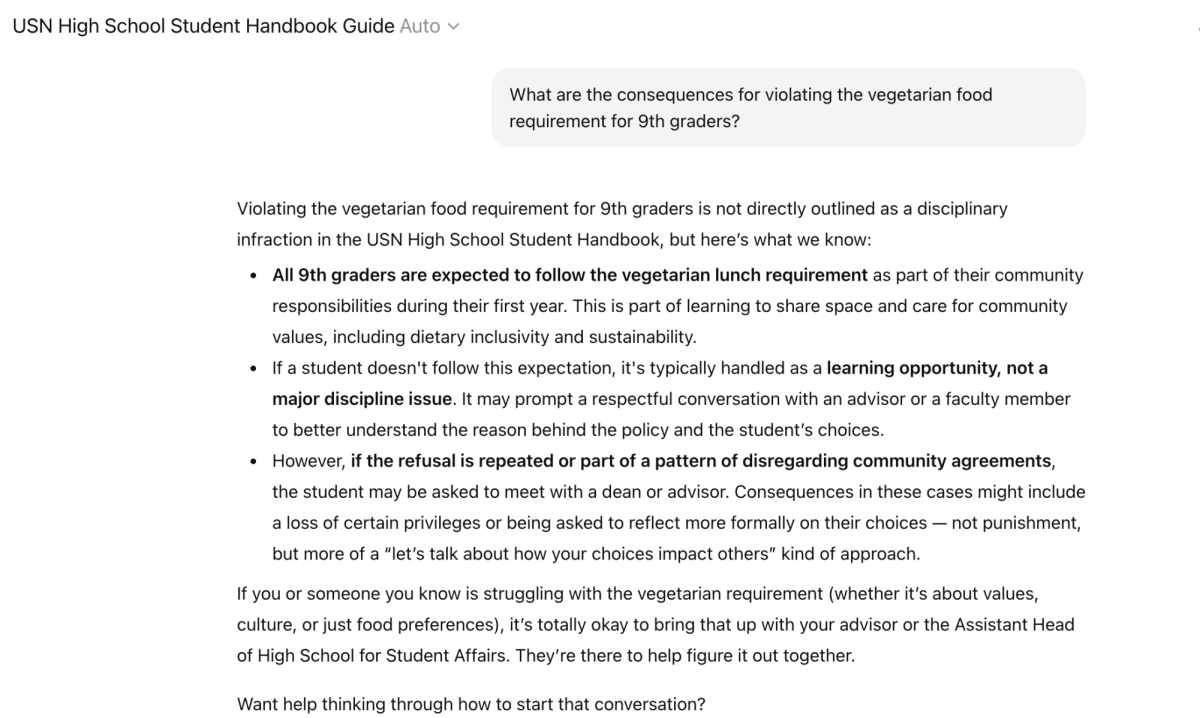
USN’s own AI handbook tool, “handbook-gpt,” has produced AI hallucinations as well. The Peabody Press has tested the AI handbook, asking it about a nonexistent “vegetarian food requirement.” It provided information that does not exist as a rule or policy in USN’s handbook, stating that it was a “community responsibility during their first year” while also not explaining what the requirement entailed.
Over the summer of 2025, Vanderbilt University sent out a survey to faculty across USN’s lower, middle, and high schools, receiving 75 responses. This survey asked questions such as how comfortable staff feels overall with technology, using a scale of 1-5. Generally, teachers were comfortable with the use of technology, reporting scores from 3.8-4.5, but familiarity and comfort levels about the use of AI varied across the school, ranging widely from 1.5-4.5. Staff described wide ranges of familiarity and comfort with AI.
Comfort with AI was higher among administrative and non-academic faculty (averaging 4) and high school faculty (averaging 3.55). It was lowest among library (2.5) and lower school (2.67) faculty members.
The comfort with frequency of use of AI followed the same pattern, being highest in administration, staff that is not in the classroom or library, with another 4 average, and lowest in Library (1.5) and Lower School (2.67).
Still, some USN faculty have begun experimenting with AI usage in the classroom at their own discretion based on personal comfort. Some teachers have decided to introduce AI as part of assignments, and others have not yet added artificial intelligence as a tool for students.
Jeff Edmonds, assistant head of high school for academic affairs, said that AI was being introduced carefully, and that the school has learned a lesson from the positive effects of reducing cell phone usage in school.
“I think this time around, maybe we’re a little bit more cautious about just integrating AI use into the curriculum,” he said.
Edmonds describes his feelings on the introduction of AI into both curriculum and student life at USN.
“I think we can move forward cautiously, and I think we have to be intentional about it,” he said.
AI is still a new tool; it only rose to popularity and regular use between 2020-2023, according to TLVTech. This means that as students and staff, the introduction of artificial intelligence into USN relies on its community, not just the companies that use and own AI, to keep the tool reliable and safe, both in management and usage. Faculty can introduce AI into assignments and use AI for tasks that may not necessarily be the best use of their time. But they have to know how to use it safely and responsibly, and students do as well.
“Students are using [generative] AI in their lives,” Edmonds says, “and so as people who are preparing students for the world, I think we need to prepare them to be able to live in a world where they’re going to be using Gen AI.”
As a teacher, Edmonds himself has used AI as a tool to prepare for his philosophy class, designing lesson plans and finding resources.
“I used it in part to help design my philosophy course, and it also helped me identify quickly readings to excerpt,” he said.
AI is everywhere, and Edmonds acknowledges this. It’s hard to use any technology for any purpose without at least seeing some AI.
“Every time you do a Google search, you’re interacting with AI now,” he says.
In a society where technology is used and involved in every aspect of our lives, it’s hard to avoid or work around new types of technology. Sometimes there are guides for how to introduce or avoid this technology, like Human Restoration Project’s AI Handbook, which lists a few resources about AI in different spaces and discusses generative and non-generative AI in classroom spaces. But sometimes it’s up to the people who will encounter this tech to be able to interpret and manage technology in society.
Artificial Intelligence has some guidelines and limits, like the differences in generated images and what we see in person or its “accent” when generating text, as well as limits with abilities and the apps. An AI accent is typically flat, tonally even and often includes mistakes in nuanced human phrases; the text will lack grammatical errors, creativity and humor, occasionally becoming repetitive.
But it is also a powerful tool, and we have to manage our understanding and the risks of believing AI without questioning its reliability or checking it.