What is a board game? The phrase might bring to mind games like Monopoly and Candyland, board games where gameplay starts and ends with a dice roll. But beyond the classics, there’s an entire world of complex, strategic board games waiting to be played.
For Justin DeSantis, Advanced Algebra II teacher and board game enthusiast, the definition of a board game is a bit more abstract than just the board.
“I give [board games] a more broad definition. Pretty much anything that has a set of structured rules, any sort of interesting strategic decision making, and that at least a subset of people would consider to be fun, would constitute a [board game],” said DeSantis.
But what makes a board game worth playing is more nuanced. And according to DeSantis, Candyland doesn’t make the cut.
“A lot of the classics I would consider to be roll- -and-move style games. These games are mostly not that fun, based on the absence of many strategic decisions,” said DeSantis. “Often you don’t get to choose; your choice is made for you by the roll of the dice or the draw of a card.”
Aidan Harris ‘28 thinks that what elevates a game above Monopoly is simple: “How big the rulebook is.”
“The rulebook being big means there are more mechanics, [and] that makes it more complex than Monopoly,” Harris elaborated.
Harris and DeSantis both have their own recommendations for games to get started with.
“My favorite simple game, [the kind] you could play with younger kids, is Machi Koro 2, because they can understand what’s going on. They don’t have to have a good strategy to play the game. They can just buy the cards they want, and they’re okay,” said Harris.
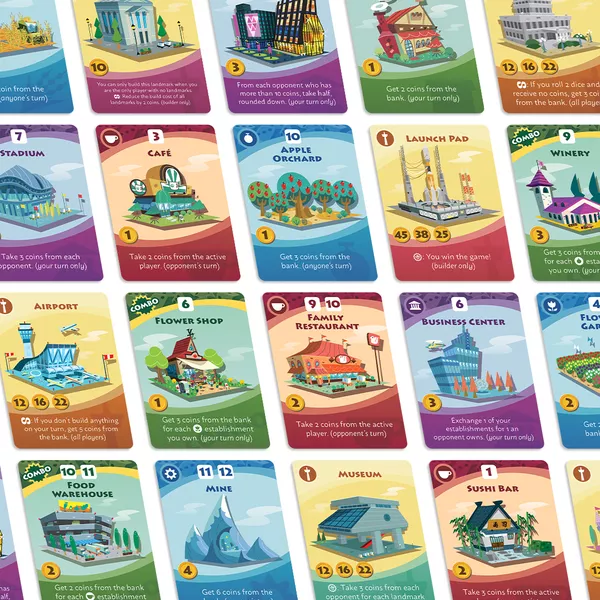
Machi Koro, and its sequel Machi Koro 2, is an engine-building game where players roll dice to gather money from buildings in their village, then use the money to buy more buildings, eventually constructing landmarks to win.
DeSantis’ idea of a beginner’s game is pretty much any party game.
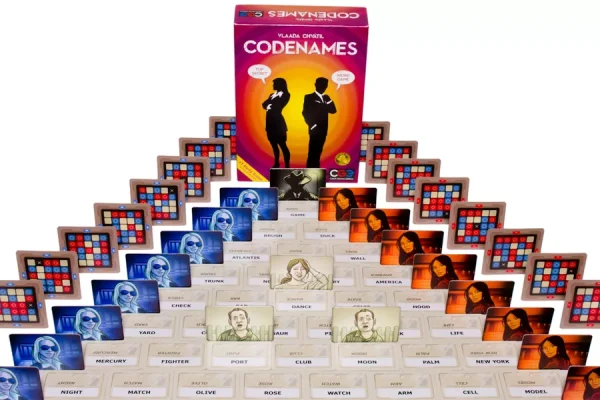
“Other casual games, things like Codenames, [are] really good for [newer players]. I think party games are, in general, a really great entry point for newer players, because [they] give less pressure to any individual,” said DeSantis. “Probably my favorite of this group is Blokus, a game that is a classic. Pretty much everybody knows Blokus, but you could play [it] a lot and still have a good time. There’s a lot of good strategic decision-making in a very simple and compact rule set.”
And once you’ve gotten started with Machi Koro and Blokus, there’s plenty more to move on to. But knowing what to pick can be hard, especially with so many different games out there. A good place to get started is on BoardGameGeek, a popular website among board gamers worldwide.
Their website states that “BoardGameGeek is an online resource and community that aims to be the definitive source for board game and card game content. The site is updated on a real-time basis by its large and still growing user base—more than two million registered users! —making the Geek the largest and most up-to-date place to get gaming information!”
BoardGameGeek is both a forum for board gamers and a catalogue of board games; with a total of roughly 170,000 different games in its database, it’s pretty hard to find a game that’s not listed there. The forums offer a place for anybody with any amount of experience to talk to fellow board gamers, whether to get recommendations or just discuss favorite games.
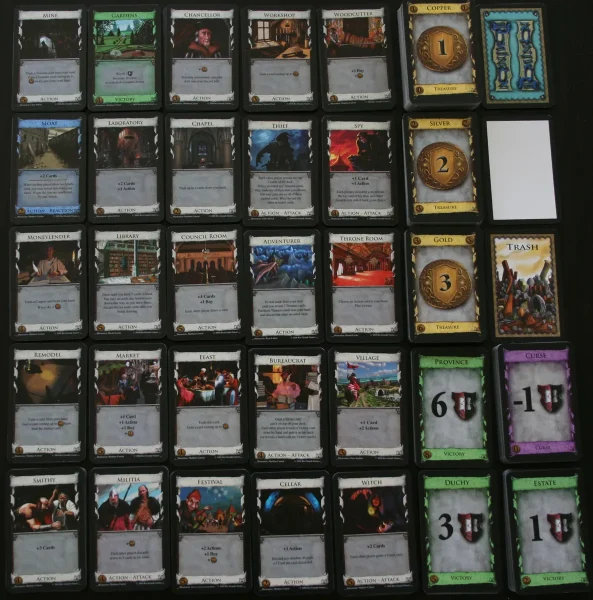
DeSantis has one final recommendation for one of his favorite games: Dominion, a card-based game inspired by collectible card games like Magic: The Gathering.
“Dominion was the first deck building game, [a] combination of genres; there used to be [just] Magic: the Gathering, collectible card games, where you spend a bunch of time collecting cards and then deciding which of the cards to add to your deck. And then there’s the other part where you actually take your deck to a friend’s house or a tournament, and then play the actual game,” DeSantis explained.
These two sides of collectible card games were merged together in Dominion, a game that would become known as a “deck builder.”
“And Dominion said, what if we just combine these two? What if you’re building the deck while playing the game? Fascinating idea. It spawned an entire genre; it was the first deck building game. And now there are [at least] 100 deck builders out there,” said DeSantis.
So, if you like Monopoly but want more, or think that board games are for you, visit boardgamegeek.com or come to USN’s very own Board Games Club. The club meets at 3:30 after school on N days, with games provided by Mr. DeSantis.
“I think that there’s something inherently mathematical about strategic decision making . . . [But] most people don’t play [for the] math,” said DeSantis. “People play games because they’re fun. I still play games because they’re fun.”