In recent weeks, the long-running Jeffery Epstein case has returned to national headlines. This isn’t due to new conviction in addition to his previous charges that included the sex trafficking of minors, but instead as his case and its sensitivity to the current state of transparency under the current administration.
For many Americans, the Epstein case symbolizes the failure, or unwillingness, of the federal government to prosecute a wealthy financier with powerful political connections.
“Money offers one explanation for why people seemed to ignore the obvious. But money, here, is really shorthand for a range of ways to exert influence” journalist Amy Davidson Sorkin said for the New Yorker
Epstein first came under scrutiny in March 2005 with a Palm Beach, Florida police report alleging he engaged in “concerning massages and unlawful sexual activity” as well as ordering “victims to remove their clothing” with females as young as fourteen.
Since then, and up until his suicide on August 10, 2019, Epstein was investigated by various local, state, and federal agencies. The culmination of these findings are located in the elusive “Epstein Files”.
The outcry to release these files has grown since 2018, with Miami Herald reporter Julie K. Brown demanded the release and better treatment of the victims and the case.
“Federal prosecutors quietly shut down an ongoing FBI investigation that had identified dozens of possible victims.” wrote Julie Brown in the Miami Herald.
The exposure of the investigation’s alleged mishandling and the concessions made to Epstein further increased widespread demand for the Epstein Files’ release
Many Americans remain skeptical that genuinely unedited and usable Epstein files will ever be released.
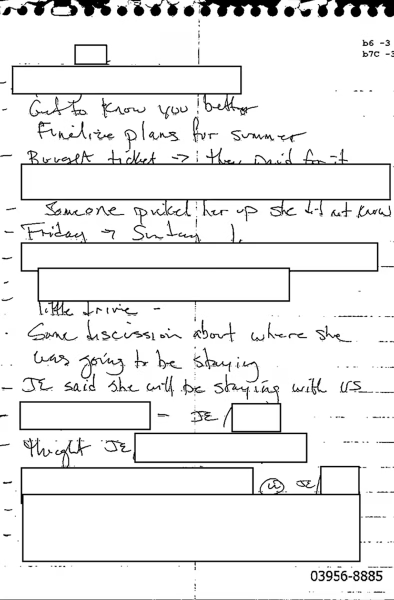
Previous releases from the federal government saw portions of pages of information completely redacted.
The challenge in releasing all of the documents relates back to the complexity of the case.
Various agencies, prosecutors, and departments have all worked on the case, each with their own disclosure rules. This means that the final release will take time and cooperation for it to come to fruition.
But it isn’t just a bureaucratic issue; it’s an issue of trust. The release of the Epstein Files compels many Americans to question how much trust we place in the government. Many Americans feel lied to and misled by the former releases of data regarding not just Epstein but also major news events.
Releases, or lack there of, on CIA “Black Sites” in 2005, the Flint Water Crisis in 2014, and information on the War on Terror all lead to a lack of trust among many Americans.
Supporters of the release argue that any information regarding Epstein is better than none. In a poll conducted by PBS, roughly 75% of Americans would like a full release of the files, while another 13% would want just “some” released.
It’s a bipartisan issue that should unite the government.
However, there have been cases in which former devout party members have been ostracized from their party due to their stance on Epstein.
Marjorie Taylor Greene, a former MAGA and Trump supporter, had a political fallout with the President in November after demanding a full release of the Epstein files, something President Trump did not endorse.
Jess Michaels, a victim of Epstein, stated in a quote to the Guardian, “I have family members, and I have friends, that are conservatives, and they equally believe this needs to just happen,” Michaels said. “The files need to be released to get to any clarity.”
However, not everybody believes that the files should be released.
A federal judge, in response to a push to release files related to Epstein associate Ghislaine Maxwell, stated “The materials do not identify any person other than Epstein and Maxwell as having had sexual contact with a minor. They do not discuss or identify any clients of Epstein’s or Maxwell’s. They do not reveal any heretofore unknown means or methods of Epstein’s or Maxwell’s crimes” and that it was more of a “diversion” than about disclosure.
Many critics of the release believe that the information would not reveal anything not already known by the public.
They also argue in favor of the privacy of the victims and witnesses, believing any further releases would place them in jeopardy.
Still, the debate over the Epstein Files has grown into something larger than a single criminal case. It reflects a question asked by many Americans: How transparent should the government be when the public’s trust is already strained?
USN students had a wide variety of answers and perspectives, but one theme remained constant: transparency.
“I think that government transparency is very important in order to try and salvage the trust of citizens,” Henry Baxter ‘27 said.
Another student stressed that transparency matters not only for trust but for holding leaders accountable.
I think they should be very transparent with us, because that’s really important. And if the government was involved with that stuff, like Trump and stuff, he should not be our president, and we should know that” and that “we need to know what we’re voting for, and we need to know who’s in control of our government,” said Kyryl Shcherbiak ‘29.
Students also reflected on what transparency means for the American political system as a whole, not just for individuals.
“Democracy depends on transparency, and to have this group of people that you’re asking to trust you, I think transparency is really important,” said Mei Tyson ‘26.
For now, the public is left waiting for an answer and are hopeful for a future release of more information surrounding Epstein.
The depth and length of the release, if it happens, will hopefully signal how seriously the government views transparency during a time in which Americans increasingly demand it and see it as a key issue during the 2026 midterm elections.