by Margot Ross ’24
March 4, 2024
Do artworks produced by AI deserve copyright protection? When, if ever, is it permissible to deceive someone for their own good? Are true crime shows inherently morally suspect?
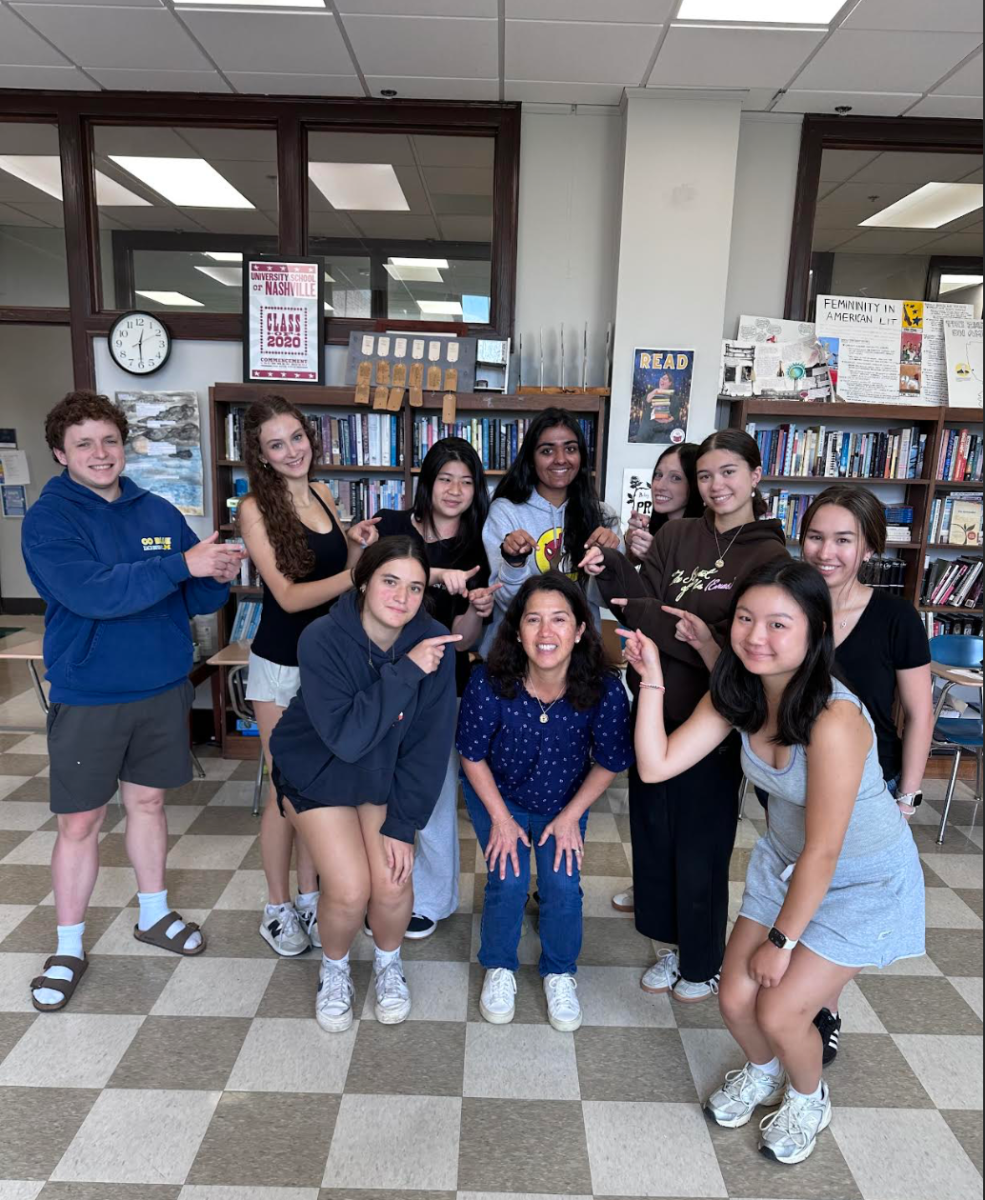
On Saturday, February 3, USN sent a team to the Tennessee High School Ethics Bowl competition at The Webb School in Knoxville. The team’s mission: to present comprehensive, nuanced stances on such questions while fielding alternate propositions from opposing teams.
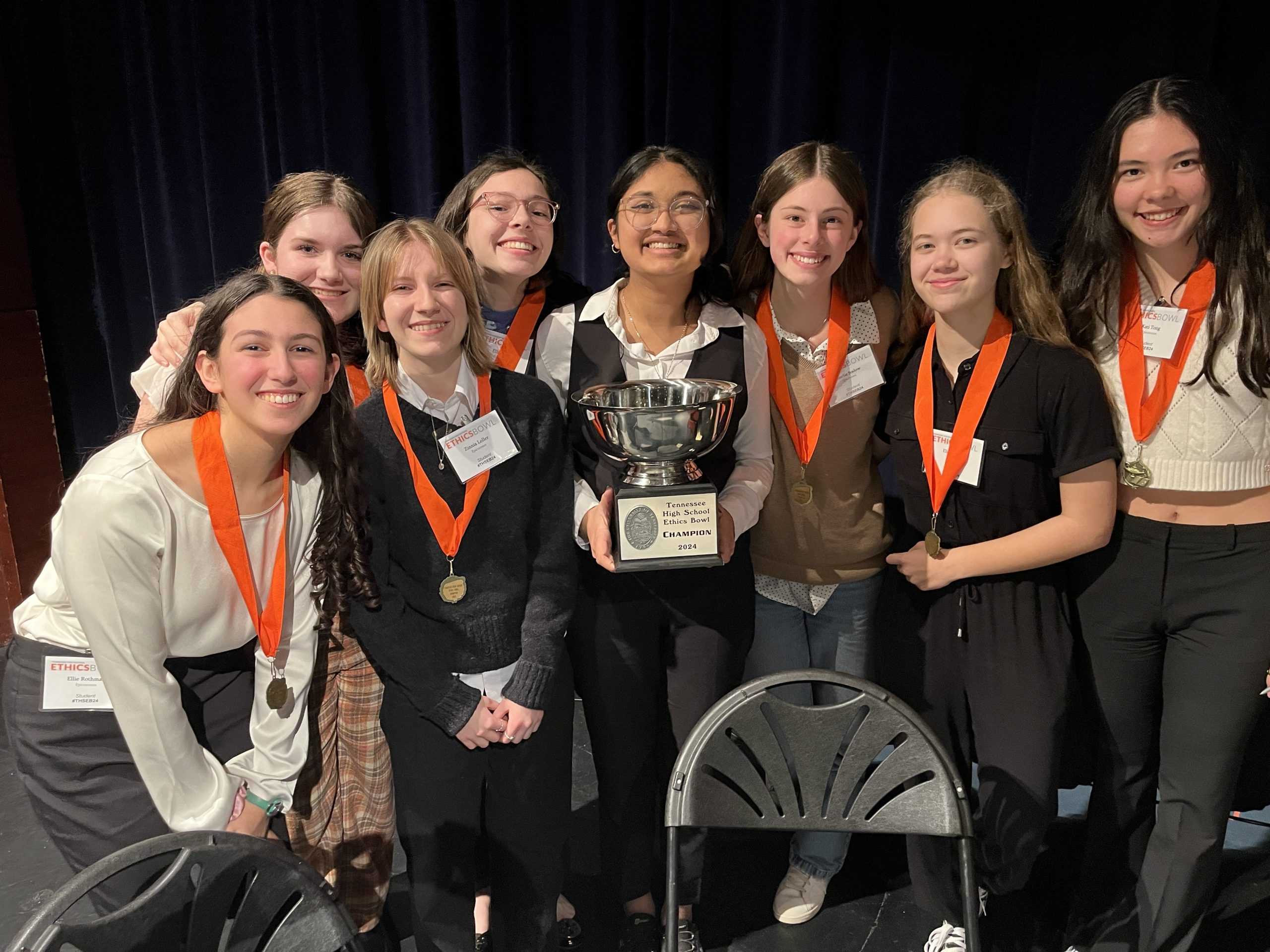
Though this year only marked the second time a USN team competed in the Tennessee Ethics Bowl competition, the group—dubbed the “Epicureans”—went undefeated and won the championship. The team earned 17 out of 20 of the judge’s ballots.
Their win qualified them for the Southeastern Divisional playoffs, held virtually on Wednesday February 7. Once again, the team went undefeated, ultimately qualifying for the National Championship.
The team is entirely composed of members of the class of 2025, with Caroline Keiper, Zinnia Nichols-Loller, Ellie Rothman, Ellie Klein, Eliza Nichols, Amelie Soslow, Jaya Gupta, and Kati Tong competing.
The team was founded last year by Nichols-Loller, who read about the Ethics Bowl competition shortly after developing a budding interest in philosophy.
“I read this article in The New York Times, [during] freshman year about the Ethics Bowl competition and what it was…I really had gone through a phase, after watching “The Good Place,” of diving into ethics and moral philosophy,” Nichols-Loller said. “I was like, ‘This is something that I could actually do in community with other people, and I can make it happen in a place where I already have a community, and it’d be really fun.’ So I decided to start the club.”
In order to start the team, Nichols-Loller had to first find a faculty advisor willing to assist her. Nichols-Loller reached out to Dr. Jeff Edmonds, the assistant head of high school for academics. Though Edmonds earned a PhD in philosophy from Vanderbilt, it was clear that he did very little to guide the team with respect to the construction of their arguments. Instead, Edmonds helped the team by coordinating logistics around the tournament.

“I love philosophy. At first I was nervous about being a coach. I was like, ‘I can be a sponsor, and I can help liaison…but this is your thing.’ And I think that ethos has continued, you know, mostly because I’m really busy, but also because [the team] know how to carry it,” Edmonds said.
Edmonds expressed that one of his favorite parts about the Ethics Bowl team was that student-driven ethos.
“This is truly a student run organization from A to Z. I spent very little time on Ethics Bowl. It’s just amazing what they’ve done really, without much of a coach,” Edmonds said.
After securing Edmonds as an advisor, Nichols-Loller recruited a few of her friends to compete. Though the team did not advance past the state competition last year, Nichols-Loller expressed that it was helpful to learn from her first time competing. Some lessons had to do with the way the team constructed their arguments.
“I think last year, there was definitely a learning curve. We lost our first two rounds last year, but then we won all of our remaining ones,” Keiper said.
Klein elaborated.
“Last year, our arguments were very solid and unchanging, and that’s something that I think was important to learn—that [arguments] need to kind of adapt and shift. You can’t just stay and argue the same thing because then you can get backed into a corner, and that just does not look good for you,” Klein said.
Other lessons had to do with the presentation of the team’s arguments during rounds.
“Something that we didn’t realize that is actually instrumental to Ethics Bowl is saying ‘thank you.’ Whenever you start your presentation, you’re supposed to start and be like, ‘Thank you, everyone, for being here, and University of Tennessee Knoxville for sponsoring,’” Nichols-Loller said.
Klein chimed in.
“When the judges asked questions, it’s, ‘Thank you for such an insightful question, it really helps us delve into our argument.’ And we did not know that,” Klein said.
In this year’s state competition, the team was able to implement those lessons to better connect with judges in accordance with the ethos of the Ethics Bowl competition.
“We were a lot better at interacting with judges—instead of getting defensive, just trying to take their questions in stride and being respectful and trying to [work] with the other team instead of just against them,” Rothman said.
The team’s unique approach to preparing arguments also propelled them to victory in this year’s tournament. In Ethics Bowl competitions, each team is responsible for constructing arguments and questions regarding each “case,” or ethical dilemma, in a packet released at the beginning of the season. Typically, teams prepare so that every member has a high level of knowledge regarding every single case in the packet.
The Epicureans, however, prepared differently. Instead of asking every team member to become highly knowledgeable about every single case, they designated a few resident “experts” for each case. Though their preparation method was unconventional, it yielded competitive advantages.
“We would get a general overview of all of the cases, and then Eliza would divide us up into groups of two or three with the cases, and we would become experts in that case. Specialists would then go on to explain positions and clarify points,” Klein said.
The team’s other source of strength was chemistry—the sense of friendship and trust between the members. Each competitor’s unique approach to reasoning and inquiry blended well to create adaptable arguments and questions.
“Ellie Rothman is really good at memorizing everything, having really concrete points and being able to argue them eloquently. But Ellie Klein…is really good at keeping it chill and being polite and remembering the ‘thank-yous,’” Nichols-Loller said. “Interacting together allows us to decide who is going to participate in [which] case, and make sure that we have the right mix.”
Though academic competitions can induce high-stress situations and emphasize results, the Epicureans went into the State championship with a positive attitude.
“We were not trying to get to Nationals. We had no clue that that was going to happen. That happened because…we were having fun,” Nichols-Loller said.
The team will compete against other groups from across the country at the National Championship on Friday April 12. The competition is hosted by the University of North Carolina Chapel Hill. Though the stakes are higher, the team’s mindset remains the same—their ultimate goal is to have fun.