This year, the leaders of USN’s Sunrise Chapter decided alongside the leaders of ECO Club to join forces as a single club.
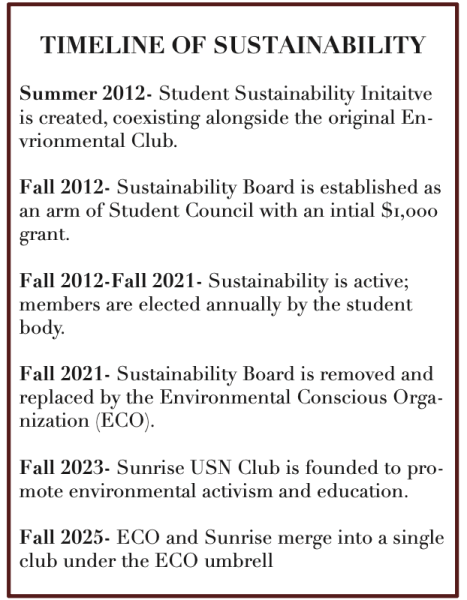
In the recent past, ECO and Sunrise club have been two separate clubs since Sunrise emerged as a new club two years ago. However, in the spring of 2025, ECO and Sunrise began collaborating on ideas and events, eventually leading to the merger in August.
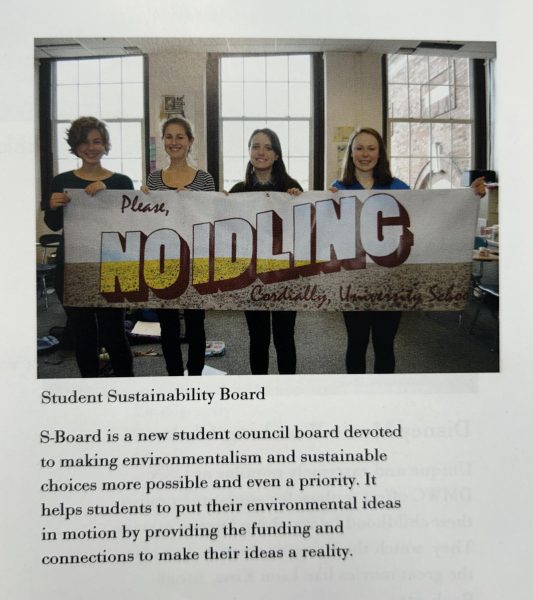
But the history of change in sustainability groups did not begin this year. From 2012 until 2021, the Sustainability Board was one of the main leadership initiatives for keeping up with green projects on campus. The S-Board emerged from a feeling among some student leaders that, since the student body was so large, all students who wanted to get involved and organize projects were unable to share their ideas with others and acquire the funding required. Although the Environmental Club was a longstanding organization, the S-Board founders felt as though representatives needed to be chosen by the student body.
This resulted in the formation of the S-Board in the fall of 2012. Consisting of one freshman, two sophomores, two juniors, and two seniors, S-Board served to oversee and provide funding for projects that aimed to increase sustainability within the school, such as recycling, managing waste from printing, and formal composting programs.
However, while S-Board solved a few problems, it created others. To serve on the board, students had to go through the process of elections: campaigning, giving speeches to classmates, and being voted in by the student body. Some grade’s races were particularly competitive, and others were consistently unopposed.
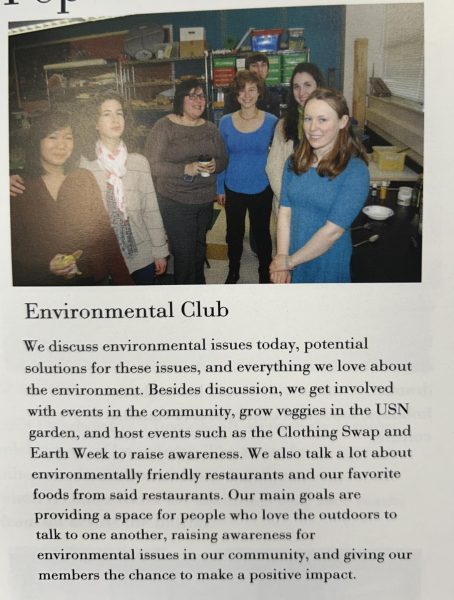
This was one of the primary reasons why S-Board became less preferred by students involved in sustainability. It was removed and replaced by the Environmentally Conscious Organization (ECO) Club in the fall of 2021.
In ECO Club, students could choose how and when they wanted to be involved in sustainability around campus. Additionally, everyone could participate in taking initiatives, rather than only a few students making major decisions and planning events for the whole school.
The Sunrise USN Club was established in the fall of 2023 by Cameron Boros ‘25 in affiliation with the Sunrise Movement of Nashville. This youth-led organization focuses on speaking up regarding the climate crisis and voicing the opinions of students while also participating in organizing student-led protests around Nashville.

However, as time passed, leaders and members made the decision to move away from the larger affiliation to be an independent club at USN. This resulted in merging Sunrise Club with ECO Club because of the abundance of opportunities it promised, such as grade-wide activities and creating spaces for students to enjoy nature. With the two clubs already sharing many common motives and goals, it made the most sense for the leaders to carry out the merger.
Wyatt Block ‘26, one of the leaders of ECO, explained the leaders’ reasoning.
“We perform similar tasks, taking care of the environment. ECO Club is about sustainability, so by merging the clubs, we can better perform conservation efforts,” said Block.
While Sunrise was more political in its orientation, and ECO Club was oriented more towards campus sustainability efforts, both clubs share the same hopes for the future in regards to bringing sustainability awareness to USN.
“I think ECO was more focused on the concrete projects at USN. Sunrise was more focused on environmental activism, education and informing students about what was going on [in the wider world],” Erin Ilagan ‘26, another leader of ECO, said. “So I think by merging them, we kept the best of both because you get to have the Green Roof, but you also have some of us focusing on what can be done to advocate for sustainability.”
From initiatives such as cleaning the Green Roof and maintaining it as a space for students to spend time with friends, to bringing awareness to the issues regarding nature on campus, the merger between the two clubs projects a greater future for sustainability at USN. Members of ECO are also excited for the future of the club and to see how they can bring the community together.
“I just love how we all work together to create a more sustainable USN community. It’s really great that we’re able to add things into the community,” said Agnes McLemore ‘26.
Many students are looking forward to what ECO is planning to initiate within USN. With students supporting initiatives such as composting bins and simultaneously educating peers on ways they can take care of the nature around them, this merger has the potential to bring significantly positive effects to campus.