by Saawan Duvvuri ’26
April 2025
After high school students returned from Spring Break in March, they were met with a new ban on phones during the school day.
In a policy shift announced a few weeks before Spring Break, the USN high school banned all student phone and headphone use until 3:00 PM.
The new rule, designed by a joint faculty-student phone committee and members of the high school administration, bans phone usage during lunch, class, free periods, office hours, and advisory. Teachers can still carry phones and students can still use laptops without much restriction. But the smartphone, a once ubiquitous sight of USN’s hallways, has been consigned to backpacks and lockers.

Suzie Zhao ‘28 expressed shock at the policy’s sudden rollout.
“I was really surprised. I thought USN was not that strict about phones. I used mine an hour a day. [My phone usage] was bad, but I did not expect this ban,” Zhao said.
However, Zhao admits that the phone ban has promoted healthier academic and social habits.
“Academically, it is kind of a blessing. The [phone ban] makes me more focused and is allowing me to lock in more on school. Socially, it prompts me to actually talk to my friends and have conversations with them,” Zhao said.
Connor Harris ‘25 shared similar experiences.
“I think not having my phone is having a positive effect on me socially. I have noticed a lot more convergence between social groups since the [phone policy] was introduced,” Harris said.
Robert McKay, high school English teacher and faculty member of the Phone Committee, agreed.
“In my advisory, my advisees were much more interactive with each other and were engaging in conversation far more than before. I have already seen it have positive effects,” McKay said.
Will Pope ‘26, a member of the phone committee, also discussed the non-academic reasons behind banning phones.
“We talked about allowing students to use their phones during lunch, X block, or afternoon office hours, but we decided that we were banning phones not just for academic reasons, but also for social reasons,” Pope said.
Still, Harris noted academic drawbacks of the new phone ban.
“Sometimes, in classes like engineering, I need my phone to take photos of objects that I build or measure angles and other engineering-related things,” Harris said.
Despite its drawbacks, Zhao believes the ban is fair because “it mostly has a net positive benefit on the school, for example initiating socialization between students, and [the ban] is backed up by lots of scientific research.”

However, like Harris, Zhao recognizes some downside to the phone ban.
“It will make it harder to communicate with family and friends in some ways,” particularly for “communicating with parents for pickups and driving arrangements.” However, she acknowledges that “many students with MacBooks can also use their laptops to message people and get around these issues.”
Zhao also said that may pose difficulties for students.
“For some students, the ban may be hard to get used to because it was implemented in the middle of the school year,” Zhao said.
Connor Harris ‘25 echoed this idea.
“I did not believe it when I first heard it…I thought they would at least implement the policy sometime at the beginning of next year.” He followed this by saying the phone ban’s sudden implementation was “kind of bewildering.”
Yet, for other students, the ban was welcomed.
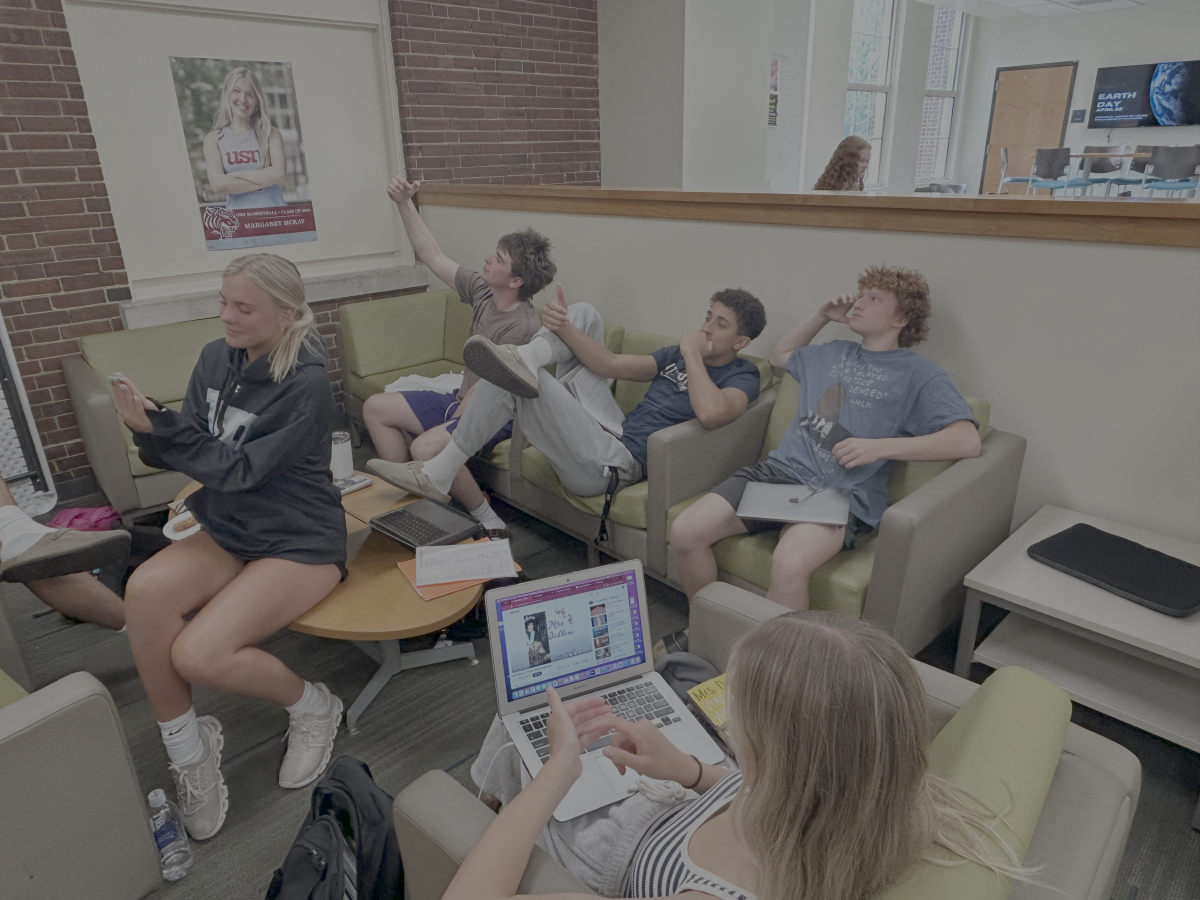
“We all came to an understanding that we think phones should go,” said Will Pope, when discussing student and faculty views during his time on the phone committee. “I feel like phones have hampered social bonds at school. I have always been anti-phones,” Pope said.
Pope joined the committee after being informed of the opportunity by Nicole Jules, Head of the USN High School.
“I wanted to make my voice heard and also because I support the phone ban,” Pope said.
The committee of seven students and seven teachers met every few weeks to review survey results and community feedback, share articles and research on the topic, review policies of schools around the country, and engage in dialogue about phone usage in high school.
“I was really impressed by how much [teachers] listened to students,” Pope said. “[Administrators] really listened to us and heard us out with how the policies would be implemented. They took a lot of student input.”
However, while Pope praised the administration for “actively [making] efforts to reach out to students,” Harris was more critical.
“I would suggest that the administration would have been more vocal about opportunities to be involved with the phone committee. A lot of people were very busy with the start of the year, especially seniors who were very busy with college applications.”
Despite the difficulties in enforcing a mid-year implementation of the ban, many argue that the timing was beneficial. While Zhao said that the mid-year phone ban made it “hard to transition,” Harris found the post-Spring Break launch much more effective, saying that “it was not just introduced over a long weekend.”
McKay rejected the notion that the phone ban was sudden.
“This is not a sudden change. [USN’s faculty] has been talking about this for years,” he said.
“More and more of the evidence is becoming convincing. There have been more and more books and articles that come out over the years that have shown how harmful phones are to teenage brains,” he added.
McKay also spoke on the harms of excessive phone usage on high school students.
“Phones are harmful to teenage brains, and anything we can do to reduce that harm is helpful. Every study that we look at has emphasized that phones are detrimental to learning and to mental health” McKay said.
“If we want to promote a positive sense of mental health, then it is our responsibility to have [students] put their phones away,” he added.
However, enforcement of the policy remains a gray area.
“I think students will hide behind the mezzanines or go to the bathroom,” Pope speculated.
McKay expressed similar thoughts.
“It would be naive of us to assume that students would not try to find ways around it. I think this policy will be consistent in spirit, but it may be hard to enforce in practice,” he said.
McKay also insisted that the new policy reflects institutional trust in students.
“We are showing trust because we believe that students can handle staying off their phones [during the school day],” he said
For many students, including Harris, the process around student voice still leaves questions.
“The most unfair part of the phone ban are the punishments. I think the punishments for not following the phone ban are too harsh,” he said.
Nicole Jules, assistant head of the high school for student affairs, clarified some of the punishments regarding the phone policy.
“The first time you are caught with your phone, you are given a warning. The second time, your teacher can take your phone, and you have to pick it up at the end of the day. The third time you are caught with your phone, we will call your parents,” she said.
What this policy ultimately means for daily life at USN depends on who you ask. And while phones may be gone, the debate around phones, and the policy that governs them, is alive and well.