by Cameron Boros ’25
December 10, 2024
Statistic after statistic says that the economy is doing well. Forbes and other publications cite an increase in GDP and low unemployment numbers, as well as a strong stock market and low inflation on paper as signs of a strong economy.
Yet for many Americans, it is more difficult to purchase basic goods such as groceries and gas, and they may not have seen large enough hikes in their wages to outpace the inflation.
So what’s happening?
The global economy has seen many upsets, including the Covid-19 pandemic that many countries, including the U.S., are still reeling from. During the pandemic the federal reserve, led by Jerome Powell printed money en masse. In December of 2019 there were 44.9 Billion notes in circulation, and by the same time in 2023 that number rose to 54.6 Billion notes. The economy and labor market have seen drastic changes as a result of the pandemic.
Currently, inflation sits at 2.6%, down from 2022’s high of 9.1%. Bill Wilson, USN’s economics teacher and debate coach, commented on the current economic state.
“The inflation rate is now around 2% which is an optimal amount of inflation for an economy. So I don’t think we have a current problem with inflation,” he said.
Wilson also explained what drives the gap between the economy’s performance on paper vs what people actually experience.
“I think the Democrats were in a very tough position,” he added. “We have a very strong economy, especially compared to other countries and areas of the world right now. We have close to full employment and a very low inflation rate. That’s a difficult nuanced message to send to voters because voters have seen through new inflation the price of goods has gone up. Disinflation [the rate of inflation slowing], is good for the economy. But that’s different from prices decreasing.”
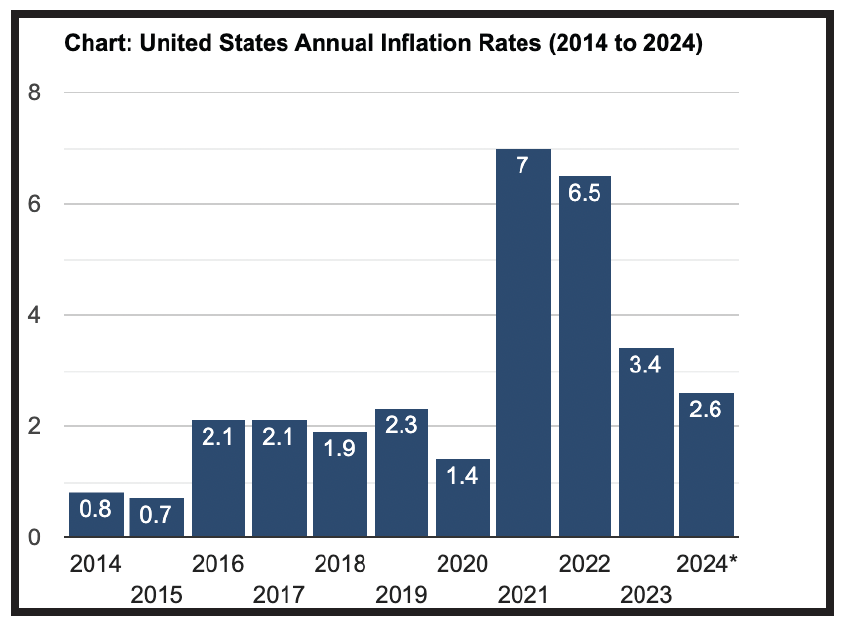
Inflation peaked in 2021 but has fallen steadily since then, currently sitting at 2.6% (via US Inflation Calculator)
Wilson explained that the only way prices could go down would be through a deflationary period and if nominal prices are going down that’s a really bad thing for an economy, that means that companies are making less profit through the same amount of sales, it also means that an individual is more likely to wait to make big purchases because in the future the price will be lower, and that slows down the rate of sales and economic activity. So deflation is a much worse thing for the economy than disinflation, but that’s not what people want to hear when grocery prices are high.
One way to interpret this is that the economy may not be good for consumers as it is, but it is rebounding relatively well from the situation that it was in just a few short years ago.
It is important to note that inflation is not simply an American issue. Economies across the world have been dealing with the effects of inflation for some time. This has led to a trend of democratic countries rejecting incumbent parties in favor of other parties who claim to be able to fix the economy. ABC reported that in 30 different countries, ranging from Senegal to Japan to the UK, incumbent parties have lost elections in 2024. Although the economy is not the only issue people are voting on, it is likely a motivating issue for people wanting a change.
What are tariffs?
President-elect Donald Trump is very fond of tariffs. He has called them ‘the most beautiful word in the english language.’ So it helps to understand what a tariff is. Simply put, a tariff is a tax imposed on the import or export of a product. Contrary to what some might think, foreign countries do not pay the tariffs, American companies pay the tariffs subsequently meaning that American consumers will [typically] pay higher prices. Therefore, tariffs hurt consumers. By making consumers pay more you’re reducing demand for foreign imported products, thus, spurring American manufacturing.
Trump issued many in his first term, including those on washing machines, from foreign companies like LG and Samsung As washing machine prices went up, dryer prices went up as well. This created around 1,800 jobs, as foreign companies opened plants in America, and it generated the US government $82 million annually.
However, American consumers paid an additional $1.5 Billion as a result of the tariffs, meaning Americans paid around $815,000 per job. Many economists are not fond of tariffs as a means of job creation, as they are generally expensive, and may result in net negative jobs. After Trump placed tariffs on steel and aluminum from the EU, Harley Davidson shut down some of its American factories, losing jobs.
Tariffs are more complicated than mere percentages and statistics, they can serve as a bargaining chip, and potentially change the behavior of other countries. Interestingly, the Biden Administration didn’t attempt to remove Trump’s tariffs, in fact, they suggested placing more tariffs. Tariffs are not only about the economy, but foreign policy as well. Tariffs can often provoke retaliatory tariffs, which hurt American exports, as foreign markets react by buying fewer American made goods.
At the time of publication, Trump has moved forward with his policy of placing tariffs on some of America’s largest trading partners. He has said that he will place a 25% tariff on Canada and Mexico, as well as an additional 10% levy on goods from China. In 2022, America imported $428 Billion of goods from Canada, of which cars and petroleum constitute the largest share of imports, $493 Billion from Mexico, of which vehicles, vehicle parts and electronics are the most frequent imports. We also imported $563 Billion from China, from which the US imports textiles, chemicals and plastics, manufacturing parts, machinery and mechanical appliances and a litany of other goods. Some businesses have already begun to prepare for these tariffs, and Walmart’s CFO has already said that the retailer may have to raise some prices as a result.
The thing that makes tariffs so tricky is there is too much unknown about them. We can draw examples from smaller tariffs implemented recently, or past similar tariffs placed many decades ago, but it’s difficult to infer what they could mean for the economy in the long term.
What about deportations?
Wilson says “There are millions of people working in this country that are subject to deportations.There are entire sectors in this country, like construction and building, that rely on undocumented labor. [Deportations] are terrifying and bad for all Americans.”
It’s true that undocumented migrants disproportionately represent the workforce. Only around 3.3% of the population is undocumented, yet they make up around 4.8% of the workforce (estimates vary, asthese statistics are from 2022). Notably, 42% of farmworkers were immigrants who held no work authorization, around 1.5 million work in construction, a million in hospitality and nearly a million in professional services were undocumented. It is likely that the large impact to the workforce will likely result in price hikes for goods and services. This goes without mentioning the enormous economic impact of carrying out the deportations, which some estimates place at around $85-315 billion dollars annually.
What can we expect?
As many USN students are moving closer to independence, they are gaining more fiscal freedom, which means increased fiscal responsibility. It is important to know how changes in policy and the state of the economy can affect you. We should expect price hikes on many goods and services as a result of policies implemented by the incoming administration. Additionally, we should probably expect many businesses to continue the practice of price gouging, that is, businesses artificially raising prices and blaming tariffs for price inflation. We have seen price gouging occur in response to inflation as well. Gasoline and cars and car parts are likely to increase in price, so it’s important to invest accordingly.
Wilson suggests that people educate themselves on the issues.
“I think everyone should take a economics course in college,” he said. “It’s a useful high utility set of knowledge for people to have, and if that’s not something you’re interested in read the newspaper everyday and follow what’s happening in politics and the economy and if you don’t understand the terms and concepts in an article.”
This article just skims the surface of the current economy and what will likely happen in the future. However if the content here piques your interest or seems relevant to your life, it’s important to do your own research and come to your own conclusions about the way that the economy and economic policy can affect you.