by Carmen Gaskin ’25
November 2024
On September 6, the small Pennsylvanian liberal arts school, Gettysburg College, experienced a disturbing incident that left students and faculty reeling.
A Black sophomore had become the victim of a hate crime.
A member of the men’s swimming team allegedly etched a racial slur into their chest, an act raising concerns surrounding safety and inclusivity on college campuses.
Maintaining the anonymity of both the victim and the accused, reports detail that the student and the perpetrator were attending an informal gathering hosted by members of the college’s swim team at an on-campus residence hall at the time of the incident.
On September 20, the family of the targeted said in a statement published by The Gettysburgian, the college newspaper, that their son “became the victim of a hate crime” when a teammate held the victim down and used a box cutter to carve a racial Black slur, “the N-word,” across their son’s chest.
The Gettysburg swim team said in a statement that the incident “is not a byproduct of an unhealthy athletic team culture or reflection on the team itself; rather, we see in the captains the measure of what it means to be a Gettysburgian by their notification to their coaches. Racism has no home here—neither at Gettysburg College nor on our team. We stand united in condemning the actions that took place.”
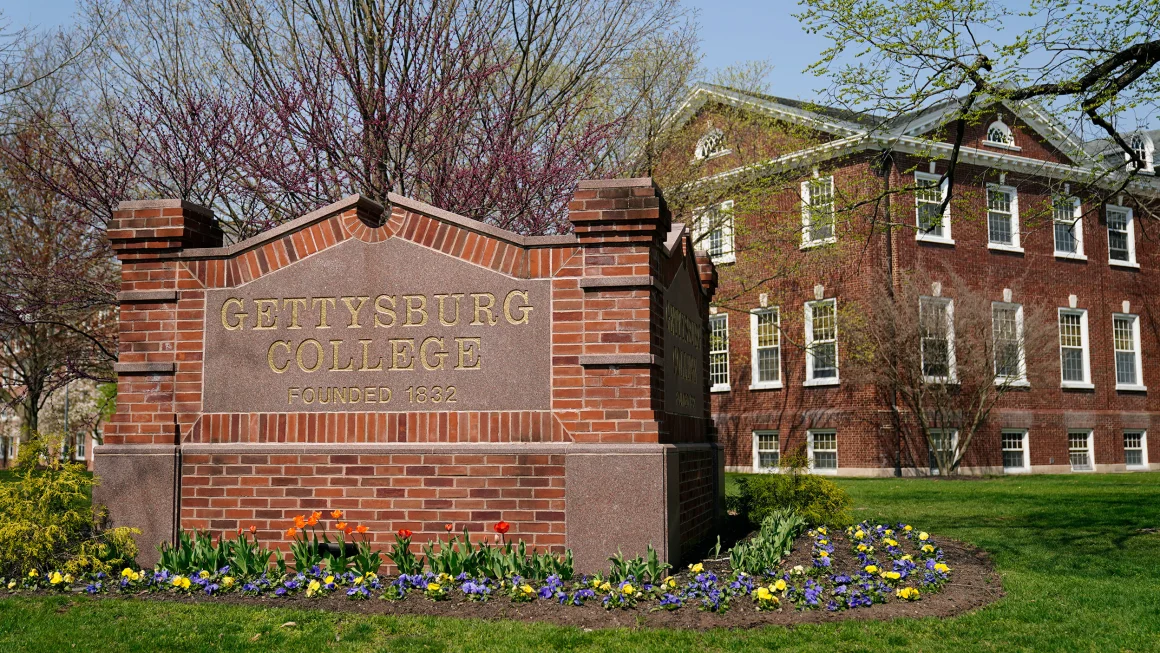
Gettysburg College said it was investigating after it was reported that a student had a racial slur scratched onto his chest during a gathering with other swim team members. (via Matt Rourke/AP)
The parents of the victim voiced that their son was the only person of color at the informal gathering, the victim initially felt safe attending, as the perpetrator of the crime had been a “trusted friend” before the crime was committed.
Their son was later interviewed by the swim team’s coaching staff members, and after a conduct review, both the violator and victim were later dismissed from the team, sparking backlash from D.E.I. educators around the country.
As of November 6, neither of the students are enrolled at Gettysburg College.
“No matter the relationship, and no matter the motivation, there is no place on this campus for words or actions that demean, degrade, or marginalize based on one’s identity and history,” Bob Iuliano, the president of Gettysburg College, addressed.
In an email to students, Iuliano described his feeling of “profound stress,” the crime’s lasting impact on marginalized communities on campus, and its implications on a school “continuing its evolving efforts to create a truly inclusive environment.”
The head of campus safety, Robert Glenny Jr., advised that the college encouraged the victim to contact law enforcement and hire a third-party investigator, although ultimately decided to report to college disciplinary proceedings to handle the crime.
In an additional statement issued by the victim’s family, they stated they are “aware they retain the right to pursue local, state, and federal criminal charges in the matter.” The family filed complaints to the N.A.A.C.P.’s Harrisburg chapter, the N.A.A.C.P. Pennsylvania conference, and the Pennsylvania Human Relations Commission. The family of the victim cited racial discrimination, harassment, and lack of due process during the incident, indicating their commitment to seeking justice and underscoring the severe nature of the crime, although supporting the school’s internal investigation.
“We want to be clear that we understand that an investigation should not be rushed. We support a fair and thorough investigation,” they added. “To this end, we appreciate the standardized procedures and protocols that are in place. We know that they are meant to ensure that the rights and responsibilities of all parties involved are maintained and protected.”
While it remains unclear what disciplinary actions the college will take against the accused student, the school has confirmed they are “no longer enrolled” at the institution.
The victim is among 2,207 full-time undergraduate students enrolled at Gettysburg College this fall. According to the institution’s official website, 62% of students attending from within the United States identify as white, and 21% identify as students of color.
Gettysburg, Pennsylvania is a little town with a Sheetz, a Walmart, and a college with the desire to provide access to education that “recognizes the inherent worth of all individuals and their unique values, ideas, and experiences,” says Dr. Eloísa Gordon Mora, chief diversity officer at Gettysburg College.
Outside of the university, about 7,000 people live there. Approximately 4 percent of that population are Black students.
With colleges and universities beginning a new academic year, we grow to expect contentious debates surrounding programs that promote and protect diversity, equity, and inclusion. While progressives are composed of a 32% racial minority in the United States who double down on access to inclusive education, anti-DEI states such as Pennsylvania, with a 39% conservative-lean population, are beginning to erase D.E.I. courses entirely.
In early March, Republican State Rep. Stephenie Scialabba introduced a Pennsylvania bill prohibiting universities from mandating D.E.I. and Critical Race Theory courses and training at universities across the state, including Gettysburg College.
“These concepts and courses should be offered as electives and should not be forced upon students, especially where the pedagogy is unbalanced with a mandatory course of counterthought,” Scialabba argued.
Meanwhile, students of color–who are the targets of these bills–still have specific needs. In 2024, about 76% of public and private institutions retained their enrolled Black students. This rate of return is known as the “persistence rate,” and it is highest among Asian American and White students (88 and 80 percent, respectively) and lower among Latino, Black, and Native American students, according to federal statistics.
The problem? Students of color don’t feel protected on their college campuses.
Dedicated advocates for anti-DEI legislation have continued to stir chaos and a lack of clarity among collegiate students. As a result, educational settings rise as everyday environments for hate crimes to be committed, identical to the incident at Gettysburg College.
Meanwhile, reported offenses at institutions based on anti-Black bias have skyrocketed, with 1,690 hate crime cases reported since 2019.
It’s an alarming picture but an incomplete one.
Although universities remain dedicated to maintaining diversity, equity, and inclusion protocols on campus, attacks on D.E.I. halt their efforts toward success.
Where have we found success? Some policymakers have advocated for the Clery Act.
Originally named after Lehigh University student Jeanne Clery, who was murdered in her dorm in 1986, the Clery Act is designed to make all institutions more transparent regarding instances of crime and hold them accountable for the safety of their students on campus.
Calls for implementing the Clery Act alone underscore the continuing need to ensure that colleges collect and share accurate and up-to-date hate crime data, actively engage in positive racial climates, address systemic issues, and establish support structures for ethnic minorities, ensuring success for all students, regardless of racial background.
As defenders of diversity, whether on the playing field or within the classroom, fostering a sense of belonging among students of diverse backgrounds is a mandatory precondition for educational success.
“Inclusion and diversity help our programs have depth,” says Josh Scouten, athletic director and boys’ lacrosse coach.
“You can be a positive force for the things that you do believe in, when setting a culture that empowers student athletes to be able to be somebody who stands up when something is out of place,” he added.
Although requiring heavy lifting, educational institutions must work with students to construct a community where every identity is affirmed.
Inclusivity does not ignore identity. It provides an academic framework in which difference serves as a starting point for dialogue and intellectual curiosity rather than the basis of separation and fragmentation.