by Bronson Schmidt ’25
November 2024
Beneath the intricate structures of the USN student’s underdeveloped neural network lurks an ever-hungry presence. It waits patiently beneath the surface of every social interaction, every joke, every thought. This wretched, omnipresent thing seeps into the crevices of our very minds, stirring, looming, morphing, feeding… this “thing”, this horror, this parasite– is Brain Rot.
Brain Rot is a phenomenon that has loomed in the halls of USN for a little over two years now. As it permeates into the brains of students, it too seeps into the culture of our school, affixing itself as an unavoidable hallmark of our current generation.
The term “Brain Rot” itself has metamorphosed, with no single definition held as standard; the idea of Brain Rot presents itself differently to each beholder, embodying a sort of dialectic state between clarity and formlessness. However, certain experts in contemporary cultural literacy may provide a good starting place when it comes to defining this strange phenomenon.
One of these experts, Dr. Michael Hansen, has his own idea of what the phrase “Brain Rot” really refers to.
“[Brain Rot] is like detritus shed from the minds of a pulsating mass of unnamed people online,” says Hansen. “Out of that detritus, little nuggets are picked up and some piece of that detritus becomes a gem that is then projected out to the world. […] It becomes a flexible piece of information.”
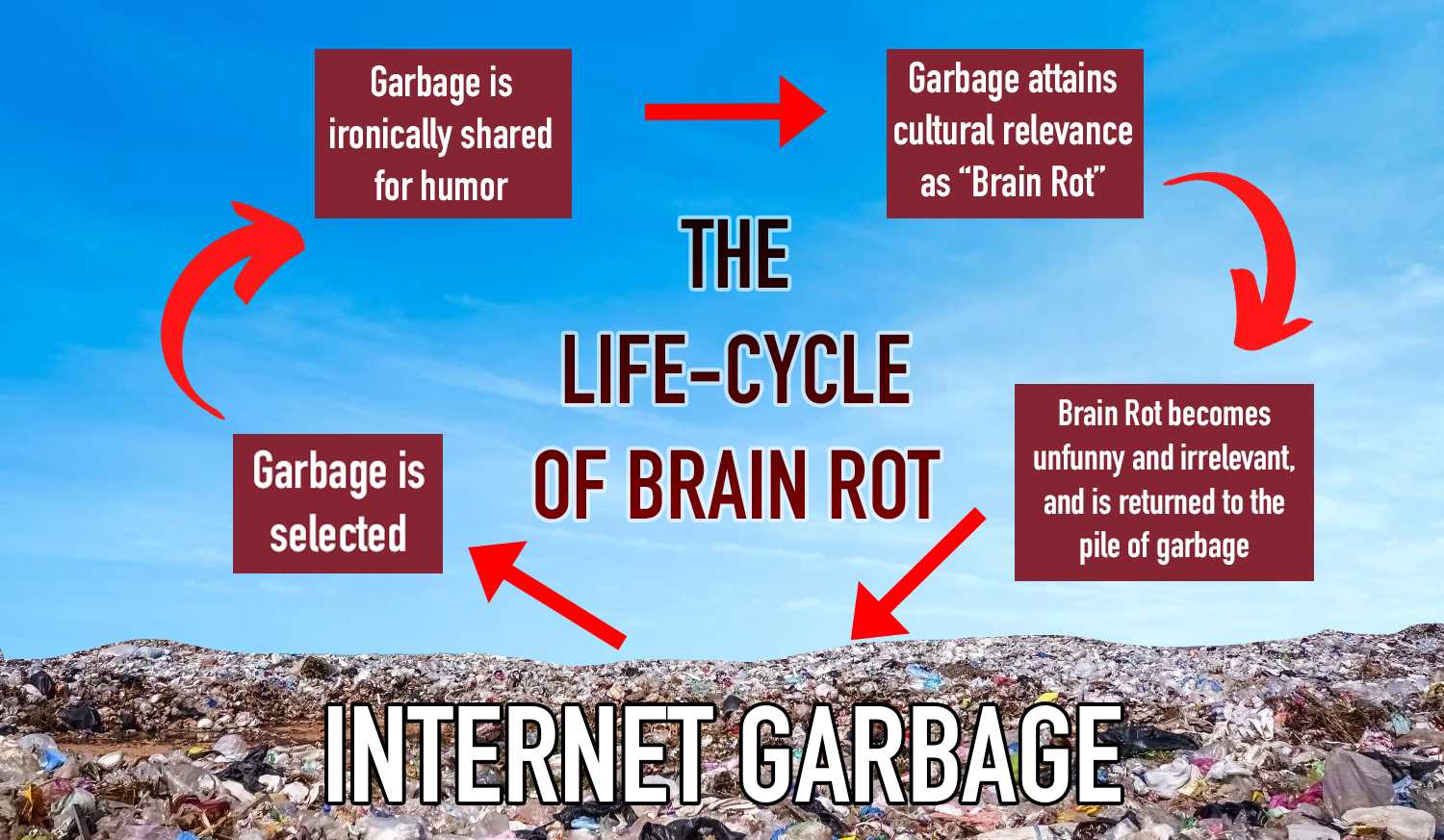
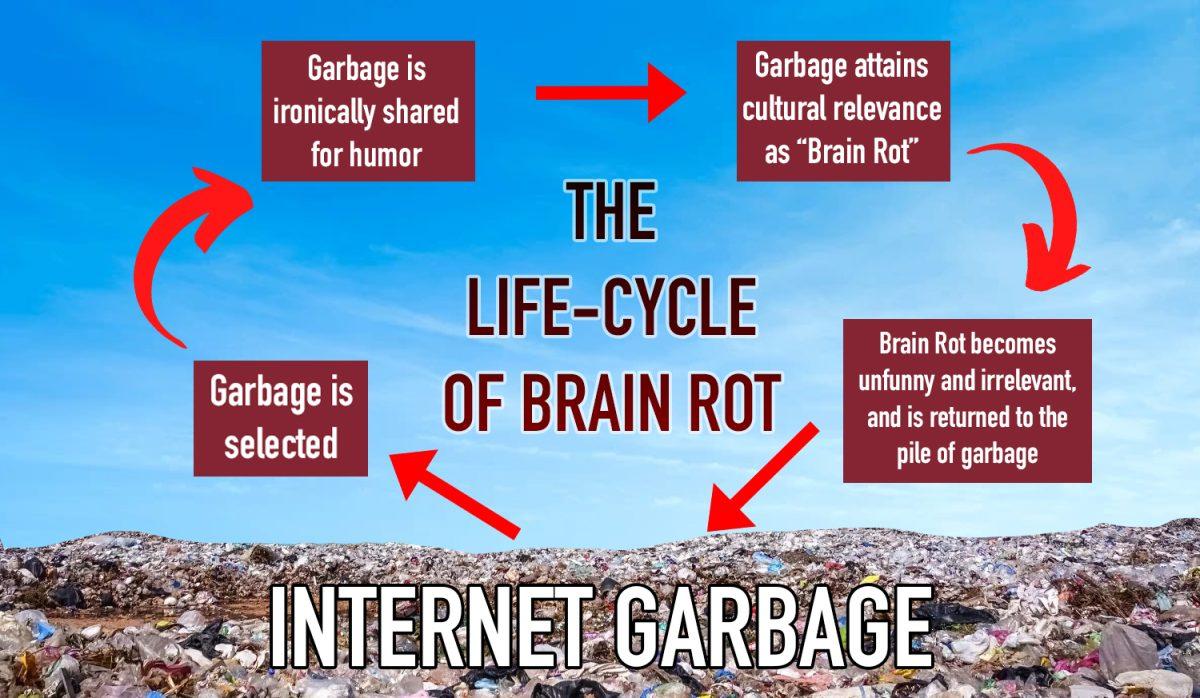
Hansen’s words paint a picture of a sort of life cycle of Brain Rot. The cycle starts with the constant creation of internet-stuff that is dumped into the incomprehensibly large landfill of discarded, niche internet content– think of old twitter posts, abandoned websites, etc. Out of this desert, a lone internet traveler discovers a piece of garbage that they find interesting. The traveler then duplicates this garbage and shares it with other internet dwellers, who then in turn share it with even more internet dwellers, and so on.
With astonishing speed, the selected piece of garbage has become a temporary fixture of internet culture; by nature of its popularity, the piece of internet garbage has transcended into something more. But this does not last; as fast as the garbage rises, the internet masses collectively decide to throw the once-coveted garbage back into the land-fill of irrelevant content. Once again, the collective mass of the internet hungers for a new piece of garbage to idolize. Thus, the cycle repeats itself.
But the mechanisms of internet culture are not merely confined to the internet; with the omnipresent force of social media, internet culture is inevitably reflected in real world culture. Hansen views this as a fascinating surprise.
“The weird thing about Brain Rot is that you just assume that it is garbage, but actually what it is is something that has been lifted out of the garbage and activated in language again,” said Hansen.
This is what Brain Rot is; a class of internet garbage that experiences a temporary transcendence into language and culture at the hands of the internet’s masses. However, just because a piece of garbage can transcend into a gem, doesn’t mean that gem is beautiful.
Wright Bergesen ‘25 agrees.
“[Brain Rot is] short form content that uses buzzwords and sort of trendy things in a way that is not at all meaningful or is just stupid,” said Bergesen.
If the creation of Brain Rot is so complex, yet produces only stupid and meaningless trends, then one might question how and why this strange cycle ever came to existence, and what it means for USN students and beyond. In order to understand the answers to these questions, it is imperative to reflect on pertinent examples of Brain Rot. One early example of this was the so-called “lobotomy trend.”
“Lobotomies were short form videos [that were] a series of images and sounds that did not have any correlation to each other and didn’t really make sense, but it was humorous because of how strange it was,” said Bergesen.
This theme of absurdist, strange imagery created a strong backbone for most modern day Brain Rot. Most notably, Skibidi Toilet.
“Skibidi Toilet is an animated series on YouTube, [that] involves Garry’s mod characters or half life characters sticking their heads out of toilets,” said Bergesen.
For context, “Garry’s Mod” is a sand-box video game published by Valve Software in 2006, with a focus on absurdity and no real objectives. Half Life is a 1998 first person shooter published by the same company.
Skibidi Toilet has created quite a reputation for itself due to its strangely endearing simple animation and unignorable music with the following lyrics over an electronic loop:
“Skibidi dop dop dop yes yes, Skibidi taupled dip deip, Skibidi dop dop dop yes yes, Skibidi taupled dip deip! We’re here to hurt nobody! (Skibidi skibidi skibidi skibidi) We want to see you move your body! (Skibidi skibidi skibidi skibidi)”
Despite its looks, and its sounds, Skibidi Toilet hosts an intricate and nuanced plot that spans 180 Youtube videos. However, many find it distasteful.
“I really don’t like those Skibidi Toilets. I just don’t get what’s funny. But maybe what’s funny is that it’s not funny and people insist on talking about it anyway. I don’t know,” said Hansen.
Hansen touches on an important point– Brain Rot is consumed not because it is inherently funny, but because there is a sort of irony in pretending that it’s funny. This idea of pretending to assert meaning to something when no meaning is actually intended is exemplified with the reception of Skibidi Toilet, but also in how Brain Rot has affected colloquial language.
For example, take the term “Skibidi Rizz”.
“‘Rizz’ was derived from [the word] ‘charisma,’ meaning how well you’re able to attract someone, usually romantically. Combining those two terms together means absolutely nothing, which is why I think it’s categorized as Brain Rot,” said Bergesen.
This example further clarifies that Brain Rot exists primarily in the realm of language. An online Brain Rot trend cannot continue to live outside of the internet unless it is resuscitated through the constant use of real spoken language. The Brain Rot trends that have survived the longest aare the ones which are easily and consistently used in everyday language, such as Rizz. Even a word like “Skibidi”, which started out inherently meaningless, has become a humorous adjective who’s definition constantly shifts. Skibidi gained meaning through its continued use in language, which started out as an ironic joke, but has developed into something more.
Hansen has found there is a sort of solace in the stupidity of such Brain Rot trends in how they positively affect language.
“As a parent I immediately think ‘this is awful that my kids are being exposed to such stupidity, right?’ But on the other hand, there’s a whole culture around Skibidi Toilet, and people have changed the way they talk to each other using shorthand from that series of really, really stupid videos. So the videos themselves are not brilliant, but I think the use of some of that Rot is almost poetic at times,” said Hansen.
Outside of his role as a parent, Hansen has witnessed Brain Rot language being used casually in class as well. But students do not solely use Brain Rot language in class; it has become ingrained into every aspect of social speech.
The constant use of Brain Rot in everyday language attributes much to the speed at which Brain Rot develops. Not only does it grow incredibly fast online, but the immediate adoption of Brain Rot terms into younger generations’ vocabulary allows the ideas of Brain Rot to spread far and wide, even to those who have no idea what it refers to but are still willing to use it.
“One thing that surprises me, is that my kids, who I allow only a limited access to this stuff, they hear about it. Even if they don’t hear about it firsthand on YouTube, they start repeating things anyway, because their friends all use this language. […] Talk about speed– […] Within the same week, I will hear things from my kids and the high school kids,” said Hansen.
The speed at which Brain Rot travels leads to an inevitable knowledge gap between those who know about Brain Rot and those who do not. This disparity has represented itself as a divide between younger generations and older generations. For younger generations, social media and their social groups immediately provide them with new language ripe for use, but it could take adults who are not in those circles far longer to understand what they are talking about, if they ever understand at all. In many cases, adults do not even feel a need to try and understand.
Bergesen agrees.
“I think the majority of older people don’t understand what it is, and they view it as just like a trend, because trends have been around for a while, and I think that’s something they can understand. It’s like an online trend. So they probably just think, ‘oh, it’s the newest thing that I don’t really understand,’ and so they kind of write it off. But for the [young] people that do understand it, they probably find it funny, and it probably characterizes Gen Z as a peculiar group of people,” said Bergesen.
Hansen offered another reason that older generations struggle to understand this modern microcosm of culture.
“[In my experience living before the internet, there was never] anything that could spread on the scale that [Brain Rot] does now, especially with the speed. […] There were warders at the gates of culture. There was somebody producing [media] saying that they could or could not proceed into the world. Nobody is doing that anymore,” said Hansen.
Hansen’s point also provides an answer to how the internet has such a vast and accessible digital landfill today. There is no buffer between consumer and content, and there is no buffer between creator and content. Anyone can create digital content at any time, and anyone can consume digital content at any time. This is a process which is extremely foreign to those who grew up in a world of production companies and curated media, a process which still exists but has no connection to Brain Rot. Thus, those in older generations view Brain Rot as foreign, strange, and short lived.
Of course, Brain Rot is enabled by social media platforms that dominate the lives of everyone, especially Gen Z individuals. Many avid social media users feel that they are harmed by consuming Brain Rot, a sentiment which Brain Rot connoisseur Quinn Dehner ‘25 emphasizes.
“I feel [Brain Rot] keeps me glued to a screen with media that I don’t care about,” said Dehner. “You know that feeling when you’ve eaten too much candy at Halloween? You go to bed, you’re full and bloated, but you feel empty, like it was all very hollow. I feel that same sort of sense from Brain Rot. It’s fulfilling while you’re ingesting it, but once you’re done, you’re just left feeling worse.”
However, not all students share this perspective, as Bergesen makes clear.
“I think [Brain Rot is] a good influence for me specifically, because it’s funny to share with my friends, and I don’t take it seriously,” said Bergesen.
In many cases, Brain Rot has further increased people’s use of social media.
“It captures my attention, so I spend more time [on social media] than I want to. I’ll open up Instagram […] and then I’ll find myself scrolling,” said Dehner.
Once again, this perspective is not ubiquitous.
“ I think it might have decreased my social media usage,” said Bergesen.
The affects that Brain Rot has on individuals represent larger trends of Gen Z as a whole. Because social media is the primary conduit of Gen Z social interaction, the affects that Brain Rot has are monumental.
“Brain Rot can be positive as a quick boost to your mood. You feel it down, it’s stupid, it’s funny. It’s like a bad joke. But if you have someone you’re constantly telling you bad jokes, you’re not gonna like that. The ingestion of Brain Rot really just needs to be monitored– I feel like it would in the end have a long term negative effect on you,” said Dehner.
While Generation Z has witnessed the creation of Brain Rot mainly due to their own efforts, the younger generation, Generation Alpha, has begun to grow up with Brain Rot as a cultural fixture. Even before Brain Rot existed as a classification of meta internet humor, Generation Alpha was already experiencing a similar phenomenon of so-called absurdist nonsense in the media they consume.
“I think that YouTube videos for kids […] were kind of brain rot before Brain Rot. It was sort of oversaturated colors and characters from games all being pushed together into weird scenarios, I feel like [Generation Alpha won’t] change much [with the introduction of Brain Rot] because the content that was being fed to kids at the time […] was already pretty bad,” said Bergesen.
While some fear the impacts that internet culture like Brain Rot will have on Generation Alpha as they grow up in an increasingly online world, others find that hope is not lost yet.
“If I think about why [Generation Alpha] thinks that [Brain Rot] is funny, I think they think it’s funny because it’s so stupid. […] Even my eight year old has a completely different reaction to the Simpsons or other things he thinks are comical than what’s funny about brain rot. I think, I’m not sure, but I think he may be more clued into that than [some] think,” said Hansen.
Dehner agrees with Hansen’s hint at a maturity in how Generation Alpha consumes Brain Rot.
“I feel like [Brain Rot] is both holding them back and also forcibly maturing them in a way. My brother is on the older end of Gen alpha, and I can see [him consuming] Gen Z targeted brain rot. […] I feel like he is almost maturing a little bit too quickly through his social media use,” said Dehner.
If Generation Alpha truly does understand the nuance behind the irony of Brain Rot, perhaps Brain Rot has given their mental development a step ahead when it comes to differentiating between irony and sincerity, a skill which is incredibly hard to fine tune.
Regardless of how Brain Rot may affect younger generations in the future, it is clear that Brain Rot is an unstoppable force in the modern ecosystem of Gen Z culture. Be it through everyday language, videos shared with friends, or more, Brain Rot has created a genre of culture that is incredibly unique to this exact moment in time and unparalleled by any other form of media in the past.
Brain Rot is a fascinating microcosm of contemporary culture that is somewhat of a dialectic. It is potentially harmful, through its normalized senselessness and stupidity, but it is also strangely beautiful. The internet is a garbage pile, and yet we find meaning in it. Albert Camus once described absurdism as being “born of this confrontation between the human need [for meaning] & the unreasonable silence of the world.” In a world of war, disease, and an ever present illusion of progress, Generation Z needs their own voice to break that silence.
Perhaps we need to appreciate the freedom and voice that Brain Rot empowers us with– the power to create something from nothing, even if for a fleeting moment.