by Penny Borinstein ’28
September 2024
It is without question that the world of learning has changed drastically due to the technological advances of today.
From computers and calculators, to cloud computing and artificial intelligence, technology is constantly evolving. However, these advances put modern learning in a conflicting spot. Opinions differ on whether or not USN students should have their entire educational careers jammed into a 13-inch laptop, or if traditional methods of learning are more effective.
As the future becomes increasingly digital, a question becomes progressively relevant: In our technology-based world, what will happen to printed textbooks in school?
One major advantage of paper textbooks is that there isn’t the distraction of being on a laptop with access to other websites or apps. Physical textbooks provide a deep dive into visual learning rather than the shallow aspect that online books supply. The physical act of flipping pages, annotating, and interacting with peers in class helps students be more present in the classroom and not get preoccupied with online diversions on a laptop or other device. On the other hand, there are also tools available with some of the online options that may help students use digital texts in a more traditional way.
“If the digital [textbook] gives you the ability to insert some annotations, highlight, circle key words, then I think that can be a powerful tool that also has a lot of convenience. But some of our digital textbooks don’t easily have features that allow annotation and highlighting,” said Debbie Van Slyke, high school learning specialist at USN.
Depending on whom you ask, digital textbooks could be a better option, but not being able to annotate or immerse yourself into the reading is a major drawback. Digital textbooks pose a risk to students using other online sources to cheat or rely on unregulated sources, such as AI, Google, or Wikipedia.
“What I see as the risk of digital text again and again is that it’s easy to search for an answer, so there’s a search bar that will find the answer to an important conceptual question, and students, because they run short of time, will often go search for the answer and miss the broader context,” Van Slyke said.
Paper resources can also help students digest words and comprehend reading much better than online books can. Studies have shown that reading and writing on physical textbooks help students retain information more efficiently and for a longer amount of time. A 2017 study by Lauren M. Singer Trakhman, Patricia A. Alexander & Lisa E. Berkowitz showed the effect of physical vs digital textbooks on high school students. The study had 72 tenth graders in Norway read an expository and narrative text on printed and digital textbooks. The results were that the students who read digitally completed the reading faster, but the participants who read printed had much better performance overall on a comprehension test involving the given texts. The study concluded that reading printed pages helped students retain more important information and scored significantly higher on the assessment, by causing the students to slow down and absorb what they were reading. These same facts apply to students at USN, and they show a major advantage to learning with physical textbooks.
One of the most obvious upsides of digital textbooks is practicality. Textbooks can be heavy and unwieldy to carry around all day, especially for USN high school students trudging up and down multiple flights of stairs.
In years past, it was possible for USN students to go downstairs to the USN bookstore and purchase textbooks in person, or pick up textbooks they had already ordered. Now, students must order the textbooks on usn.ecampus.com and have them shipped to their homes Although it can be quicker and more direct to have them shipped to your home, there have been complaints from USN students about the layout of the book list, saying that it was somewhat out of reach.
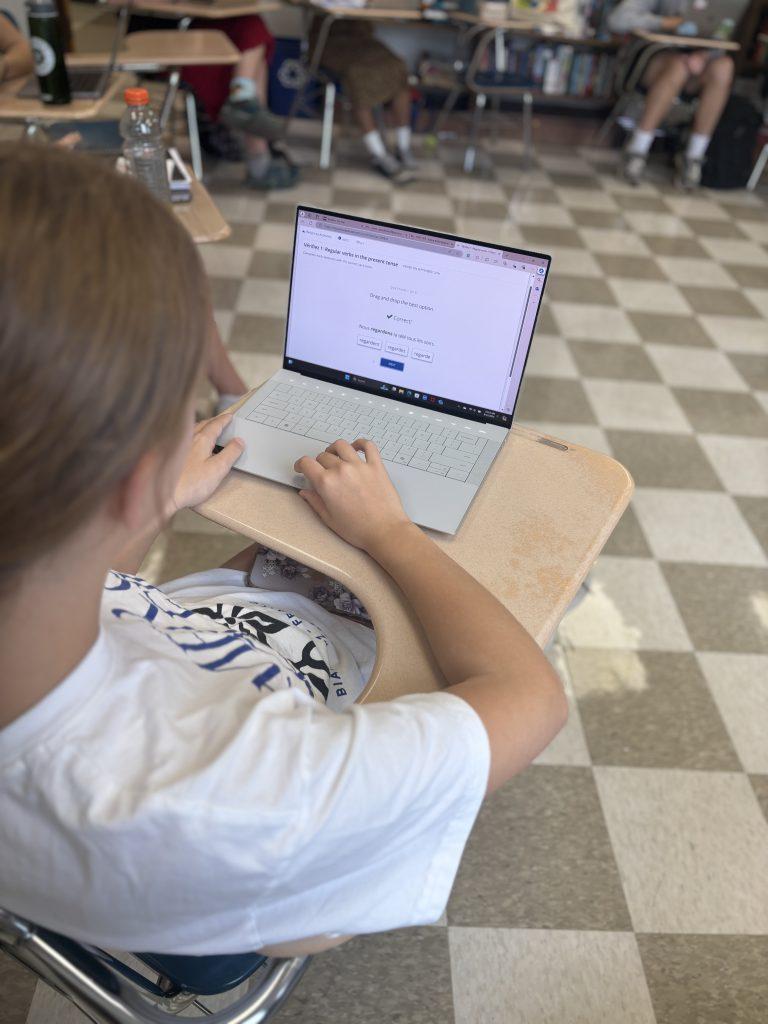
“I really didn’t like how they had you access the book list this year, because to see them you had to go through a whole survey online on what your classes were,” said Greta Molvig ‘28.
Alexandria Manoukian ‘28 said that the list was unclear and hidden when it came to ordering. Because of this, some students said that they didn’t have a textbook, or the right textbook, for a certain class.
“They also just didn’t really tell us where to find the books,” Manoukian said. She adds that learning with paper texts is more effective, but using online textbooks can be helpful for short assignments, as you can have your laptop open and complete an assignment quickly and efficiently.
On the economical side of things, there is so much waste in paper, cardboard, and ink due to the constant reprinting of new editions of school-issued textbooks. Wisconsin Department of Health Services states, on estimate, 320 million textbooks are thrown away instead of recycled each year. This has a tremendous climate impact, as the production of an average paperback book emits around 2.7 kilograms of CO₂ into the atmosphere. To put this in perspective, you produce the same amount of CO₂ by making 43.2 cups of tea. If you think about the size of some of the textbooks students use at USN, it puts in perspective the impact on the environment.
Grace Ann Lukach ‘03, the USN Spirit Store manager, says that it’s hard to keep up with the constant making of new editions of textbooks.
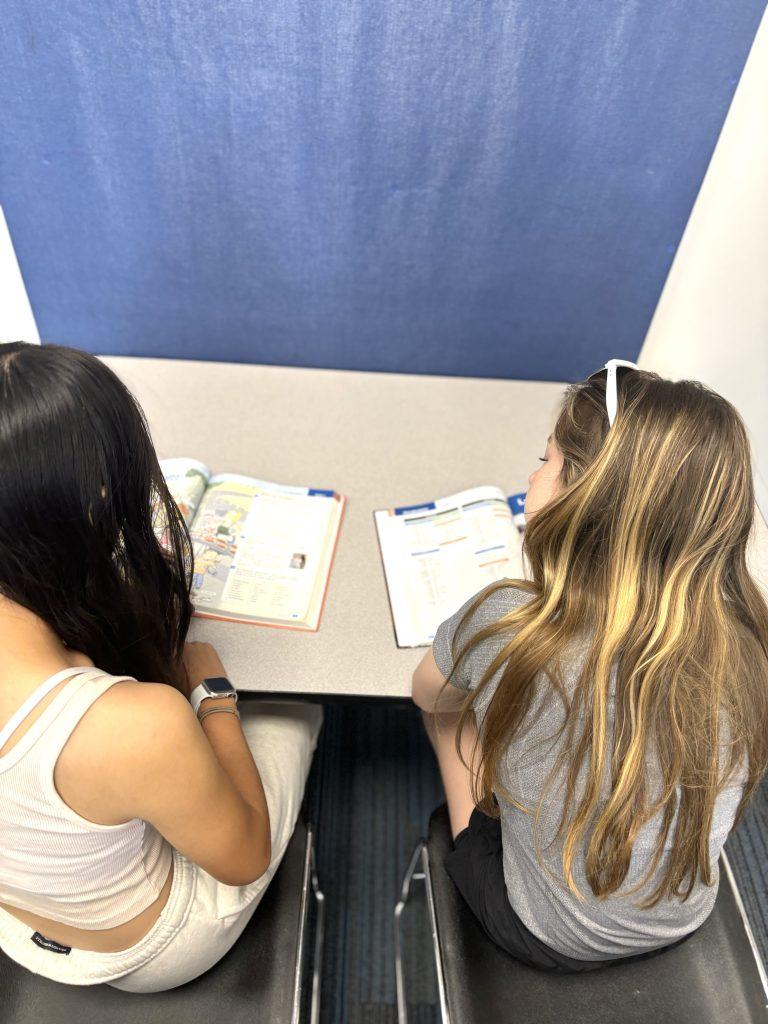
“All of a sudden [publishers are] doing a new textbook or a new edition. And so all of those old textbooks would have to be completely obsolete. What do you do with all those textbooks? And sometimes information [in the textbooks] hasn’t changed, and that just seems like a waste,” she notes.
Most USN high school students spent hundreds of dollars on textbooks this year. Switching to fully digital textbooks could have a major impact on how much money high school families spend, the amount of CO₂ released into the atmosphere, and the amount of paper and cardboard wasted.
However, we still don’t know if the pros of online learning outweigh the comprehension and focus that paper texts are scientifically proven to provide. Both options have their ups and downs. Whether or not the future is truly computerized is something only time will tell.