by Margot Ross ’24
October 31, 2023
Though USN isn’t typically regardes as an athletic powerhouse relative to its football-centric peer institutions, participation in sports and physical education is still arguably ubiquitous (85% of middle and high school students play a sport)—and required to graduate. This year, a few students were chosen to advocate on behalf of all USN student-athletes: they are the members of the Student Athlete Advisory Committee (or SAAC, for short).
Though organizations with similar missions have come and gone from USN over the years, none have worked in a capacity as official as SAAC’s. The group—a committee of sophomores, juniors, and seniors chosen by coaches on the basis of demonstrated leadership—was created by High School Counselor Latricia Watkins and Athletic Director Josh Scouten.
Watkins managed similar programs at her previous school, Riverdale High. In creating SAAC, Watkins was both searching for ways to deepen her involvement at USN and seizing an opportunity to use her own experiences as a student-athlete to help others.
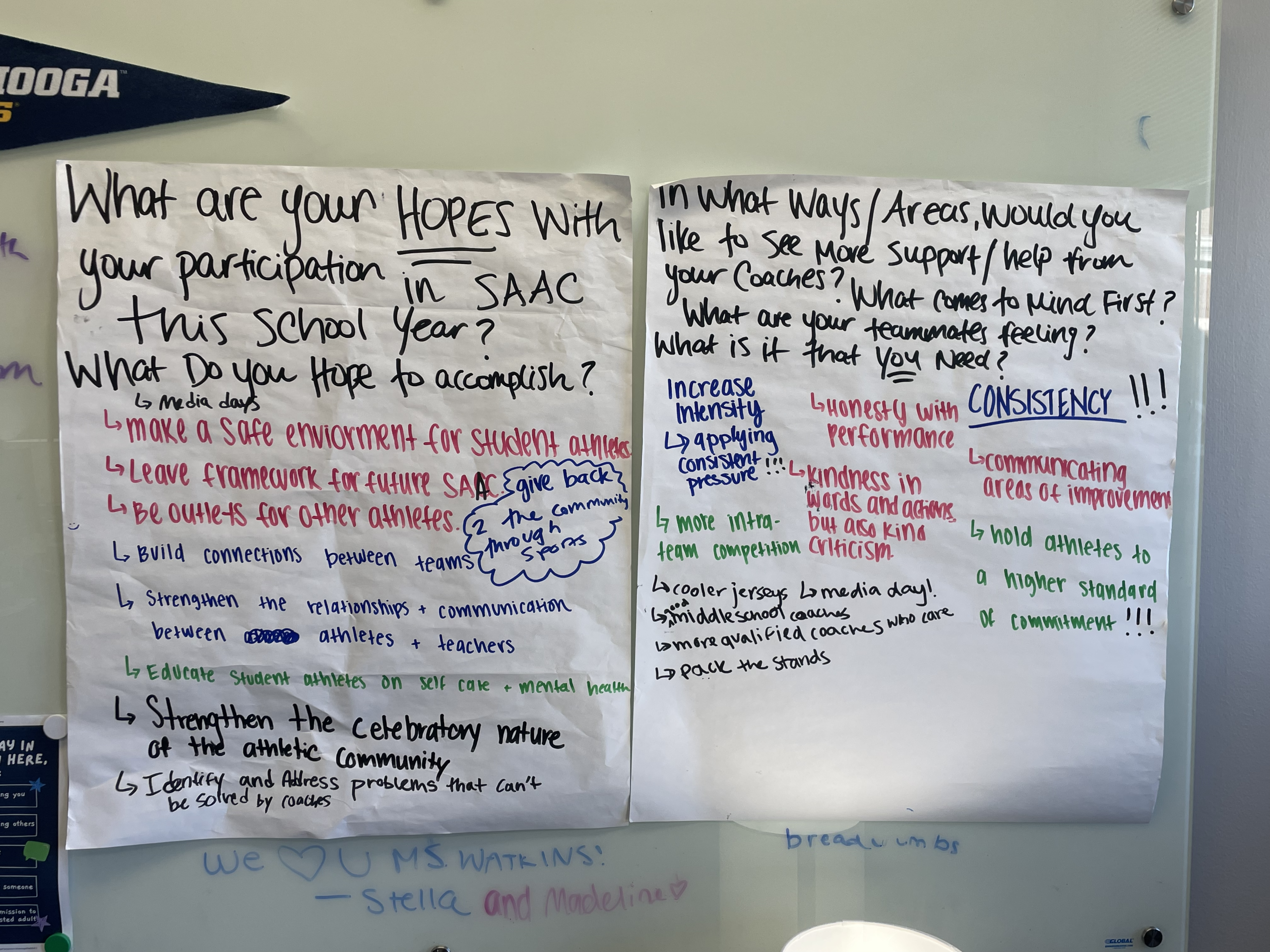
SAAC works to assist students through multiple avenues. On one level, it serves as a space where student-athletes can get help managing their own teams. In meetings, which occur twice a month, athletes have the opportunity to both voice concerns about their own teams and get feedback about their own styles of leadership.
“[Athletes] get an opportunity to reflect on their leadership skills and reflect on [themselves] as individual student athletes. We want to help them be able to reflect on their strengths and areas that they want to continue to grow in, as they’re also in a position [of] advocating for other athletes,” Watkins said.
Members of SAAC also have the opportunity to express personal vulnerabilities about certain stressors that they might be dealing with as student-athletes, such as managing injuries, frequently traveling to games, and trying to balance their athletic commitment with USN’s academic workload or other extracurriculars.
“We also understand that [athletes] are growing daily as well…we want to support them and provide a safe space for them to be vulnerable with each other and talk about the highs and lows that they’re experiencing,” Watkins said.
Finally, SAAC members work to deepen their engagement with the broader USN community. On Wednesday, October 18, the group organized a talk by sports psychologist David Sacks on the mindset of athletes. The group also plans to take on a service-oriented project by providing tutoring and lessons in literacy to students at partner public schools.
Watkins hopes that through this service component, athletes will inspire their mentees to continue their athletic endeavors as they get older.
At the SAAC meeting on September 28, the concerns expressed by athletes were broad in scope, and typically had more to do with logistics or funding than social or emotional dynamics. One athlete expressed discontent that their team’s senior banners were only hung up for their final game of the season; another asked about how their team would meet certain academic standards required to play if quarter grades weren’t being formally released by USN.
Some concerns, however, did focus on team dynamics—one athlete inquired about how to manage team morale when injuries frequently occurred on her team.
Throughout this portion of the meeting, Watkins primarily worked to facilitate dialogue between athletes as pieces of advice were exchanged, occasionally chiming in to offer a helpful comment. It seemed fitting that athletes chosen for their teamwork on the field would work together to solve off-the-field issues, too.
Olivia Hess ‘24, a three-sport athlete on SAAC, hopes to increase practice attendance while serving on the committee.
“USN is obviously known for being very inclusive of everyone, which is great. But when it comes to sports, I think that is not always great in terms of like, having people saying, ‘Oh, it’s okay if I don’t come to practice today,’” Hess said. “Part of being committed to your team is showing up to practice…[that’s] something that [we] can work on as a whole.”
Some other athletes expressed concerns similar to Hess’: those that suggest that changes in the culture around athletics might need to come from students-athletes as opposed to administrators.
“The second it comes to something that doesn’t supposedly enhance your knowledge, it seems like we flip a switch,” said Binyam Dunne ‘27, who competes in track and field as well as cross country. “I feel like it’s viewed that [those] who are very good at their sport are sometimes not as smart…I would just hope that everyone who does sports at USN can be viewed as [passionate] about something that isn’t as academically intense.”