At USN, a wide variety of arts, both visual and performing, are offered to students. One of these is printmaking.
Printmaking is an art form that uses light, pressure, carving, and layers to create images that can be produced in large quantities.
In the high school printmaking class, students’ main projects involve linocut block and screenprinting. In the fall 2025 semester, students’ main focus was a Halloween/monster-themed linocut block print and a screenprint.
Printmaking speaks to people for many reasons, and for high school art teacher Chris Cheney, one of these was the availability. Compared to other art mediums, printmaking supplies tend to be relatively affordable.
“Paper is sort of utilitarian; I can afford it. Ink is a fairly cost accessible medium,” Cheney said.
In the high school printmaking class, the main focus is on linocut and screenprinting, but students also have the ability to do other types of prints, with the guidance and permission of the teachers.
Dr. Michael Hansen, high school English teacher, will teach an English seminar called “William Blake: Poetry as Visual Art” in the fall 2026 semester. The course will utilize printmaking as part of its coursework. Hansen suggests that one of the draws to printmaking is how utilitarian and low-tech it feels.
“Everything [these days] is swallowed by the web and AI, there’s something significant in the counter-cultural move to make it yourself and make it with that down with the man kind of thing,” Hansen said.
There are three main categories of printmaking, and eight types that fit inside those categories, one of which stands alone as its own type of print.
Woodcut, using tools to cut the design into wood before rolling ink onto the layers of the design and pressing it onto fabric or paper.
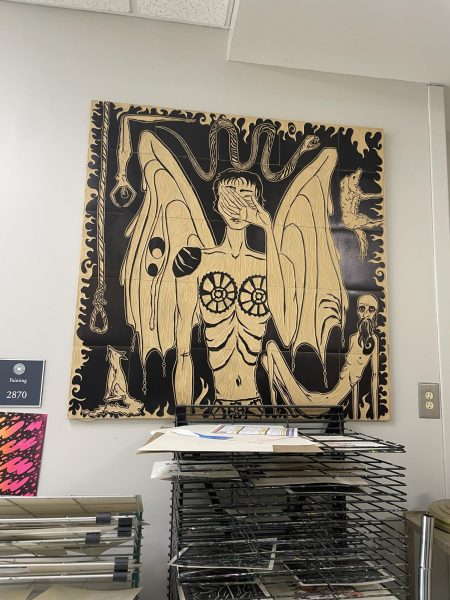
Linocut, similar to woodcut, uses sharp tools to cut into a sheet of linoleum. It yields similar results to woodcut because they are both relief prints, meaning that you cut or add onto something to create the design. They use ink rolled onto them before being pressed onto fabric or paper.
Collagraph is another style of relief print, it collages thin items together before adding them to a printing plate. Pressing a printing plate into the medium before onto the paper allows the design to transfer, making a relief print.
Other printmaking types include engraving, a method of intaglio printing. Intaglio printing covers the entire plate in ink before wiping off the uppermost surface. Unlike relief printing, it then uses the ink still in the grooves to create an image on the paper by pressing the paper into the plate.
Etching is another intaglio print type, drawing designs into a wax-covered plate with a needle. Aquatint is almost the same as etching, but focuses less on detail and often yields blockier images.
Monographic prints are a planographic type of print. They only make one print, and are made by spreading ink on a flat surface.
Lithography is another type of planographic print, but is made by developing an image onto a stone or plate.
The final type is screen print, a unique type of print used by pushing ink through a screen mesh, creating distinct images through stenciling. Notably, this year’s Zeitgeist shirts were printed using in-house screenprinting.
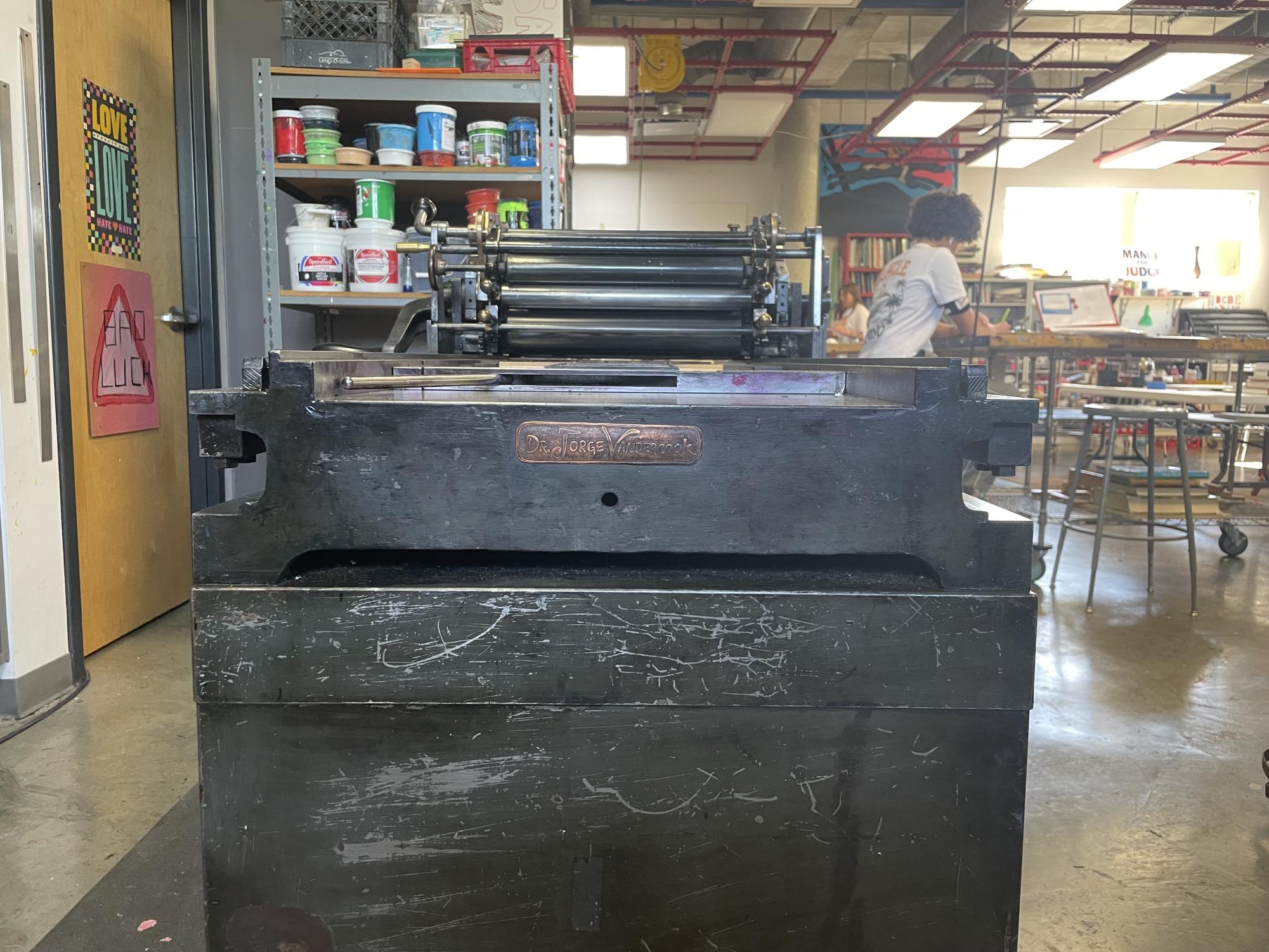
Cheney and Hansen both use a Vandercook 3 proof press that USN houses, one of seven known Vandercook III presses made that year, and one of one hundred and thirty documented total, according to the Vandercook census.
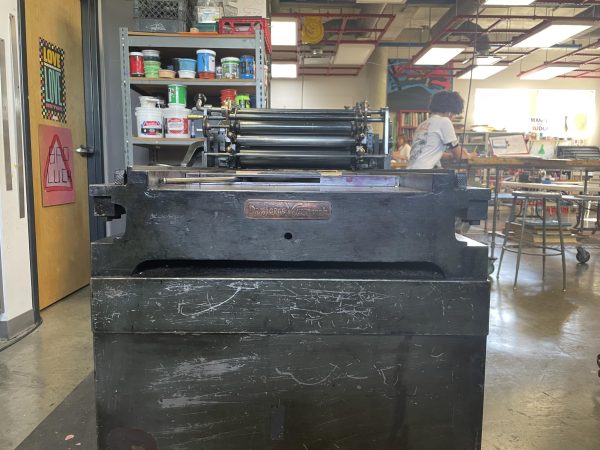
The school acquired this press through Cheney, who previously had it at a print shop he co-owned called Sawtooth Print Shop. When he began working at USN in 2020, he brought it here because they weren’t using it.
“The reason it ended up here is because we weren’t using it. It was in my garage, and we were constantly shuffling it around. And it’s 1,000 pounds, it’s hard to move, and so I just asked if we could move it here. [my business partner] agreed, and we moved it in,” Cheney explained.
The press was named by USN alumna Eliana Gorden, ‘24. Gorden dubbed the press “Dr. Jorge Vandercook.”
Despite paper and ink being low-cost, a printing press like Dr. Vandercook costs about $7,500 today, according to Vandercook Press Info. A Vandercook 3 can range in price, but a brass press like Dr. Vandercook may be worth even more, $13-15,000.
Although a Vandercook 3 press is expensive, USN gets a lot of use out of Dr. Vandercook. Both students and teachers use the press year-round.
“That press, I’ve since learned, likes to be used, and so we’ve never stopped using it,” Cheney said.
Not only does the art department have Dr. Vandercook, but they also have two smaller presses, although those are used much less frequently than the others.
Printmaking at USN has flourished through Cheney and his class; there are prints in both the art wing and the main building with unique styles. Students are encouraged to create prints in their own styles with only mild guidelines, staying in theme with the project, allowing such interesting art to be created.
The use of different techniques allows students to explore many types of printmaking while they learn how to print linocut or screen print. The different methods and availablity are enjoyed by more than just USN students during the year; teachers and campers alike will utilize it over summer.