by Margot Ross ’24
March 4, 2024
On January 11, USN juniors embarked on a field trip to various Civil Rights monuments across Nashville. Students then came together in groups to conceptualize and design their own civil rights monuments. The culmination of the projects was a presentation in which students pitched their monuments in a “Shark-Tank” like environment, fielding questions from both their class and a panel of faculty judges.
Spearheaded by English Department chair Freya Sachs and History teacher Anna Stern, this exploration into the Civil Rights movement was originally the centerpiece of American Studies, an interdisciplinary humanities course that combined American literature and history curricula.
Sachs and Stern conceptualized the project after visiting Woolworths, a café located on 5th Avenue which is known as the focal point of the Nashville sit-in movement. Stern and Sachs were surprised by the lack of material in the café commemorating its importance to the sit-ins.
“We both had this uncomfortable experience [of] knowing we were in a Civil Rights landmark and being in a restaurant that was kind of co-opting that experience,” Stern said. ‘It didn’t feel like it was doing so authentically. It didn’t feel like it was doing so in a way that commemorated what happened.”
“Both of us kind of left independently thinking, ‘Something about this isn’t right. What if the people who created this restaurant had really dug into this Civil Rights history and thought about how to make what really happened at that location consumable for the average tourist?’” Stern said.
Though the scope of the project was originally limited to Woolworths, it eventually expanded to include the design of outdoor installations. When the American Studies course was discontinued after 2021-2022, juniors no longer executed the project.
However, towards the end of the 2022-2023 school year, Sachs and Stern began to think about bringing the project back.
“We both were missing what the project had offered to juniors,” Stern said.
Before revitalizing the project, Sachs and Stern had to get their fellow faculty members on board. They reached out to Head of High School Quinton Walker, English teachers Robbie McKay and Justin Karpinos, and History Department Chair Mackey Luffman.
Luffman signed on to the project because of its humanities-oriented nature and its focus on communication techniques.
“It’s truly a humanities project. It’s not just important to learn about history, but it’s also important to be able to communicate it,” Luffman said. “The idea behind this is good [because] there’s more leeway for creativity.”
In the first part of the project, students went on a field trip to survey the existing Civil Rights monuments around Nashville. They traveled to sites such as the Civil Rights room in the Nashville Public Library, the reconstructed home of Civil Rights attorney Z. Alexander Looby, and the Witness Walls located by the Nashville Metropolitan Courthouse.
Many students were shocked by the lack of commemorative material at the sites, especially given their importance to a historic movement.
“I was really surprised that I hadn’t heard of our specific topic before. We were talking about the desegregation of the Centennial Park public pool, and I had not heard about that at all, which I thought was surprising because I dance at Centennial Park,” Devon Brown ‘25 said. “I’m there six days a week. I thought it was kind of surprising…the lack of memorials that are already there.”
After visiting the Civil Rights monuments, juniors had around two weeks to design their monuments and prepare for their presentations. The first phase of the project was a brainstorm. Students were encouraged to think of a theme to connect the elements of their monument in order to create a cohesive experience.
After they conceptualized their projects, students were supposed to have the opportunity to ask questions about curation and design before a panel of experts. The panel was originally composed of Katie Delmez, a curator at the Frist Art Museum; Lakesha Celvin, a curator at Fisk University’s VanVechten Gallery; Nathalie Lavine, the Vice President of Education & Outreach at Cheekwood; Elois Freeman; and Melissa Mallon, the University Librarian at Vanderbilt.
Because of a winter storm, however, students were unable to hear from the panelists in person. The inclement weather also delayed the final presentations.
After that, students completed archival research to learn more about the events and people their site would commemorate. Finally, students created a sketch, model, or mockup of their site and prepared a presentation explaining its significance.
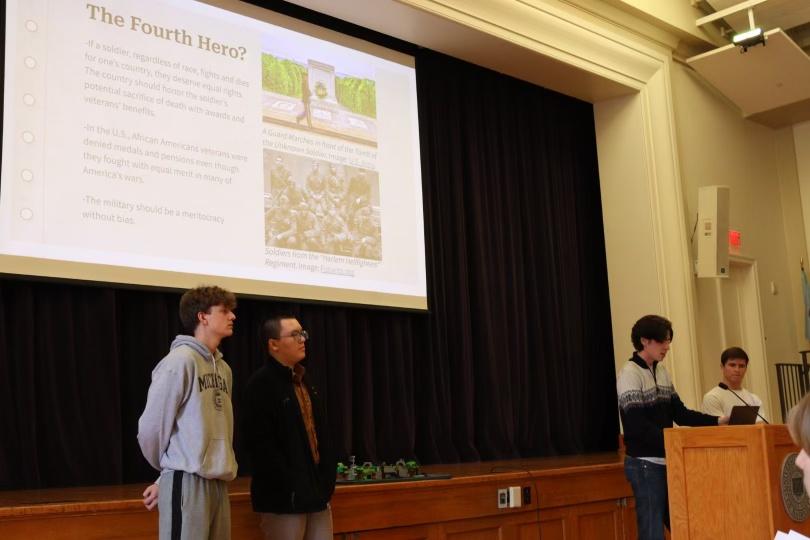
On January 24 and 26, students presented their monuments to their entire class and a panel of faculty judges during Community Time and lunch. Each group was unique in both the monuments they conceptualized and how they chose to showcase their design.
Many groups were guided by a common interest. Margaret McKay ‘25, for instance, was inspired to design a gymnasium and community center in honor of Perry Wallace after hearing girls’ basketball headC cach Karsten Olson discuss the unifying power of sports. Wallace was the first African-American basketball player in the SEC conference.
“I’d heard my coach talk about how [Olson] went and played like this five-on-five tournament with random people, and…the love for basketball brought them together. So we kind of used this idea of the love for basketball to bring people to learn about Perry Wallace in the gym and in the community center,” McKay said.
Other groups leveraged unique skill sets to create interesting mock-ups of their sites. Saul Sharfstein ‘25 was the member of a group that used an interesting medium—Lego blocks—to create the model of their memorial. Sharfstein’s group designed a bridge to honor African-American Vietnam Veterans from Tennessee.
“None of us are particularly artistic—actually, Josh [Muelllenbach] was, so we went to his house because we were trying to figure out how to make a model for the structure. At first we thought we were going to make it out of wood or something like that, but then we decided to do it out of Legos, which ended up being a lot of fun,” Sharfstein said.
In a similar fashion, Sawyer Beckwith ‘25 was able to use his skills in computer graphics to render multiple images of the site. Beckwith’s group designed a music venue honoring Harry Belafonte, a musician and activist who was dropped by his label in the 1960’s after he began speaking publicly about the Civil Rights movement.
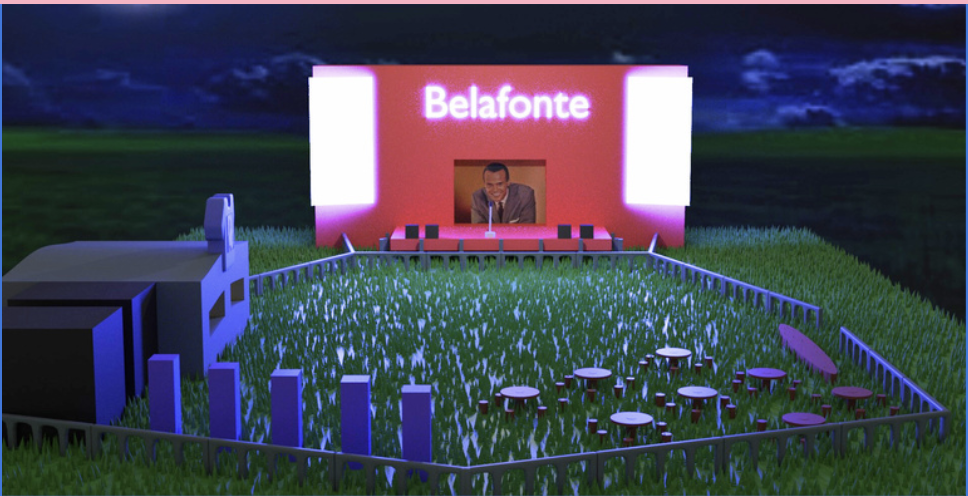
MUSICAL MONUMENTS: For his project, Sawyer Beckwith ‘25 created 3D renderings of a music festival dedicated to Harry Belafonte, a musician and Civil Rights activist. (via Sawyer Beckwith ‘25)
“For years, I’ve been working with 3D design and animation on my laptop. So I included my skills in that with the map, venue, and concept art,” Beckwith said. “It was really interesting because different people on my team were able to [use] their strengths and weaknesses and combine them to create a project.”
Stern noted that the public speaking component of the project was designed to prepare students for their careers, as most jobs require proficiency in public speaking.
“It’s nice if you have great ideas, but if you can’t articulate them in a way so that other people absorb them and use them, those great ideas only go so far,” Stern said.
“In pedagogy, we’re talking about ‘authentic assessments,’ things that mirror what you could do in the real world. Writing a research paper is not always that authentic, but having to make a pitch, having to make a presentation, or having to advocate for yourself is a skill that pretty much everyone is going to have to do in their professional lives at some point,” Stern continued.
Stern expressed that her favorite designs were those that strayed away from typical monuments and were guided by shared interests between group members.
“Some of the best projects I saw were not about kids trying to fit some mold of what a museum or what an exhibit or a statue has looked like in the past. They were about, ‘We like this thing. We like food, we like music, we like whatever—and we’re gonna play to our strengths and design something that celebrates that too,’” Stern said.