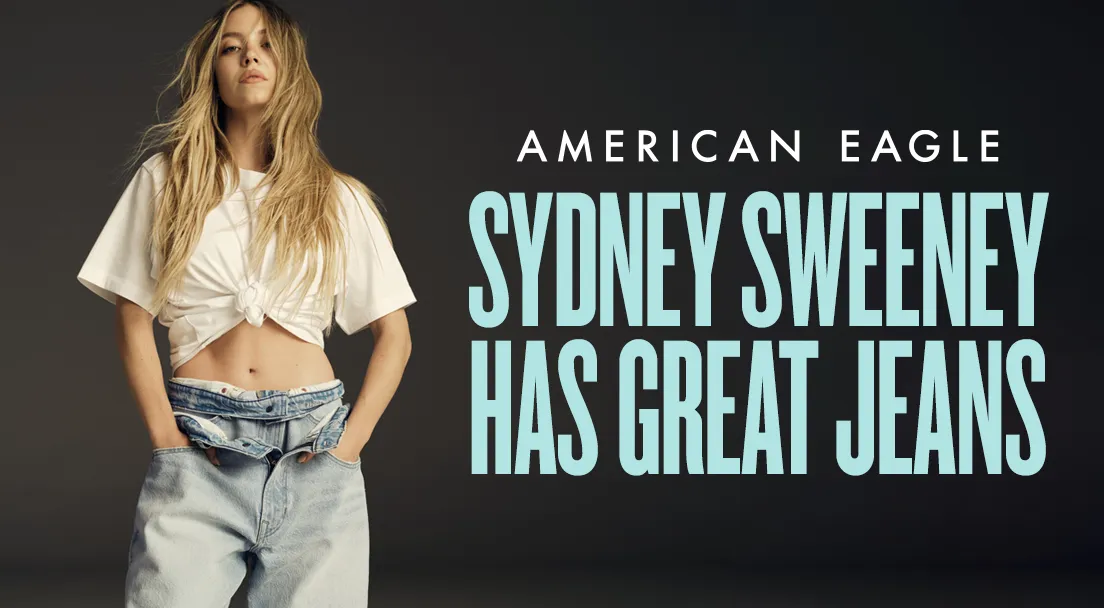

EU-JEAN-ICS?: Sydney Sweeney’s ad has drawn backlash and attention. (Graphic via CyberNews)
It’s just a cute apparel ad until Sydney Sweeney purrs “good genes” to an audience of millions, sparking a pop culture debate that would divide the internet for weeks. While some interpreted her words as cheeky wordplay, the ad left some students and faculty on USN’s campus with larger questions about the dynamic motion of American pop culture.
For Laila Fierce ‘27, the ad didn’t seem to be about jeans at all.
“The ad focused more on Sydney Sweeney than it did on jeans. It wasn’t an American Eagle ad — it was a Sydney Sweeney ad,” Fierce said.
“More and more, Sweeney is leaning towards a male-centered audience. If you are selling jeans for women, then why are you making an ad marketed towards men?” she added.
Fierce began researching the ad after its controversies over sex and race grew.
“I did a little more digging out of boredom, and I found out it was based on an old Calvin Klein ad with Brooke Shields when she was 15 at the time [in 1980]. The play on words like good genes/jeans raised the question ‘What are good genes?’” Fierce said.
While some saw the ad as a harmless joke, many took the ad more seriously.
“I saw it as political commentary. The genes/ jeans pun was a play on words, but I didn’t see it as playful. American Eagle’s ad showed an intention to enforce white supremacy, alluding to how Sydney Sweeney’s eyes were blue like her jeans. I didn’t see it as a joke,” Fierce said.
Mila Kinney ‘26 also made connections to Brooke Shields’ infamous 1980 ad, highlighting the duality of the controversy.
“There were multiple videos and TikToks I saw. I recognized American Eagle’s ad as the same ad that Brooke Shields did, which was weird because Brooke Shields was 15 and the ad was sexualizing her. I found the reference weird and initially thought that was the reason it was controversial,” Kinney said.
However, once Kinney moved past the ad’s sexual innuendo, she began considering the public’s accusations of eugenics.
“I think that some people are overreacting a bit in terms of saying she’s a Nazi. I do think that’s a bit extreme. I don’t think she was doing Nazi dog whistles. I can see why the fact that American Eagle picked a blonde white woman with blue eyes to say she has good genes is off-putting, especially with her being a Republican and going to Jeff Bezos’ wedding. I think if American Eagle had chosen a person of color to say they had good genes, it would not have been controversial,” Kinney said.
“There was a very sexual undertone based on the way she was speaking,” Kinney said. “That’s seems to be a pattern in [Sweeney’s] branding…I don’t want women to be known solely for their sex appeal. The fact that she’s doing all this suggestive body language while referencing the Brooke Shields thing is really weird. It was a direct reference to the predatory ad Brooke Shields was in decades ago.”
Like Kinney, Eesha Nachnani ‘28 had evolving interpretations of the ad.
“I didn’t notice too much at first,” said Nachnani. “The wording was weird, but I have noticed that her ads are always kind of weird. Then I saw an article from a big newspaper which made me confront what the ad represented in a way I had not originally noticed.”
“Considering she is…a blonde white woman, her ad conveys certain meanings. Although a lot of people are calling her racist, I think people should consider whether she or American Eagle designed the ad. At first at least, I viewed it as playful wordplay,” Nachnani said.
Nachnani also noted that the delivery and persona behind the ad were essential to understanding the controversy behind the word choice.
“As a woman of color, Sydney Sweeney’s tone kind of sounded [to me] like ‘MY GENES ARE BLUE AND YOURS ARE NOT.’ The way she says it is a bit off,” Nachnani said.
USN 11th and 12th Grade Dean Matthew Haber ‘98 read the ad as more careless than intentional.
“I was surprised at the lack of awareness that American Eagle demonstrated. Maybe I am naive, but I assume that this happened because of carelessness rather than some kind of intentional attempt to promote eugenics. I think it was just meant to be a pun. They probably thought that it would be funny without thinking about the consequences of it,” Haber said.
Still, Haber doesn’t excuse the carelessness.
“It was probably intended as playful wordplay, but advertisers should be aware when they are portraying standards of beauty,” Haber added. “American Eagle was trying to sell Sydney Sweeney’s sex appeal, but by discussing her genes, American Eagle took the discussion to a new level. By turning the ad into a discussion of genes, they implied that beauty is whiteness, blonde hair, and blue eyes.”
Nachnani, however, wondered if American Eagle’s actions were unintentional.
“I definitely think companies like American Eagle court controversy for publicity. If you hear all of these controversies for a specific line, it almost feels like they’re the ones who started the spark,” Nachnani said.
Kinney agreed with Nachnani.
“[American Eagle] probably thought that by having Sydney Sweeney, who’s been in so many controversies, they would get more clicks or whatever. A lot of brands have been almost rage-baiting their consumers to get more clicks,” Kinney said.
Haber also points towards a shift beyond advertising.
“Recently, everything has politics in the background. In the past year or so, we’ve seen the pendulum swing back [to the right],” he said. “A few years ago, we saw companies appeal more to left-wing ideologies. Companies worked publicly on DEI, representation, but now, companies are very publicly moving the other direction.”
For Nachnani, there is a glaring rightward cultural shift.
“[President] Trump is really pushing the American Dream: a two-story house with a white picket fence and a nice, big family. I am more likely now to find an ad with a [traditional] family that has four or five kids than with a gay couple,” Nachnani said.
Nachnani also noted that after Sydney Sweeney’s ad was released, Trump posted in support.
“Sydney Sweeny, a registered Republican, has the ‘HOTTEST’ ad out there. It’s for American Eagle…Go get ‘em Sydney!” Trump wrote in a Truth Social post on August 4.
Fierce notices the polarization getting more extreme.
“I think the public’s response to the ad shows that American culture is very divided and very politically polarized,” Fierce said.
Haber says that capitalism and a thirst for drama also are at play.
“I think the ad says that we have a media culture that thrives on and profits from controversy. When the opportunity to exacerbate a controversy comes along, a lot of people benefit,” Haber said.
Whether the controversy was caused by carelessness or meticulous planning, its ripple effects demonstrate that pop culture has become inseparable from politics.