by Lindley Davidson ’28
November 2024
With rising problems that phones create during school hours, USN has established a high school phone committee of faculty and students that will evaluate the current situation of phone usage and implement future policies and guidance to help manage phone usage during the school day.
Phones are a crucial part of student life, but balancing their use with academic focus is a growing concern.
Assistant Head of High School for Student Affairs and High School Psychology Teacher Nicole Jules holds a crucial role on the phone committee.
Jules describes the primary duties of the phone committee and its plan of action.
“[The committee] is looking at usage and what the data is around phone usage with adolescents, and so that’s what we’re looking at,” Jules explains. “So we’re pulling in all sorts of data from other schools, what’s out there in the world, and just seeing how that compares to, like, what our community culture is.”
USN’s lower and middle school have strict no phone policies. However, in the high school, phones are allowed in class at the discretion of individual teachers, since the USN High School Student Handbook does not specifically detail any in-school phone policies. High schoolers have complete freedom of their usage in between classes and during lunch. More recently, phones have been banned during Assembly and class meetings and must be put away during work blocks for freshmen.
High School English Department Chair Freya Sachs acknowledges the negative effects cell phones have on not just students, but everyone.
“Cell phones distract all of us all the time,” she explains, “and I understand my own distractibility…it’s not just students. This is humans in 2024.”
A New York Times article published on September 6, “Smartphones in Schools,” by David Leonhardt examines the effect phones have on children and their well-being.
Nicole Jules mentioned the book, “The Anxious Generation” by Jonathan Haidt, which explains phone usage data in the last decade when social media usage exploded, as well as the deterioration of mental health during that time frame.
Jules noted what she has observed when kids don’t have unlimited access to their phones.
“What I’ve noticed is that kids, when you restrict their phone usage, especially, I’m thinking about, retreats and that sort of thing, how they turn back into kids,” she said.
A Washington Post article published on February 7, 2023, “What teens think parents should know about phones,” by Elizabeth Chang and Kelly Glass, dives into the perspectives of various teenagers about their own phone usage.
One teenager, Carline Greenhouse, explained her own experience of social media to Chang and Glass. “I do feel a little bit of pressure from my friends to be on social media, but other than that, my phone is a necessity,” Greenhouse says.
Another teenager, Caleb Murphy, details his social media experience and what he has noticed about how it affects his friends. He explains, “Social media is not good. And however old I am, it’s still hurtful. TikTok is incredibly addicting…Instagram, especially for my friends who are girls, is really not good for mental health as far as body image stuff.”
“It’s not a good worldview to base your life off of,” Murphy added.
Sachs emphasized the addictive and isolating nature of phones, noting, “Phones are designed to be addictive, and I think they are one more way that pushes us outside of the community and learning we’re in, in moments where we probably want to be present.”
Another New York Times article published February 27, 2023, “The Phone in the Room,” by David Leonhardt discusses the dense topic of phones and teenage mental health.
“By many measures, teen mental health has deteriorated, especially for girls, since about 2008. The suicide rate for girls and boys began rising around then,” Leonhardt writes. “Feelings of loneliness and sadness began rising, too. The amount of time teenagers spend socializing in person has declined. So has sleep.”
The Leonhardt article overviews the possible causes for such a rapid uptick in phone usage and discusses how mental health data suggests that the creation of the iPhone and more advanced technology is to blame for the decline in mental health among teenagers.
As phone usage has skyrocketed, so have concerns about its impact on the well-being of young people.
Here in Nashville, USN’s peer schools are confronting similar challenges. The Montgomery Bell Academy weekly newsletter from August 7 by MBA’s headmaster Dr. William H. Daughtrey details that cell phones are a major distraction and get in the way of crucial needs of daily life. Daughtrey explains that cell phones are major interruptions and interfere with important daily tasks and activities.
“The incredible effectiveness of smartphones in providing a rapid rush of feel-good dopamine has, in Haidt’s term, ‘rewired’ our brains to avoid a cycle of thoughts that we don’t want to address, or to avoid stressors of the day, or to avoid awkward social moments, or to avoid simple moments of boredom,” Daughtrey says.
Leonhardt, in the New York Times article, reflects on his own observations of students in high school and college classrooms when he goes to talk with students about his career in journalism.
“I can see how many of them are scrolling through sports coverage, retail websites, text messages, or social media, looking up occasionally to feign attention,” he notes. “It’s not everyone, of course. Some students remain engaged in the class. But many do not.”
As a result of this data and these trends, many schools have opted to institute strict phone policies for students.
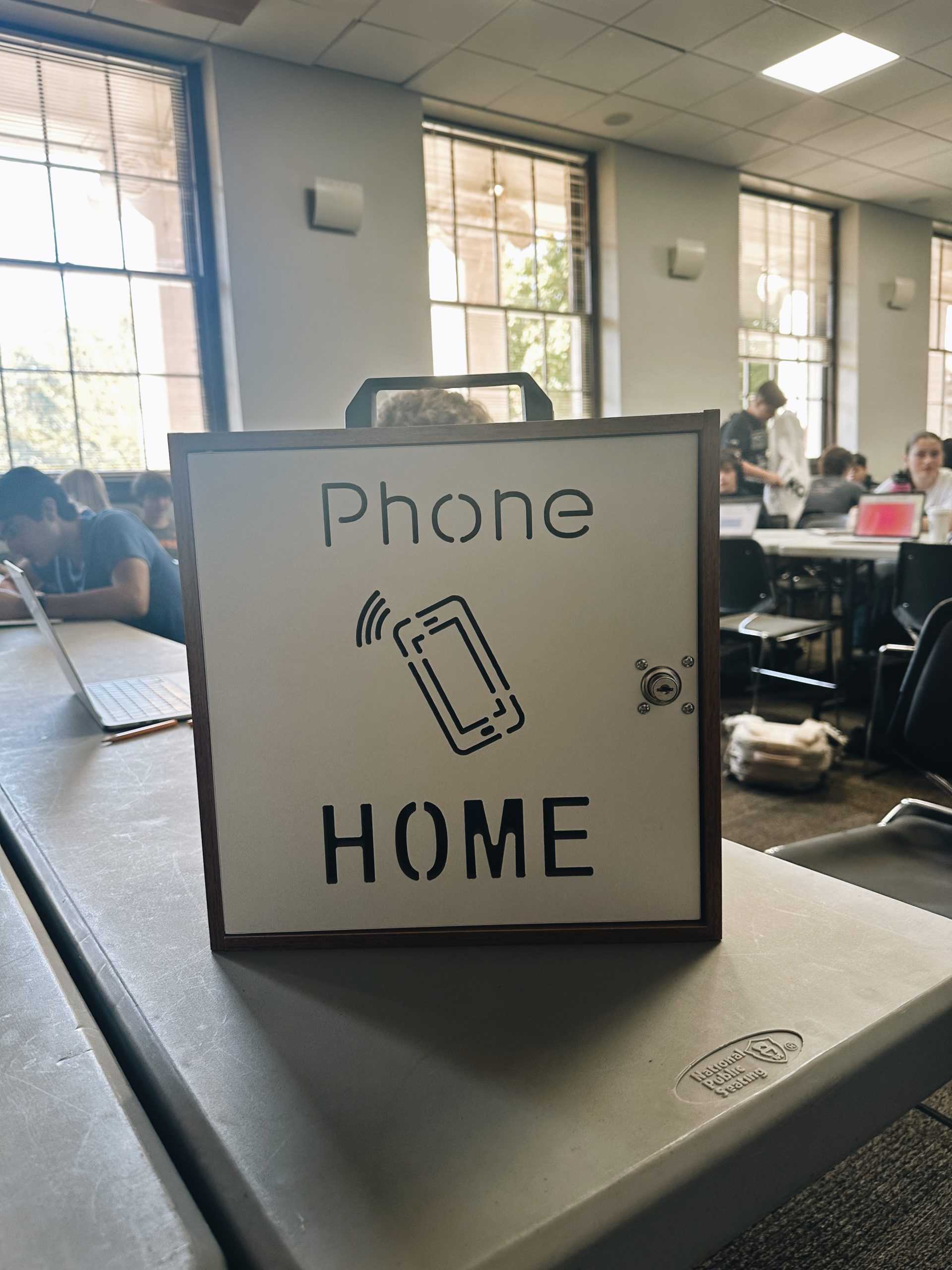
At Father Ryan High School, phones must be in a phone home during class and cannot be used between classes or at lunch.
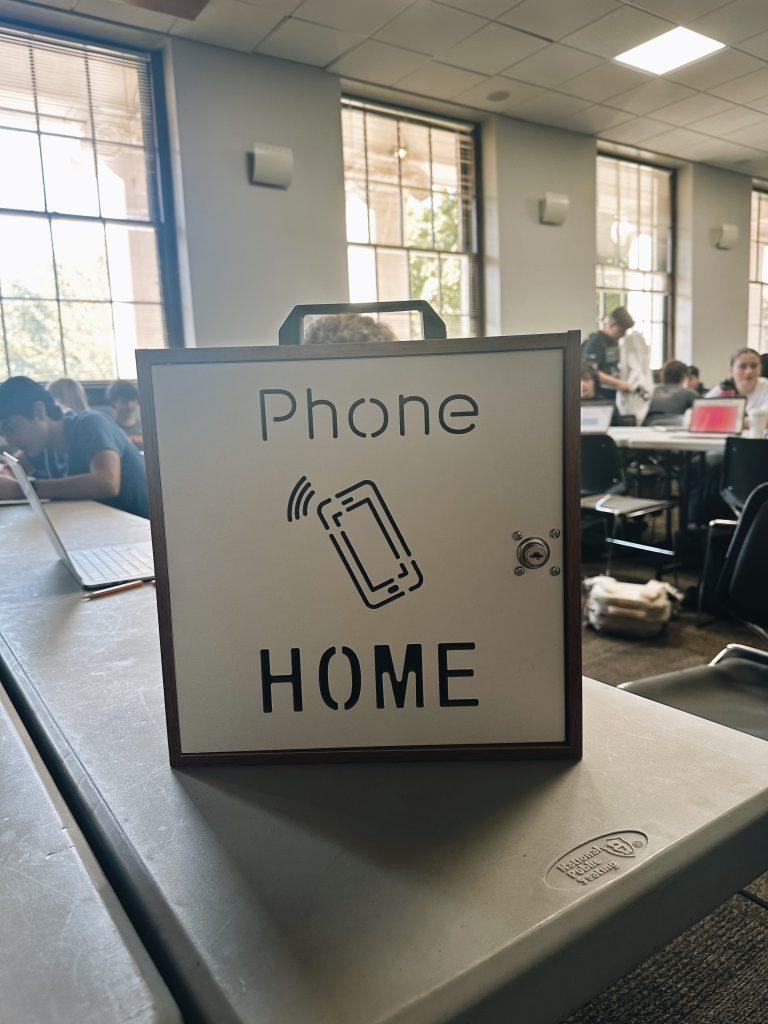
Ninth graders use Phone Homes like this one during their work block in Payne Library (via the Peabody Press).
Father Ryan student Jack Sparks ‘27 explains how phones are distractions and take away valuable time.
“They [phones] can be a distraction while you’re learning, and they can lead you away from doing what you should be doing,” Sparks said.
However, he acknowledges that phones can be beneficial because they provide easy and quick access to the internet, which is helpful during the school day.
At Valor Collegiate Academy, phones are only allowed during lunch and must be put away during class time. Valor Collegiate Academy student Allyson Link ‘27 finds this overly restrictive.
“My school is very strict with their phone policy, and I think other people’s opinions are the same as mine, where they believe that we should be able to have our phones more,” she said.
Montgomery Bell Academy has also shifted to a zero cell phone policy for the entire school during the school day. In the weekly newsletter, they detail the harmful issues that phones cause and explain MBA’s hope to help put an end to the problems phones cause every day.
“By eliminating the rapid access to these distractions during the day, I hope that we will both foster presence and connection and help students develop what Dr. Kanojia calls an ‘endurance for boredom,’” Daughtrey writes.
As policies from other schools in the area differ, USN is attempting to work towards phone guidelines that are best for students and faculty. The phone committee is considering potential changes to phone policies in the future, though they have not finalized any specific recommendations yet. The committee plans to gather feedback from students and faculty through surveys and work from there.
Jules speculates that phone usage policies may change during some times and spaces during the school day, but that it’s unlikely for the University School of Nashville to go completely phone-free.
Faculty may also experience changes. Jules says that is “definitely part of the conversation.”
Additionally, the committee has to be thoughtful about phone policies because phones may aid certain students for academic or health reasons, such as staying on track with medications or if a computer is not immediately available.
The phone committee may face challenges like setting the right example, communication needs, and interference with existing school systems when considering what policies are right for the University School of Nashville.
“I think about Ruvna for emergency drills…the communication pieces, with families, with students, with faculty—we’re just gonna have to be very intentional and thoughtful about how we share the word once we’ve gotten to something,” Jules said.
Although phones cause serious problems, there are also known benefits that phones bring. Leonhardt says that, “Teenage deaths in vehicle accidents began falling more rapidly about 15 years ago. Teen pregnancies and bullying are down as well.”
As phones continue to play a central role in students’ lives, USN’s phone committee is working to create thoughtful guidelines that address both the benefits and challenges of phone use. With input from students, faculty, data from other schools, and expert findings, the committee hopes to strike a balance that promotes focus, well-being, and healthy phone habits.