by Carmen Gaskin ’25
September 2024
As we approach the November Presidential election, experts wonder whether Vice-President Kamala Harris will be able to reverse a troubling trend for Democrats.
Approximately 40 million members of Gen Z will be eligible to vote in November. Of that 40 million, half of that population are young people of color, including nearly 6 million Black youth, according to a study at Tufts University.
Generally, young Black voters tend to vote Democratic. In 2020, 92% of Black voters cast their vote for President Biden, while only 8% of the black voting bloc backed former President Donald Trump.
In 2016, Pew’s Validated Voter survey found that 14% of Black men voted for Trump, while virtually all Black women (98%) voted for Hillary Clinton. Overall, Clinton led Trump among Black voters by 91.6 percent.
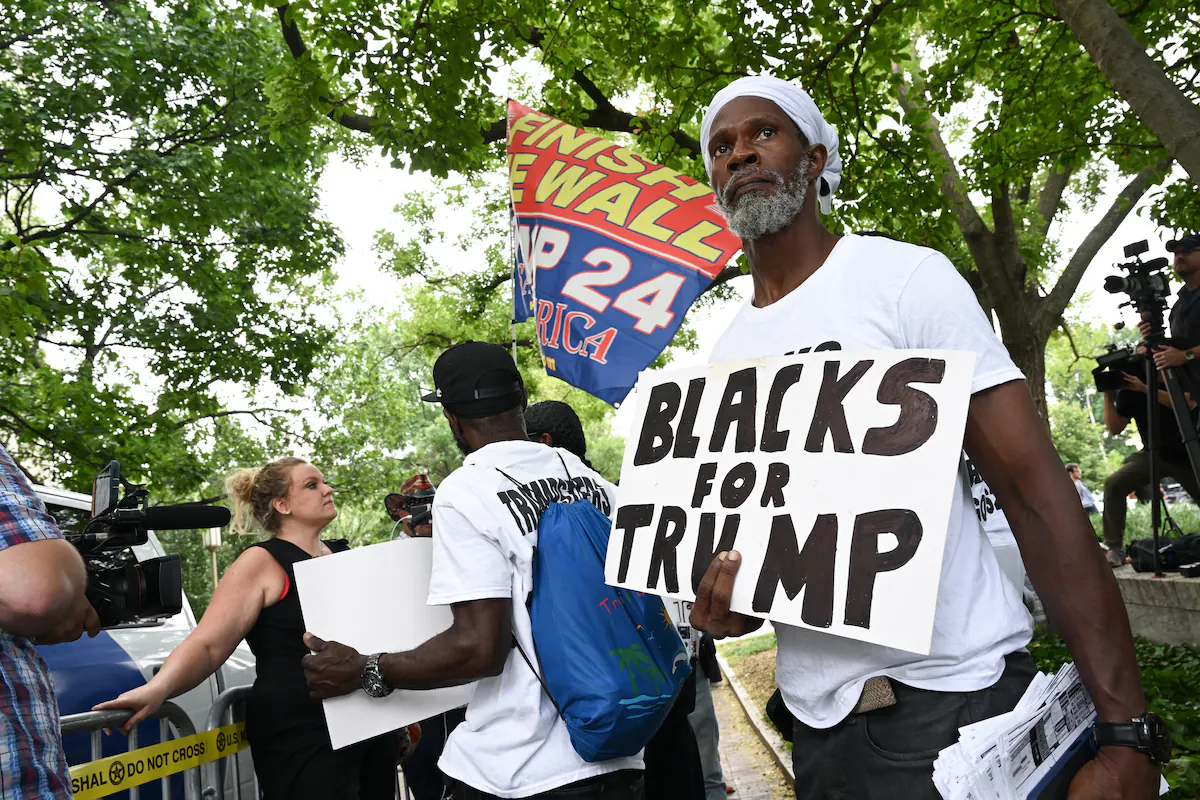
In May, an ABC News poll suggested that Biden had begun losing the support of Black voters before his withdrawal from the race, as young black voters began to lean more conservative than their parents. Nearly one out of five Black voters say they support Donald Trump and seem especially open to casting ballots for the Republican party. Among Democrats, this has sparked fear that Black voters in cities like Detroit, Philadelphia, Milwaukee, and Atlanta will cost Harris those critical swing states.
The last time Republicans put up numbers near that level with Black voters was in 1976, with Republican candidate Gerald Ford garnering unforeseen Black Votes against Georgia Governor Jimmy Carter. Carter ultimately won that election.
What are Black men voting for?
As once inactive generations of young Black voters become increasingly right-wing, older conservative voters attribute this Republican appeal to Trump’s image as a celebrity businessman who is more than capable of talking about all things money.
Economic mobility seems to be at the forefront of concern within the Black community in the November election, as conservative Black voters have come to appreciate his “economic know-how:” low inflation during his 2016 term, law-and-order stances, and alleged low unemployment numbers for Black Americans.
Following economic insecurity in the midst of the COVID-19 pandemic, many applauded Trump’s attention to job security and financial stability when issuing nation-wide stimulus relief packages.
According to an Invest in You survey conducted by SurveyMonkey in 2021, a study measuring the public’s perception of financial assistance during the pandemic, nearly 50% of African Americans were counting on another round of government financial assistance to “get by,” versus only 22% of white respondents who resonated with that level of financial anxiety.
Meanwhile, minorities most in need of COVID-19 financial assistance remained less likely to receive it promptly, as less than half of the Black population received the funds.
“Checks are likely to get lost in the mail, so if you don’t have a bank account for direct deposit, then it’s easier to miss your stimulus payment,” said Louis Barajas, a member of the CNBC Financial Advisor Council.
Many Democratic Black voters believe this polarization in economic Black sentiment is unlikely to predict the final vote distribution in November.
“To me, the stimulus checks were a band aid at best on a large gaping wound,” said Roderick White, director of Diversity, Equity, and Inclusion at USN. “The tradeoff is that while those stimulus checks went out, many people appreciated those checks. But the reality is we’ll be paying those checks off for, if not one, several generations.”
“For some that might have been the difference. But I also think if that’s what you’re hanging your hat on, I gave everybody a one time check, that’s a really short sighted way to address the problems that the country has,” White added.
Simultaneously, for many Black voters, the problem lies within pandering to the Black community, as American public policy reveals a history of momentary handouts to key constituencies that determine the outcome of presidential elections.
An example of this campaign strategy is Lyndon B. Johnson’s 1964 “War on Poverty,” which promised access to education and healthcare, only to quickly lose federal funding for academic programs that granted African-American children a chance at higher education.
Mike Jones, USN’s director of high school service learning, and high school boys’ basketball coach, highlighted the short-lived impact of stimulus checks.
“You don’t treat symptoms. You actually treat the problem,” he said. “Give a man a fish he’ll eat for a day. Teach him how to fish he eats for a lifetime.”
Although, sources say economic mobility is only one of the issues prevalent in voter’s minds.
As Harris vows national protections on reproductive rights, abortion politics amongst Black Christian voters has remained a fractious issue.
According to Pew Research Center, 26% of religiously affiliated Black Voters voiced abortion should be illegal in all, or most cases, and supported Trump’s overturning of Roe V. Wade, in which he argued, brought the abortion debate back to the state level.
Efforts to address these concerns amongst conservative voters have been made, as Harris promises voters will not have to abandon their faith at the ballots.
“Most important is the freedom to choose what women can do with their bodies, and healthcare for all,” said William Officer, application support specialist at USN. “I don’t see how someone can think women take that lightly.”
Can Harris reverse these trends?
Steady streams of donations and endorsements suggests that Harris has accumulated immense amounts of enthusiasm from the Democratic Party, especially within the Black voting bloc.
On July 22, Win with Black Women, a network of Black women leaders, organized a virtual teleconference to support Harris. Almost 50,000 people joined the call, and the group generated more than $1.5 million in under three hours for Harris’ campaign. That same week, more than 53,000 Black men participated in the Win with Black Men virtual teleconference, outwardly showing their support for Harris, and successfully raising over $1 million in under four hours.
According to Harris’s campaign managers, the candidate brought in over $200 million during the first week of her presidential campaign, with nearly 66 percent of these donations coming from first-time donors.
In recent weeks, Harris has dominated in seven battleground states, leading in four: Nevada, Michigan, Wisconsin, and Pennsylvania, and trailing behind in the other three, North Carolina, Georgia, and Arizona, by two points or less.
If the leads in these states continue, and the remaining states perform similarly to how they did in the 2020 election, Harris will narrowly win the electoral vote – making her the first African-American Indian woman to become President of the United States.