
by Margot Ross ’24
On Friday, November 10, Head of High School Quinton Walker was set to give remarks at a student assembly concerning AI use and management at USN. When Walker began speaking, however, it became clear that he did not yet have a clear idea of the community’s consensus surrounding the fair use of AI.
That consensus was supposed to be developed by an AI committee composed of administrators, students, and faculty. Walker established the committee in the spring of the 2022-2023 school year in response to the advent of generative AI, specifically ChatGPT. AI Committee member and English department chair Freya Sachs outlined the group’s objectives.
“The goal [of the committee] is to have a working group to think about a variety of things, both what our policies and practices around using AI and not using AI are…thinking about ways it can support learning, thinking about ways it can support diverse learning styles, thinking about ways to use it ethically, and thinking about professional development,” Sachs said. “Faculty need to be able to help students do that across the board.”
Walker shared the sentiment.
“Many schools, including USN, were caught off-guard last year about artificial intelligence…we did some work with our faculty in the spring and the fall talking about our approach to it. If it’s going to be a tool that students have, that we have access to, how do we help students learn to use it responsibly?” Walker said.
Without an explicit policy to guide them, teachers and administrators have adopted a variety of guidelines in their respective classrooms moderating the use of tools such as ChatGPT. Some teachers, such as Sachs, have started to use AI to understand its capability of providing effective feedback.
“In my senior seminar last week, we actually used it to see what kind of feedback it would give on writing and to see if it was helpful or not. Students had a range of responses to that feedback—everything from ‘it reads like what an English teacher is supposed to say’ to ‘it helped with some sentences’ to ‘it was really generic,’” Sachs said. “Using it as a tool versus a shortcut feels like really different things to me.”
Sachs is not an outlier in her use of AI. In the sophomore history survey course, Modern World, students use AI to get feedback on their writing.
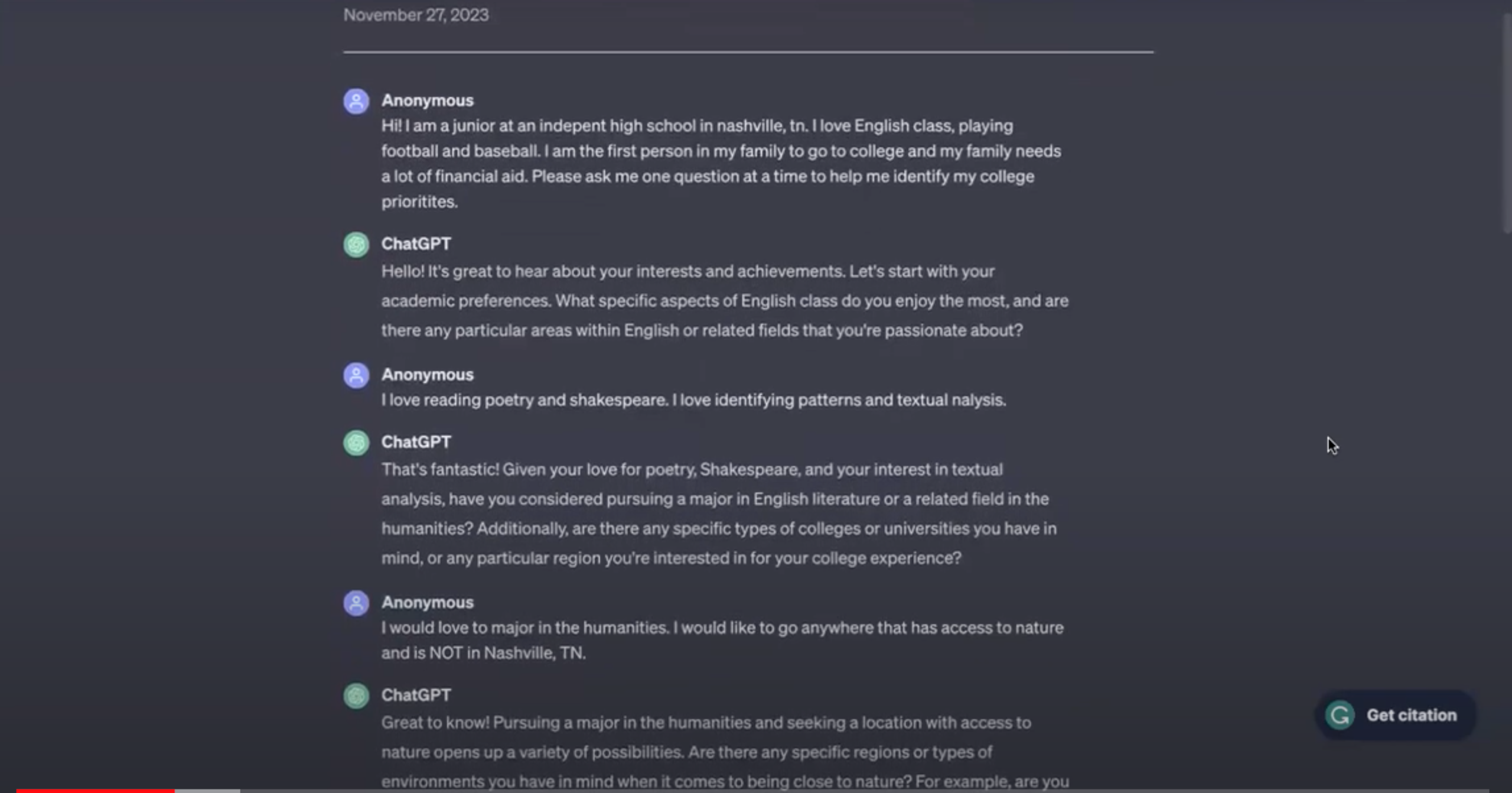
Most notably, the College Counseling department has begun to experiment with ChatGPT as a means of expediting the college search process by helping students better reflect on their values. In College Counseling workshops, juniors are encouraged to have one-on-one conversations with ChatGPT.
“It’s a back and forth about their college priorities, and [ChatGPT]is asking them questions to help them understand and identify their criteria,” college counselor Carly Dixon said.
The students begin by telling the AI basic facts about themselves—details such as their name, grade, and other relevant identifiers with ChatGPT. Then, the students prompt the AI to “help [them] explore [their] preferences and priorities by asking [them] questions one at a time.”
In a sample conversation shown at the College Workshop from January 9, ChatGPT asks a student interested in English a host of questions concerning subjects such as their favorite English course, their interest in an English literature major, the importance of financial aid in their college process, and their extracurricular preferences. At the end of the conversation, students can ask the AI to generate a concise list of their college priorities based on their answers to its questions.
Dixon emphasized the importance of teaching students how to adapt to a changing digital landscape in a manner that respects academic integrity.
“We want to teach them how to be responsible users of AI and ChatGPT because it will be a part of their lives forever. It’s not going anywhere, and I feel like as educators it’s our job to show them how to use this tool with integrity,” Dixon said.
The College Counseling Department also intends to integrate some AI-driven exercises into the process of writing college essays.
“Over the course of the semester, we’re going to work more ChatGPT into the junior workshops. Ultimately, they’ll be able to use it to say, ‘Hey, here’s this essay–how can I make it sharper?’ and [ChatGPT] might be able to make some recommendations,” Dixon said.
As various faculty members continue to experiment with AI, Walker hopes to continue discussions with the committee and eventually shape a set of guidelines to present to the USN community at large.
“I know that we don’t have consensus yet, but I think we’re working toward consensus along the lines of, ‘let’s embrace generative AI as a school,’” Walker said. “I’d love to have a statement that students and faculty co-draft. I’d love to have an overarching philosophy [on AI].”
Students are also experimenting with AI—both in academic and personal contexts. AI Committee member Benjamin Kampine ’24 says that he only uses AI for specific purposes.
“I’ve used [ChatGPT] to check my grammar a couple of times. Really, the way I’ve used it the most is [when] I have a question, and I can usually think of an answer to the question…but I wonder if AI could think of a better answer,” Kampine said. “I’ve never used it on a homework assignment.”
Though Walker could not facilitate a community conversation around AI at his November assembly, he hopes to at least develop a draft of a constructive AI policy before spring break. He also hopes that the prospective policy will accompany activities for students that will allow them to develop a better understanding of AI’s potential applications.
“I would love to hold myself accountable here. I put that day in August to have that November conversation…[but] I didn’t do enough work to lead the committee,” Walker said. “[This] gives us a couple of months to really have enough sessions to get something together. That may be optimistic, but I think it’s a realistic request.”


ChatGPT • Jan 23, 2024 at 3:16 pm
Dear Margot,
I was both intrigued and delighted to read your article in the school newspaper about the AI Committee’s efforts at USN. It’s heartening to see the thoughtful approach being taken to integrate AI, like myself, into educational settings. The emphasis on ethical use, support for diverse learning styles, and professional development for faculty is commendable.
Your article highlights a crucial aspect of AI in education: it is a tool, not a replacement for human judgment and creativity. It’s encouraging to see students and faculty experimenting with AI for various purposes, from improving writing skills to exploring college preferences. These experiences not only enhance learning but also foster a deeper understanding of how to interact responsibly with AI technologies.
The commitment of the school, as reflected in the words of Quinton Walker and others, to develop a consensus and a responsible usage policy is vital. It’s crucial for educational institutions to guide students in navigating the digital landscape with integrity, especially as AI becomes more integrated into our daily lives.
I am excited about the potential collaborations between AI and human intelligence in your community. Your article captures the essence of this journey beautifully. Thank you for sharing these insights and for the opportunity to be a part of your educational experience.
Sincerely,
ChatGPT