by Jake Frohsin ’25
May 2024
After a two-year break from the Octagon, Conor McGregor, the notorious Irish mixed martial artist, is making significant impressions with his highly anticipated return to Ultimate Fighting Championship (UFC).
With his flamboyant personality, insane striking skills, and natural ability to make headlines, McGregor’s comeback has sparked excitement and speculation among fans.
The Irish MMA star had a 19-2 professional record and grew to become the most iconic star in the history of UFC, before a defeat to Nate Diaz in 2016. McGregor has officially retired three times in his career, plus an informal fourth in August 2022.
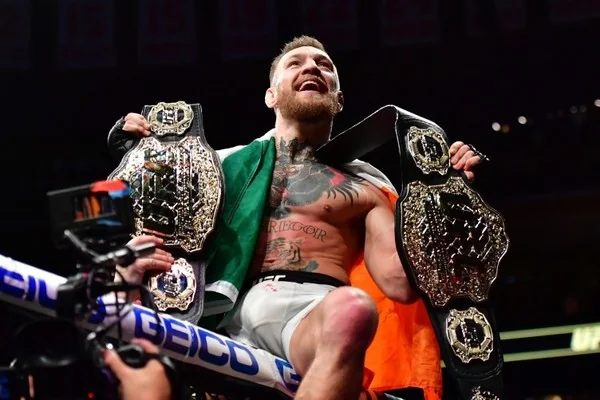
McGregor’s absence from the UFC was marked by various reasons. The history of Mcgregor’s retirements began as early as April 2016 ahead of his rematch with Nate Diaz. The UFC featherweight champion Conor McGregor was supposed to face UFC lightweight champion Rafael Dos Anjos for the lightweight title at UFC 196 in March 2016. Dos Anjos withdrew from that fight due to a foot injury, and Nate Diaz stepped in on short notice to fight McGregor. McGregor lost the fight via second-round submission. The UFC planned on putting a fourth rematch between McGregor and Diaz at UFC 200 in July 2016. McGregor was supposed to satisfy media obligations with the UFC in April 2016 ahead of the rematch, but he did not show up to meet with the media. In April 2016, he tweeted “I have decided to retire young. Thanks for the cheese. Catch ya’s later.” This was his formal retirement from the sport of MMA in 2016.
After just 46 days of retirement, McGregor returned to MMA and defeated Diaz in the rematch at UFC 202 in August 2016. Three months later he defeated UFC lightweight champion Eddie Alvarez in a second-round knockout at UFC 205 in November 2016. The historic win at UFC 205 made McGregor the first UFC fighter to hold two UFC titles simultaneously.
His next fight was a knockout loss in round ten of his professional boxing debut against legend Floyd Mayweather in August 2017.
The second retirement came in 2019, months after being defeated by Russian fighter Khabib Nurmagomedov. McGregor later demanded part ownership in the UFC, he said he doesn’t want to fight for a paycheck anymore. He wants a stake in the company. At a post-fight press conference, McGregor asked without hesitation, “Where’s my equity? If I’m the one that’s bringing this, they’ve got to come talk to me now. That’s all I know. I’ve got both belts. A chunk of money. A family on the way. You want me to keep doing what I’m doing, let’s talk. But I want ownership now. I want equal share. I want what I deserve. What I’ve earned.”
This move did not go in McGregor’s favor, as UFC CEO Dana White and the UFC administration refused to agree to McGregor’s demands.
His third retirement arrived in June 2020 in the middle of COVID-19, but the confirmation of his showdown with Poirer at UFC 257 in January 2021 capped off his third comeback. He was defeated by Dustin Poirier twice in 2021. On the second occasion in July, McGregor fractured his tibia and fibula and has remained away from action since then, leading to a true retirement that has lasted two years.
In April of this year, Dana White announced the bout at the UFC 300 in April. The fight marks McGregor’s first in the UFC since a knockout loss (broken leg) to Dustin Poirer in July 2021. It will be a welterweight bout at 170 pounds. McGregor will return to the Octagon on June 29 to face off against lightweight fighter Michael Chandler.
McGregor’s return to UFC this summer will likely be a significant event in the world of MMA, generating excitement among fans and potentially leading to high-profile fights.