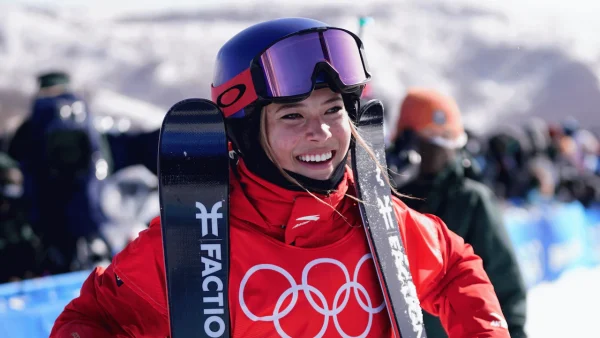
When Eileen Gu chose to compete for China instead of the United States in 2019, she fueled a long-standing global debate about identity, nationality, and belonging in modern sports.
Born and raised in the United States but competing for China, Gu has challenged traditional expectations of national allegiance. At just 18 years old, Gu became one of the most de orated Olympic freestyle skiers in history, and her recent performances in the 2026 Milano Cortina Winter Olympics have only intensified the conversation.
While Gu’s decision has drawn significant attention, she is not alone in navigating complex national identities in global sports. Athletes like Naomi Osaka, who represents Japan despite being raised in the United States, and Victor Ahn, who switched from South Korea to Russia and went on to win Olympic gold medals, have also made decisions about national representation that reflect deeper background considerations.
Gu made her Olympic debut at the 2022 Beijing Winter Olympics, where she won two gold medals in halfpipe and big air and a silver medal in slopestyle. At the 2026 Winter Olympics, she added another gold in halfpipe and two silvers in slopestyle and big air. With three golds and three silvers, she has cemented her status as the most decorated Olympic freestyle skier in history.
Gu said that her choice to compete for Chinar rather than the U.S. was rooted in connection and impact. In an Instagram post, she wrote that competing for China gave her the opportunity to “uplift others through the universal culture of sport” and introduce freeskiing to a broader audience. She also emphasized that the decision was tied to her childhood passion for women’s sports and gender equality, and her desire to encourage young girls and winter sports fans across a vast nation to follow their dreams (VNExpress).
Typically, to compete for China at the Olympics, athletes must hold Chinese nationality according to International Olympic Committee rules. Nationality, in this context, determines the country an athlete represents in competition, while citizenship refers to the legal status and rights granted by a country. China generally does not recognize dual citizenship, and there is no publicly confirmed information showing that Gu formally renounced her U.S. citizenship. This has led some critics, particularly in the United States, to question whether her representation of China aligns with traditional expectations of national allegiance.
Even though “many see her as an inspiration… others see her as challenging their beliefs about what she should represent,” according to The Gazelle, Fox News and other U.S.-based media outlets have labeled Gu a “traitor.”
This dynamic reflects broader debates in the United States about national allegiance and the expectations placed on athletes who compete for countries other than their birthplace.
Reactions to Gu are equally mixed in China. While many celebrate her success as a source of national pride, others have questioned whether her international upbringing and comments on issues such as using a virtual private network (VPN) herself, which she has discussed on her Instagram post following the 2022 Winter Olympics, reflect a level of privilege that distances her from the everyday experiences of Chinese citizens. In China, VPNs are heavily regulated and generally illegal without government approval, allowing the government system to control access to information, especially foreign websites and apps like Instagram or Google.

“A number of users fired back at Gu that Chinese citizens don’t have the freedom to just download a VPN to use apps like Instagram,” reported Yahoo Sports. “Some suggested that if Gu is in fact a Chinese citizen, a question that she deliberately has refused to answer, she is enjoying benefits that her fellow citizens aren’t.”
Gu’s multiracial background, having both American and Chinese heritage, provides important context for discussions about her Olympic affiliation. She spent summers in Beijing during her childhood, where she studied, visited family, and became fluent in Mandarin.
Essentially Sports has quoted Gu describing her identity saying, “When I’m in the U.S., I’m American, but when I’m in China, I’m Chinese,” reflecting her exposure to both cultures as she grew up. Understanding this background complicates critiques that frame her solely in terms of national loyalty, and highlights the challenges of navigating identity for Asian Americans and bicultural athletes.
Instead of adhering to strict guidelines, Gu has developed her own distinctive approach to her identity and mindset. In an interview with Fortune after the 2026 Winter Olympics, she described how she reflects on her own thinking and decision-making, using journaling and self-analysis to understand how she reacts and responds to challenges.
“With neuroplasticity on my side, I can literally become exactly who I want to be,” she said, highlighting her belief that intentional mental practice can influence both her performance and her understanding of herself.
For young people balancing heritage and personal ambition, Gu provides a visible example of how identity can be both flexible and empowering, rather than constrained by geography or tradition. Her story illustrates how success is shaped not just by dedication and skill, but by deliberate self-reflection and personal growth.
Gu is celebrated, criticized, and questioned, often at the same time. Rather than settling the debate, her career challenges the notion that belonging must fit within a single national or cultural box.
As she continues to compete and speak publicly about her experiences, the discussions around this controversial topic shows little sign of settling, reflecting how unresolved questions of identity remain, even beyond the slopes.