by Simon Fox ’24
October 25, 2023
The opinions expressed here are strictly those of the writer and do not reflect the views of University School of Nashville or the Peabody Press.
The Nashville Shakespeare Festival’s production last month of Much Ado about Nothing wasn’t your grandparent’s comedy…and definitely not your 10th-great-grandparent’s, who actually might have been alive when the play was written.
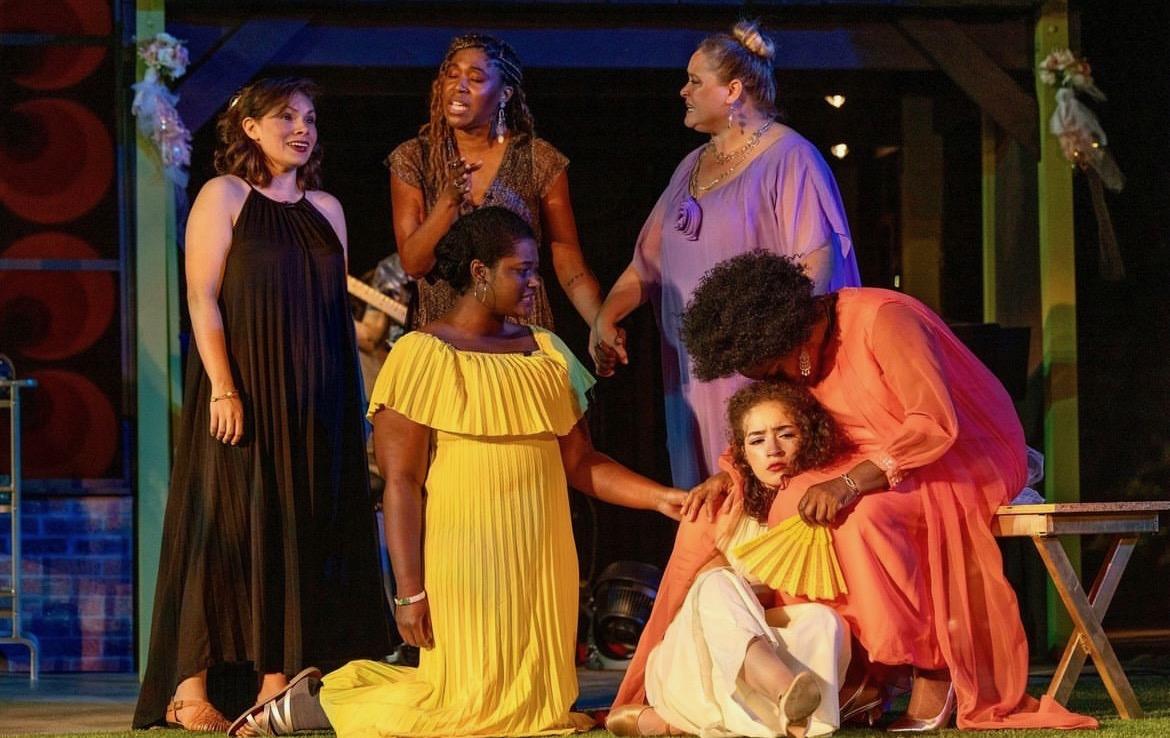
This local version of the classic tale of lies, trickery and romance was set in 1973 rather than in 1598, and some of the lead male roles were re-cast as female. The result is an entertaining story that translates well for today’s viewers, with a big help from popular songs of the 1970s.
“I liked the way they made use of the ‘70s music to help reinforce the themes of the play and the main actions in the scenes,” said Mr. McKay, who along with Dr. Wheeler, covered the play in the senior English seminar Secrets, Lies and Confessions. “I liked a lot of the costumes and I felt like the casting in most cases was really strong,” he added.
The cast features Hero, Claudio, Benedick, Beatrice, and princes Don John and Don Pedro, who altogether demonstrate how secrets and lies can be used for both good and evil. Several of the male characters – Claudio, Benedick, and Don Pedro – have returned from war to the city of Messina, where Hero’s mother, Leonata, is the mayor. On the eve of Hero and Claudio’s wedding, antagonist Don John tricks Claudio into believing Hero has been unfaithful. Meanwhile, Beatrice and Benedick have come to peace with the prospect that they will never have love or marry: “I will die a bachelor,” Benedick says in the play.
Nashville Shakespeare Festival feminizes the original script, especially by changing the author’s male character Leonato to the female Leonata. Since Shakespeare’s screen-writes don’t include stage directions, modern playwrights can take on their own interpretation of the 16th and 17th century plays. In the case of interpreting Leonato as Leonata, this strong female presence was further hammered home in the empowering opening scene with a terrific performance of Helen Reddy’s 1970s standard “I am Woman,” sung by the lead roles.
Jessica Penilton ‘24 found the changes in gender roles made the production much more engaging. “Seeing that Leonato was actually a woman that had a much bigger personality than the Leonato in the play was really cool,” she said. “The actresses did really well; they made the play really interactive.”
The modern music added an upbeat “twist” to the production. The performance brought “a fun musical twist…all of the music they played throughout and that little band they had in that little room was my favorite part,” Penilton added.
Wheeler had a similar reaction, but one colored by the familiarity of the music from her own youth.

“They were using the music of my early teenage years, which really resonated with me, and I thought they used it really well to bring out the humor of the characters in the play,” she said.
In contrast to the humor, the play’s climactic wedding scene had a more serious tone. Claudio publicly accuses Hero of sleeping with Borachio. Hero’s mother, Leonata, wasn’t having it.
One might think – or at least I thought – that with Leonato being the mother of Hero, rather than the father, her enraged response might have changed to be a more caring and understanding response in the play. However, this was not the case. Leonata was arguably more enraged by Hero’s actions.
McKay thinks Leonata’s response was fitting.
“She’s a part of that same system that believes that there are these certain measures of honor, and somehow Hero has brought ill repute to the family name and so [it makes sense that Leonata] would be upset,” he said.
McKay also noted that “the way Hero is shamed for supposedly being dishonorable” supports the idea that “it wasn’t just the men that persecuted; the women were also a part of that standard of belief, and you see that in the play.”
The Nashville Shakespeare Festival succeeded in entertaining Middle Tennessee aficionados of fine theater – and me (even if we didn’t get extra credit for attending since it is a grade less class!). Shakespeare’s Much Ado About Nothing had a good run last month here at One City’s amphitheater, before moving on to Franklin for performances in early October.