The opinions expressed here are strictly those of the writer and do not reflect the views of University School of Nashville or the Peabody Press.
Every April, screams fill my TikTok feed as videos of high school seniors opening college decisions from America’s most prestigious universities flood my screen.
In the past, I actively searched for college decision reaction videos as a form of inspiration. But watching these videos this year as a senior who just completed the admissions process has become disconcerting.
As these students recorded tears welling in their eyes and their parents’ screams of joy as portals loaded and confetti erupted from laptop interfaces, comments already began to pour in. “Stats and ECs?” “GOALS” “I’m applying early next year, any tips?”
What many commenters and viewers don’t know, and what the admitted students fail to say, is that they were a legacy at the school. Or they were a first generation student or underrepresented minority whose background afforded them a tangible boost in the selective college admissions process.
Although their achievements are real, these videos paint an incomplete picture and set unrealistic standards of what most high school students can expect to occur if they apply to several highly selective universities.
While college decision reaction videos are not inherently malicious, the problem is what these videos communicate at scale. When teenagers are constantly seeing TikToks of students getting admitted to Harvard, Stanford, Yale, MIT, and Columbia, schools with acceptance rates ranging from 3-5 percent, their frames of success become extremely warped. Of course the videos of students getting into these schools are the ones that will go viral, but these outcomes are by and large the exception, not the norm.
Unfortunately, smart and hard-working students across the world spend hours across their formative middle and high school years being bombarded with subtle messaging from pop culture references, Instagram reels, and YouTube videos that anything short of admissions offers to America’s ten most selective and prestigious universities is a failure. Acronyms like HYPSM (Harvard, Yale, Princeton, Stanford, MIT) and Ivy+ (8 Ivies + Stanford, MIT, Duke, and UChicago) dominate platforms like Reddit and College Confidential where stressed students and parents submit their and their kids’ profiles for random strangers to “chance.” College admissions, a once deeply personal process, has been reduced to angsty speculation, comparison, and a game of faking passion to win the heart of an unknown admissions officer.

Capitalizing on the overwhelming fear and stress of high school students and families navigating a highly competitive process with no objective rubric for measuring success until decision day, a growing number of recently admitted students with acceptance letters to a handful of elite universities quickly pivot from sharing results online to providing advice on building the perfectly packaged academic and extracurricular profile. Many begin offering 1-1 coaching for amounts ranging from $50 to $500—yes, $500—per hour.
Worryingly, virtually none of these recently admitted students have experience working in admissions offices, and they do not truly know why they were accepted to the illustrious colleges they’re planning to attend. There are so many factors outside of an applicant’s control when applying to highly selective universities. Admissions committees weigh geographic diversity, institutional priorities, athletic recruitment, intended major, legacy status, first generation status, and income background.
Moreover, substantial research and data suggests that many universities have continued to consider race as a factor in admissions despite the Supreme Court’s 2023 ruling that such practices were unconstitutional, although the extent of these practices appear to vary significantly by institution.
For example, a student from rural Idaho whose essay describing his experience working on a farm and wanting to study environmental science that moved a Duke admissions reader in 2023 is not a formula for getting into any top college. Each individual is their own person with their own unique context, background, experiences, talents, and interests. A peer consultant selling a packaged version of that story to a student from Westchester, New York is not offering mentorship, but rather monetizing a process they don’t fully understand.
More fundamentally, each elite university has a distinct identity shaped by centuries of history, founding principles, and the communities these institutions are rooted in. Stanford is well known to favor innovative, bold, and intellectually curious students solving the world’s most pressing problems related to their academic fields. On the other hand, Yale’s deep commitment to public service and humility is a driving force behind its admissions process. Harvard is not Princeton. Columbia is not Caltech. The extracurricular profile and portfolio of essays that resonate with one highly selective admissions office might mean nothing to another. Advice that treats these schools as interchangeable tiers on a prestige ladder misses the point and actively misleads the students paying hundreds of dollars to hear false information.
Beyond spreading misinformation and setting unrealistic standards for student outcomes, social media has done something potentially more damaging: it has turned college admissions into an aesthetic.
Acceptances are no longer private decisions but rather loud productions that romanticize elite universities to the public and have nothing to do with academics. Pinterest Boards fill with Harvard Yard in Autumn, flicks of hands wrapped around hot coffee mugs above Yale’s snowy campus in December, and Stanford’s seemingly perpetual sunny weather glowing above Spanish missionary-inspired architecture in the Spring.
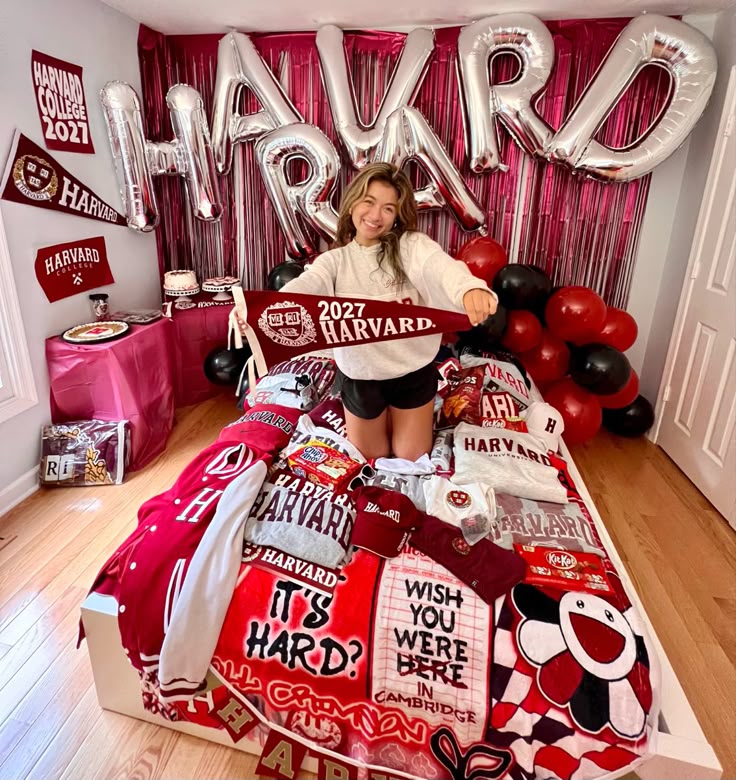
Instagram “Bed Parties,” viral trends where students decorate their entire rooms with excessive amounts of branded merchandise and decorated food items with the logo of the college they’ll be attending, emotionally encourage parents and friends into spending thousands of dollars — more than many families’ grocery expenses over several months — because students, especially senior girl, feel the practice becoming more and more normalized because of social media overexposure.

Culturally, these trends have resulted in college admissions becoming FAR more about brand and less and less about true fit. U.S. News rankings of universities have become proxies for students’ self-worth. Artificially deflated acceptance rates have become a measure of merit. Students who land at America’s top public universities or stellar liberal arts colleges with strong programs for their intended major, manageable debt loads, and cultures they would thrive in feel the need to apologize because the name of their school doesn’t land well in TikTok comment sections.
Media around college admissions has distorted our society’s perception of higher education. Research on life outcomes after college consistently show that what a student does with their education matters just as much if not more than the name of the school they went to. Fit for your academic interests, learning style, location, campus size, and financial reality should not be secondary afterthoughts after you think about U.S. News rankings and how much clout you’ll get when you post on your high school’s college decision Instagram page. These are the actual variables that will determine your college experience.
I am not arguing that elite colleges don’t matter, or that ambition is toxic, or that students shouldn’t celebrate their acceptances. However, I believe the social and popular media ecosystem around college admissions has become misleading, anxiety-inducing, and detrimental to students’ mental health, confidence, financial decisions, and their ability to find schools that will actually serve their interests.
If you get into an elite school, by all means, celebrate. But please consider what subconscious signals you’re spreading when you post a college decision reaction video. If you are thinking about offering advice (especially if it’s paid) to younger students, consider the limits of your knowledge and how other factors in your background or preparation outside of your direct control influenced your decisions, and how these same factors may not be applicable to other students. And most importantly, if you’re one of the hundreds of thousands of high school students consuming stressful college admissions content convincing you that the only way to get into Stanford is by paying $300 for the influencer’s course or online book, ask yourself who benefits from your anxiety, and whether the answer is you.
The best college for you is probably not the one with the lowest acceptance rate you can find. It is the one where four years from now, you won’t be able to imagine yourself having gone anywhere else. And sometimes, we as high school students don’t even know where that is until we arrive on campus. But there’s certainly no algorithm, reaction video, or pricey consultant who can tell you without a doubt that the only schools you’ll find happiness at are a subset of 10 universities that each accept less than 5% of applicants.