by Carmen Gaskin ’25
March 7, 2025
The opinions expressed here are strictly those of the writer and do not reflect the views of University School of Nashville or the Peabody Press.
The Super Bowl is bound to get anyone jumping, football fan or not. Between the game, absurdly comical commercials, party food and the halftime show, there are interests for everyone.
However, this year’s Super Bowl featured a halftime show that included not only a remarkable performance, but also potent political commentaries.
Kendrick Lamar’s Super Bowl LIX Halftime Show drew 133.5 million viewers–surpassing the record previously set at 133.4 million by singer, dancer, and songwriter Michael Jackson in 1993– and boasting a larger audience than the Super Bowl itself, at 127.7 million viewers.
In a slot that every previous artist has reserved mostly for record-breaking hits, such as Rihanna’s title track “We Found Love” at the LVII Super Bowl, and Beyonce’s “Run the World (Girls)” during her 2013 performance, Lamar only played cuts of his older songs, focusing instead on his new album GNX and recent diss tracks.
Released in the wake of his public clash with Drake, the album contains some of the most boastful, confrontational lyrics of the Californian rapper’s career.
In lieu of the pyrotechnical, singalong-stacked show characteristic of past Super Bowl performances – think Usher, Bruno Mars, Katy Perry – Lamar offered listeners a “televised revolution.”
Hinting towards a direct reference of the 1971 poem written by Gill Scott, “The Revolution Will Not be Televised,” in which Scott encourages readers to acknowledge true change will not be given to them by corporations, but rather, through a true change in one’s own mind and actions, Kendrick Lamar revealed a new lens.
The intricate theme of Black liberation was turned on its head by the rapper, forcing sponsors and brands to confront a reality in which America’s injustices are displayed on the main stage.
This musical revolution contained melodies honoring his West-Coast hip hop and Compton upbringing through its choreography and celebrity cameos, while also alluding to the hypocrisy of American politics and pop culture with overt costume and stage designing.
Prior to the ascension of Donald Trump, rappers and political right-wing leaders were not friends. They enjoyed – and often profited from – a mutual enmity.
Americans first witnessed the rise of political apprehension from hip-hop artists in the 90s, most notably the public dispute between rapper Ice-T, former President H.W. Bush, and Vice President Dan Quayle over the song “Cop Killer” released in 1992.
Sales of the rapper’s title track skyrocketed due to the controversy, as debates surrounding stricter media censorship policies steadily encroached the hip-hop industry.
As Ice T’s image of an anti-establishment figure solidified, Bush framed rap music as a key component to an immoral pop culture, a conservative base energized the need for law enforcement in predominantly Black communities.
For nearly 30 years, from the perch of his eponymous Fox News daytime show, political commentator Bill O’ Reilly has persistently used hip-hop to fabricate a conservative fear of Black Americans by conflating the musical genre with two elements: violent anti-Americanism and deliberate misogyny.
But this culture has shifted since Trump’s return to the White House, prompting an orgy of MAGA fever from musicians. Among those riding that wave? A host of notable rappers, including Snoop Dogg, Rick Ross, Nelly, and Soulja Boy, who returned to Washington for Trump’s inauguration.
The performance began with an aerial shot of the darkened football field illuminated by alternating symbols: a square, a circle, a triangle, and an X.
More than a few audience members noted the nod to Lamar’s life as a Playstation console controller, with a square representing paper, a circle and X representing “yes and no,” and a triangle displaying a person’s point of view.
Other viewers acknowledged allusions to the hit show Squid Game, in which poverty-stricken players compete in a series of sadistic games for a chance to win money.
Both references point to one main conceit for Lamar’s premise: the gamification of the elusive American dream, which for a large population of us, has become the “dream deferred,” as seen in Langston Hughes poem “Harlem.”
Lamar demonstrated this gamification theme when declaring between lyrics: “Forty acres and a mule, this is bigger than the music / Yeah, they tried to rig the game, but you can’t fake influence.”
“Forty acres and a mule” refers to the unfulfilled promise listed in Special Field Orders, No. 15 in 1865 to formerly enslaved African Americans after the Civil War, intended to provide them with land and resources for economic self-sufficiency.
The promise was the first systematic attempt to provide a form of reparations and estate tax to newly freed slaves, and it was astonishingly radical for its time. However, the order was short-lived.
Acknowledging the policy’s imperfections, Lamar extends the metaphor to indict America and white hegemonic power for falsely promising African-Americans a chance at financial, political, and social self-sufficiency since the 1800s.
Shortly after, Samuel L. Jackson appeared dressed as patriotism personified: the military recruitment propaganda character of Uncle Sam, welcoming viewers into the “the great American game!”
Every element of the show’s art direction, from set design to blocking to costuming, served to illustrate the friction between Lamar’s artistic identity as an inveterate truth teller, and the capitalistic demand for marketable, mindful content.
During the halftime show, Jackson’s Uncle Sam figure adopts the role of a high-status interlocutor, a character common in American minstrel shows.
The interlocutor facilitates dialogue between the performers, conjuring conversational “ceremonies” that lead the performance and engage the audience.
Thus, as Jackson’s portrayal of Uncle Sam breaks the fourth wall for communities currently living on the margins, and threatened by the new Trump administration, viewers witness the consequences of inequitable American domestic policies.
“No! Too loud, too reckless, too ghetto,” cried Uncle Sam, echoing individuals who habitually criticize Black critics of an American empire as ungrateful, arrogant, and uppity citizens.
Voicing criticisms of Lamar’s advocacy, Jackson declared that if one wishes to outplay the American game, he must “tighten up!”
This quote calls out a system that diminishes the cultural autonomy of Black individuals, suggesting that Lamar and other musicians must conform to the standards of a euro-centric society to achieve success.
The game may be rigged, but in the Superdome that night, it was Lamar and his larger ensemble who controlled the buttons.
Other viewers were reminded of several racial injustices–such as the gruesome murder of 17 year-old Jordan Davis, on November 23, 2012. Jordan was gunned down by a 45 year-old white man, Michael Dunn, at a gas station in Jacksonville, FL, after playing what Dunn labelled his “rap crap” too loud.
The quote could also highlight the murder of 28 year-old Sandra Bland, who refused to put her phone away during a 2015 traffic stop, stating that she had the right to record interactions with law enforcement. An altercation ensued between the woman and state trooper, who drew his stun gun and proclaimed “I will light you up. Get out. Now.”
Ms. Bland was aggressively forced to the ground and arrested.
The Texas Department of Public Safety stated that Bland had “[become] argumentative and uncooperative” during the arrest–too loud, and too reckless. Three days later, Ms. Bland was found dead in her jail cell.
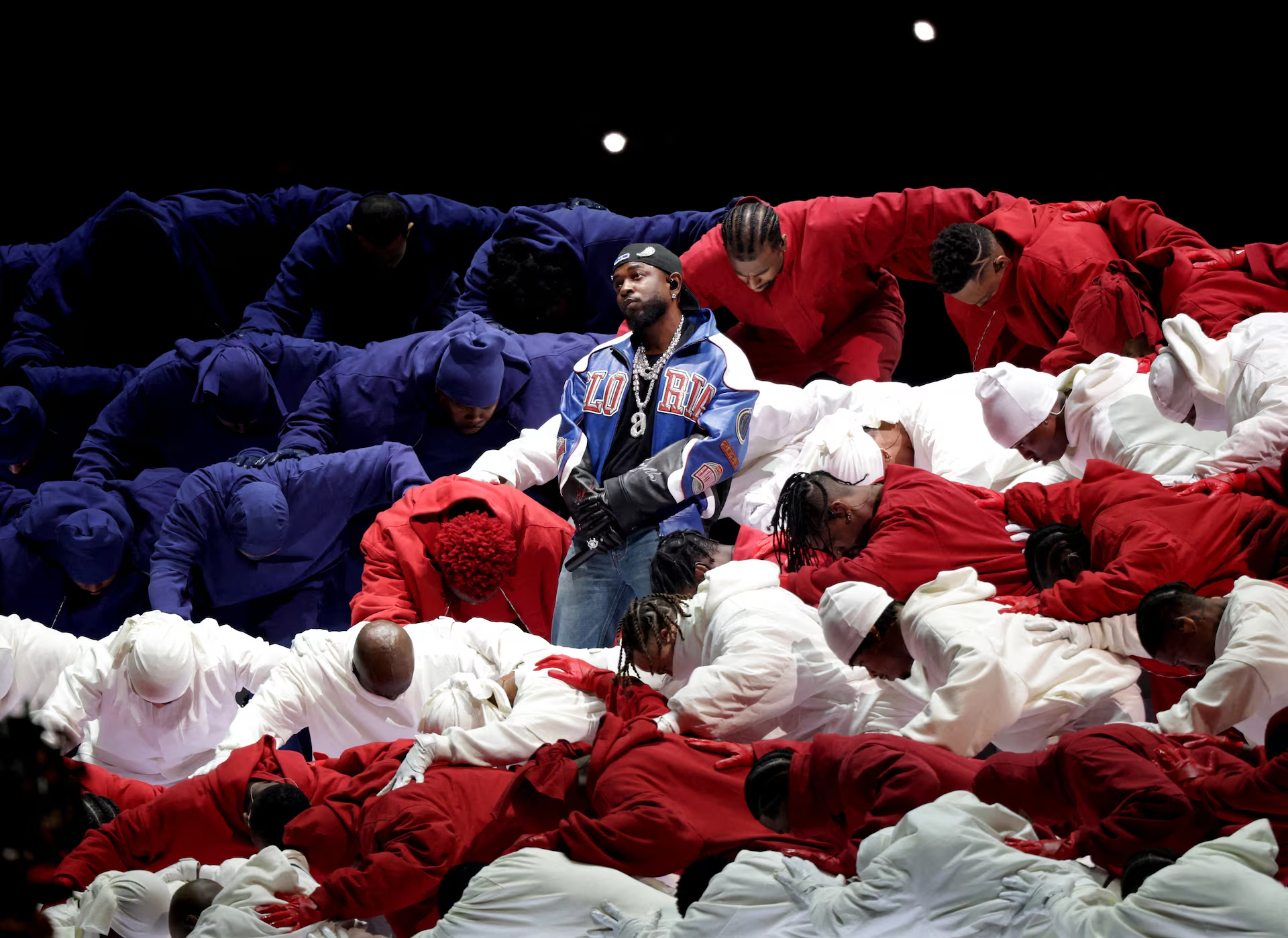
This sentiment perfectly set up the most resonant image of the halftime show: a breathing American flag as embodied by Black performers in red, white, and blue, a deafening reminder of the institutions built off the backs of the exploited.
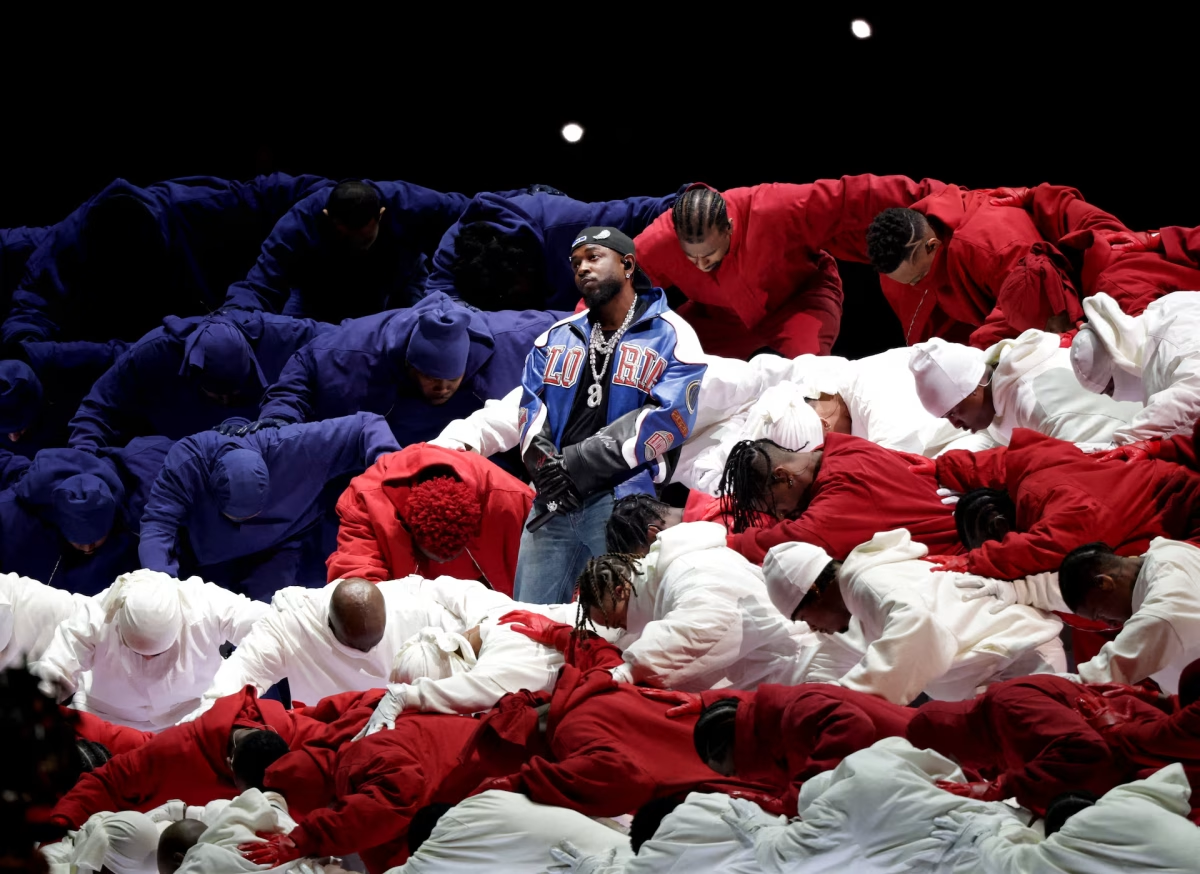
With Lamar situated dead center, the musician reframed the threat of a Black man in a hoodie through powerful iconography, portraying how freedom can look like, instead of what is usually plastered across our TV screens: dead or tattered black bodies.
Lamar’s bold positioning center stage suggests a world Black Americans continue to work towards: bold and unapologetic Blackness.
Starting this segment of the performance with his hit song “HUMBLE,” performers began to split the American flag in half, referencing the divisiveness of the country in the face of a new Trump administration and apparent political polarization.
Ironically, President Donald Trump was in attendance, the man many viewers argue is mainly responsible for the division of America. However, the split American flag may not have been the only reference to dissension in the United States.
The message “WARNING WRONG WAY” illuminated by lights in the crowd underscores the country’s regression, and ultimate diversion from a land of promised opportunities..
What followed the tense political commentary, was a concise theatrical narrative, employing Lamar’s widely publicized feud with Drake.
“Have you ever brought your enemy down with a poker face,” he rapped, sporting an enormous, disarming grin while imploring viewers to contemplate recent controversies surrounding Drake’s career.
Lamar knew the world was watching, anxious to hear “Not like Us,” the Drake diss-track turned No. 1 hit, depicting the Canadian rapper as a culture vulture and sexual deviant.
“I wanna make a move. I wanna perform their favorite song. But you know they love to sue,” he said in a mid-performance skit, in apparent reference to Drake’s recent legal threats against Lamar, alleging defamation. Universal Music Group, Lamar’s label, has described the allegations as “contrived” and absurd.”
Lamar then oscillated back to the improprieties of “Not Like Us,” flooding the stage with dancers for a deliciously petty coup de grâce. Tennis champion Serena Williams unveiled her “crip walking” across the stage during the diss track, reclaiming Black Joy.
Crip walking, also known as the “C-Walk,” originated in a 1970s Compton by first generation Crip members as a method of expression and communication with affiliating members.
Not only did it celebrate Compton, the hometown of Williams, the dance move triumphantly called-back the grand controversy she weathered in 2012. Williams, now retired, and the holder of a record-tying 23 Grand Slam singles titles, was reprimanded in the press for doing a celebratory crip walk at Wimbledon, after a defeat of Maria Sharapova in the Olympics.
The three-second celebration unleashed an onslaught of racial commentary, and a Fox News headline, “Serena Flubs Crowning Moment.”
Why must Black celebrations be mocked and condemned? Why must our successes accommodate the comfort zone of people who do not value or recognize our humanity? Why must our pleasures be caged? Williams gracefully answers each question with a culturally significant dance, reclaiming what should have been her glorious moment 13 years ago.
To dismiss Lamar’s performance as a misuse of a global platform in service of nursing a petty grievance is to miss the significance of exactly what Lamar is proclaiming.
As the right has grown all too comfortable with basking in the spoils of racial exploitation and a hatred of female bodily autonomy, the czar of hip-hop offered an under-appreciated lens into our tempestuous political climate.
There were, of course, dozens of other allusions and references throughout the show. If you found the show “boring,” or couldn’t quite catch all of them that’s okay.
For those of us who did, we got the message Kendrick Lamar. We heard you. We saw you–loud, clear, and abundantly Black.
Game over, indeed.