by Carmen Gaskin ’25
December 10, 2024
The opinions expressed here are strictly those of the writer and do not reflect the views of University School of Nashville or the Peabody Press.
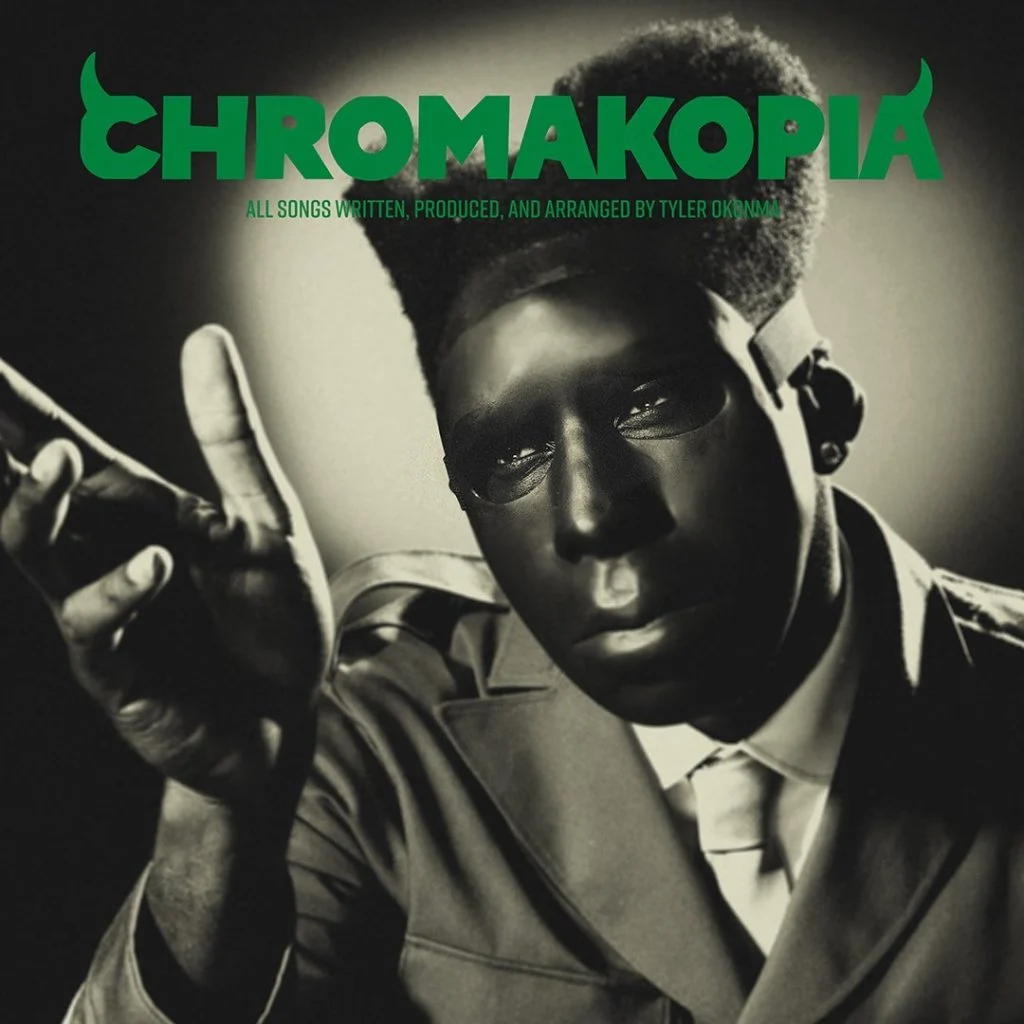
Three years removed from his last full-length album, “Call Me If You Get Lost,” Tyler the Creator returns with “CHROMAKOPIA”. Following a swift album rollout that saw release dates and tour locations scheduled all within the week of October 28, Tyler has wasted no time giving fans what they want. Tyler is mask-on and mask-off, unveiling an electric, raw, and perennially odd journey back into his aging psyche. Some standout tracks include:
Most Liked: “St Chroma” (ft. Daniel Caesar) (8.3/10)
A flute mimicking ululations sounds like a battle cry under militaristic stomps on opener “St. Chroma.” This loop of the flute is delivered in unison with other tracks, although inconsistent with the writing pattern of Tyler the Creator. The slow burn of the first two minutes, the subsequent explosion of sirens, and intense drum breaks introduce the lyrical section masterfully. Dismantling this brutality and aggression introduced at the beginning of the song, Daniel Caesar’s ethereal gospel vocals and modular synth, asking, “Can you feel that fire?” lead into an explosive midpoint and end the song, allowing listeners to traverse through time, and by the end of the song, find themselves in the heart of Tyler’s psyche.
Listeners witness Tyler’s struggle to find passion and individuality in the music industry through lines such as “Do I keep the light on or do I gracefully bow out?” and “Mirror got me thinkin’ bout my bookend.” This conflicted interest extends through the words of narrator Bonita Smith, Tyler’s mother, who voices, “You are the light. It is not on you; it is in you.”
“St. Chroma,” through the utilization of a variety of synthetic sounds, introduction of a personal narrator, and manipulation of lyrics to assign us a lens into his struggle, Tyler the Creator does an exceedingly excellent job setting the stage for “CHROMAKOPIA’s” later songs.
Most Introspective: “Hey Jane” (7.5/10)
“Hey Jane” shocks listeners with a topic incredibly intimate, vulnerable, and taboo. This track emphasizes Tyler’s vocals and his message rather than the instrumentation of the song, as often, he appears to sing in spoken word.
Tyler the Creator continues to navigate the difficulties of adulthood, although, this time, through facing an unplanned pregnancy on behalf of his significant other. The title of “Hey Jane” acts as a double-edged sword, as “Jane Doe” is often used to represent an anonymous individual, and Hey Jane is a popular reproductive and sexual health clinic that offers abortion care.
The song is also double-faceted, revealing the perspectives of both Tyler and Jane, an unnamed bearer of his future child, through conversational dialogue between both parties. These conversations reveal Tyler’s suppressed emotions, as he is “still in shock” from the surprising news, the reality of pregnancy, seen in the line “you gotta deal with all the mental and physical change,” uncertainty “that is not a good foundation to have kids,” and most importantly, reproductive freedom.
Although not as infectious as other hits, such as Earfquake or See You Again , “Hey Jane” ‘s soft instrumentals craft a beautiful, charming, and poetic song that guides its readers through the struggles of unexpectancy and deviation from an original path.
Best Single: “Noid” (7/10)
Tyler the Creator has gifted fans with the album’s first (and possibly only) single. Noid is an obtuse, experimental track, blending warbly synths and beats with a lyrical fixation on paranoia. Through a somewhat start/stop quality, with short bursts of guitar riffs and drums reminiscent of old-school funk, listeners are granted a breath of fresh air as Tyler explores foreign sounds not voiced in headline tracks from previous albums such as IGOR and Call Me If You Get Lost.
Alongside Tyler’s experimental sounds are the use of Zambian vocal performances (sampled from Nizakupanga Ngozi by the Ngozi Family), which jump from sound to sound. Like “St. Chroma,” “Noid” utilizes a slow burn to dramatize the juxtaposition of these different tones, ultimately emphasizing the overwhelming reality of stardom. His head remains swiveling as lyrics like “I think my neighbors want me dead / I got a cannon underneath my bed” address Tyler’s fears of trusting those around him amidst the controversies of his fame.
“Noid” does a spectacular job of addressing the unseen aspects of fame. After a lengthy introduction, however, the second half of the song falls into a familiar pattern of sounds with past Tyler tracks, leaving me admittedly disappointed.
Most Infectious: “Rah Tah Tah” (8.5/10)
“Rah Tah Tah,” the album’s second track, wastes no time getting bold. Contrary to the slow burn of “St. Chroma,” “Rah Tah Tah” ‘s high energy can be felt almost instantly through its channeling of the West Coast and Southern rap sounds Tyler grew up on. Many of these ties back to his childhood are found within the use of eerie, sci-fi synth and chants reminiscent of barking at the start of its song to punch listeners with militancy, confidence, and aggression in its first seconds.
Each lyric embodies the intensity of Tyler’s confidence, demonstrated through arrogant claims and comparisons of himself to other men. The first line of the song, which is repeated in the chorus, “She ain’t never met anyone who talks like that,” highlights the absurd confidence that plagues the song’s instrumentals, in which Tyler claims to have a singular, enticing personality that, outside of relationships with him, is hard to come across. While society often condemns such crass mindsets, Tyler insists this personality is something to be proud of.
Though the message of this song is not one of inspiration or reliability, “Rah Tah Tah” achieves its goal of being braggadocious, bold, and blunt. The song’s chaotic percussion, choppy 808 bass, and piercing synth chord progression keep the song’s energy red-hot, masterfully weaving a vibrant atmosphere for listeners to enjoy.
Most Heartfelt: “Darling I” (ft. Teezo Touchdown) (8.3/10)
“Darling I” stands out as one of the most introspective tracks on “CHROMAKOPIA.” It mirrors sounds presented in past tracks, notably Tyler’s 2017 album Flowerboy, with a warm, lively, and bubbly atmosphere. Through the layered use of wispy and high-pitched vocals, acoustic guitar strums, upbeat percussive patterns, and his signature warped synth, Tyler, the creator, constructs a world in which he must confront his imperfections and grapple with the emotional demands of love.
The smooth vocal performances of Teezo Touchdown and Bonita Smith brighten the song’s themes of love, individuality, and truth. However, the theme fails to reflect such bright qualities found within Touchdown’s lyrical prowess, as Tyler highlights his pessimistic views on love and struggles to find a relationship in which he feels secure. This contradiction leads to a clash of instrumentals and vocals, demonstrating the duality of navigating love: pleasantness until inevitable discontent.
Tyler’s reflection on love’s fleeting nature and his resistance to permanence, paired with fluid, smooth instrumentals and sounds, make this track a thought-provoking addition to his growing body of work.
Most Cultural: “I Killed You” (ft. Childish Gambino) (7.2/10)
Tyler has long been a Kendrick Lamar and Jay Z fan, as he performed at this summer’s Ken and Friends Juneteenth show and rapped over Jay Z’s instrumentals in album 4:44 in 2017. Given this, he was bound to address white supremacy through song someday. Surprisingly, the man who once declared he wrote music for “white friends with n***** friends who say the n-word” nails it on “I Killed You.”
The song begins as an interpolation of the children’s giddy “Wheels on the Bus” but soon becomes an interrogation of Western beauty. Djembe drums and intermittent horns line the song, placing listeners in an atmosphere reminiscent of a New Orleans street parade.
Through his lyrics, Tyler, flute in hand, urges Black people to embrace their kinks and dark skin and features a discriminatory world that tries desperately to stamp out: “You the room, baby, they the m*********” elephant.” These characteristics of a Black individual can lead to an inevitable distancing from a culture that defines you. “I killed you,” while referencing the violence African-Americans must endure at the hand of systematic oppression, transcends physical struggles and instead places emphasis on the “stigma” of being Black and, thus, an individual’s repression of their cultural identity entirely.
Childish Gambino’s melodic vocals challenge the notion that one must “kill” their identity to prosper and, instead, promote self-empowerment through the repetition of the phrase “just as beautiful.”
The message of “I Killed You” ’is electrifying, sending shockwaves to all who may fail to embrace their heritage. However, its sound does not produce the same effect. The first half of the song is characterized by chaos, which, whether intentionally or not, does not make for replayability. Its latter half’s sound is tinged with ethereal, feathery notes, combining fading vocals and peaceful strings, and the djembe’s melodic bongo pattern highlights themes of spiritual renewal, self-love, and forgiveness.
Most Cathartic: “Like Him” (feat. Lola Young) (9.3/10)
“Like Him” tastefully takes its crown as the best song on CHROMAKOPIA, with intense, masterful lyricism and beautiful harmonies of sound that follow a tranquil introduction.
Mirroring the introspective lens in other tracks like “Darling I” and “St. Chroma,” “Like Him” tackles a topic present in every Tyler album: the implications of an absent father. Through self-reflection, Tyler grapples with the mental hardships of lacking connection with his father and, further, resembling a man he barely knows, both physically and emotionally.
Tyler highlights his longing for understanding and validation from his father, saying, “Mama, I’m a ghost; I don’t know who he is.” This unveils an introspective journey of longing, self-discovery, and the inherited traits that connect Tyler to his father despite his absence. The track undoubtedly serves as a powerful meditation on how family dynamics, or lack thereof, shape one’s sense of self.
Melodies of soft piano at the beginning of the song set the stage for the chorus’s explosion of emotional intensity and vibrance, accompanied by various additional instrumentation, such as drums, hi-hats, and a distorted guitar.
This layered production of sound preserves the intimate nature of Tyler’s relationship with his father and, thus, marks “Like Him” as one of the best tracks in his discography. Ending the track with conversational dialogue from his mother with lines such as “It was my fault, not yours, not his, it was my fault” highlights the complexity of Tyler’s family dynamics and the maternal regret that accompanies shielding your child from the truth.
The album overall: 7.9/10
CHROMAKOPIA underscores adulthood’s hardships in a distinctive, imaginative, and thoughtful manner. Through brash beats and unique sounds, each track beautifully expresses the struggles Tyler experiences within the music industry and internally through tales of family and relationships, all while remaining polished. Therefore, CHROMAKOPIA has marked its spot as a top contender not only for future musical awards but also for an album that resonates in the hearts of modern hip-hop listeners for years to come.