

The opinions expressed here are strictly those of the writer and do not reflect the views of University School of Nashville or the Peabody Press.
In February, big tech CEO Jack Dorsey sent a letter to his company, Block’s, shareholders, alerting them that Block, the entity behind Square, CashApp, and Afterpay, was laying off roughly 4000 employees, nearly half of its total staff. Unlike most corporate executives who euphemize harsh news, Dorsey plainly labeled artificial intelligence (AI) tools as one of the driving factors behind his decision. Following the announcement, criticism about AI’s impacts on the job market exploded as there became more and more fear over how the growth of complex machine models would negatively impact current and future workers’ job opportunities.
These concerns have not just been confined to the tech industry. According to a Goldman Sachs Report, AI may affect nearly 300 million jobs by 2030 (coincidentally, the year that this year’s high school seniors will graduate college and enter the work force). More concerningly, AI is estimated to fully replace 85 million jobs worldwide, and women face nearly three times the risk of their jobs becoming automated in comparison to men, highlighting stark gender-based disparities in the impacts of AI on employment. Worryingly for young people, the roles most at risk are the ones that recent graduates have long used as entry points into their professional careers. Translators, writers, and customer service representatives rank among the positions with the highest AI applicability scores, according to a 2025 Microsoft Research Report, meaning that these jobs most align with tasks AI already does robustly on its own. JP Morgan CEO Jamie Dimon confirmed in 2025 that the bank had already automated 20% of its back-office positions, the kinds of prestigious entry-level finance roles that generations of business grads looking to break into one of the most respected roles in their field have relied on.
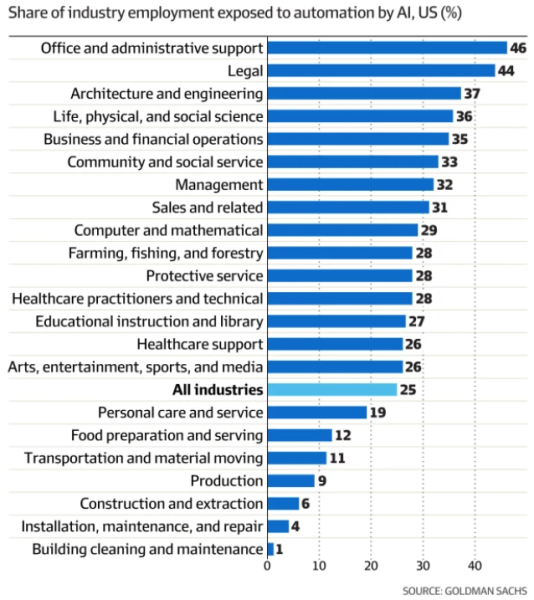
However, the role of AI in replacing jobs is more nuanced. For example, Goldman Sachs also predicts that the rise of AI will create 170 million jobs, and additionally net 78 million. The World Economic Forum identified nearly 350,000 emerging AI-specific roles, such as prompt engineers, AI ethics officers, Technology Policy Lobbyists, human-AI collaboration specialists, and other positions that did not exist a decade ago. Furthermore, hard data illustrates that only 4.5% of layoffs in 2025 actually cited AI, and one field expert finds that about 59% of hiring managers admit to using AI as a cover for job cuts that were actually primarily driven by over-hiring, pressure to cut costs, and organizational dysfunction issues that largely arose during the Covid-19 pandemic and following quarantine.
While there is certainly a lot of anxiety (and fear-mongering) about AI taking over the job market, history has repeatedly demonstrated that while major technological shifts can massively disrupt industry and economies, they typically do so in a way that transforms the type of labor society values. For example, during the Industrial Revolution, machines replaced thousands of traditional agricultural and factory jobs, causing widespread panic amongst the lower and middle classes of society, but the Industrial Revolution also created new industries in manufacturing, transportation, engineering, and business. Similarly, when computers automated a lot of repetitive and clerical office jobs in the late twentieth century, they also generated millions of new jobs in software development, cybersecurity, and technology (careers which also typically paid significantly more than the jobs they replaced). I believe that the rise of AI’s impacts on the job market will follow a similar trajectory.
Instead of entirely removing workers and engendering mass layoffs, many companies have re-worked job expectations with the expectation that employees are able to work alongside AI tools in order to increase productivity. For example, many graphic designers are now using AI-assisted image generation platforms and many law firms across the country have begun to utilize specialized AI software to summarize large quantities of legal documents. So rather than eliminating these professions, AI is changing what skills are most valuable in the job market. New grads who best understand how to integrate AI tools into their work processes will almost surely become more competitive than those who refuse to adapt to rapidly evolving technology.
Ultimately, the discussion around whether young people should be panicking about AI taking over their jobs is multi-faceted. While college students and new grads should expect to see impactful changes in the job market, Americans can also expect AI to create massive new industries that will require new skills and a new force of young people to help take charge. Adaptability, creativity, and a willingness to continuously learn may prove to be as valuable as knowing the most technical skills. The workers most at risk for AI replacement are not simply those whose jobs can be automated, but those who are unprepared for a workforce rapidly evolving around them.