The opinions expressed here are strictly those of the writer and do not reflect the views of University School of Nashville or the Peabody Press.
“Romeo and Juliet” is a play marked by its approachability in both language and messaging, and therefore tends to be one of the only Shakespeare plays that the majority of people read and thoroughly understand.
“Romeo and Juliet” was not a story completely originally conceived by William Shakespeare. It is a story that had been passed around for nearly 160 years before Shakespeare wrote his version, first by Italian authors, then French, and then the English, by Arthur Brooke in 1562, who then inspired Shakespeare around 1597.
Belmont’s fall production was influenced by “repetitions of related words: death, grief, fate, fortune and misfortune, time, clock, stars, doom and doomsday,” according to director Traci Ledford.
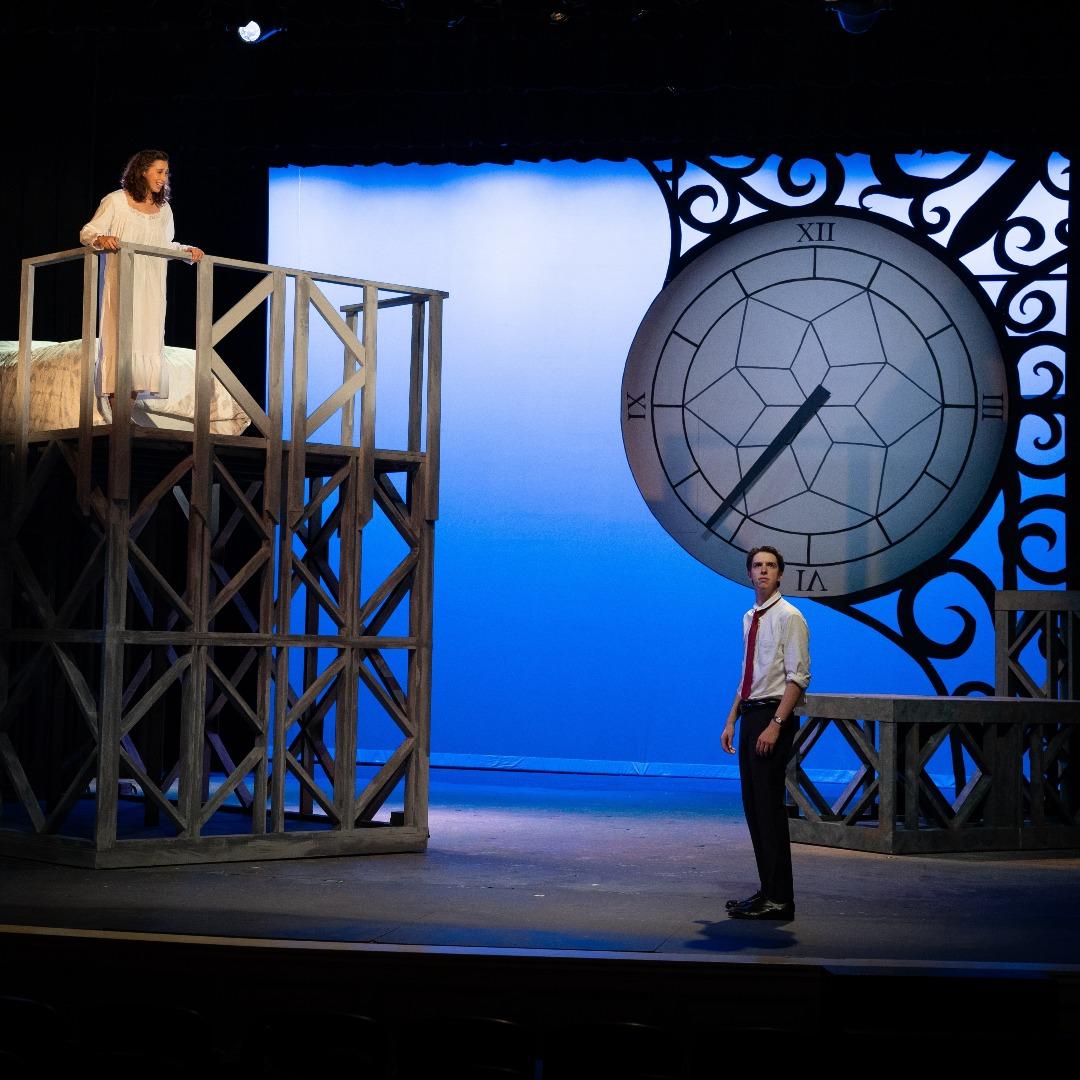
These ideas cumulated into the concept of the massive, ever-present clock that haunts the production’s backdrop, modeled after the Doomsday Clock, which was created in 1947 after the looming threat of worldwide catastrophe that was introduced in WWII. It began at seven minutes to midnight, chosen by artist Martyl Langsdorf, simply because it looked nice artistically. The Doomsday Clock has moved backwards in time eight times since it was created. At press time, it currently rests at 89 seconds to midnight, the closest it has ever rested to the end of the world.
The Doomsday Clock in Romeo and Juliet counts down to the lover’s deaths, Juliet’s in particular, as it does not hit midnight until she kills herself after her husband. The Doomsday Clock — both the one in real life and the version in Romeo and Juliet — does not count time in the same way an ordinary clock does.
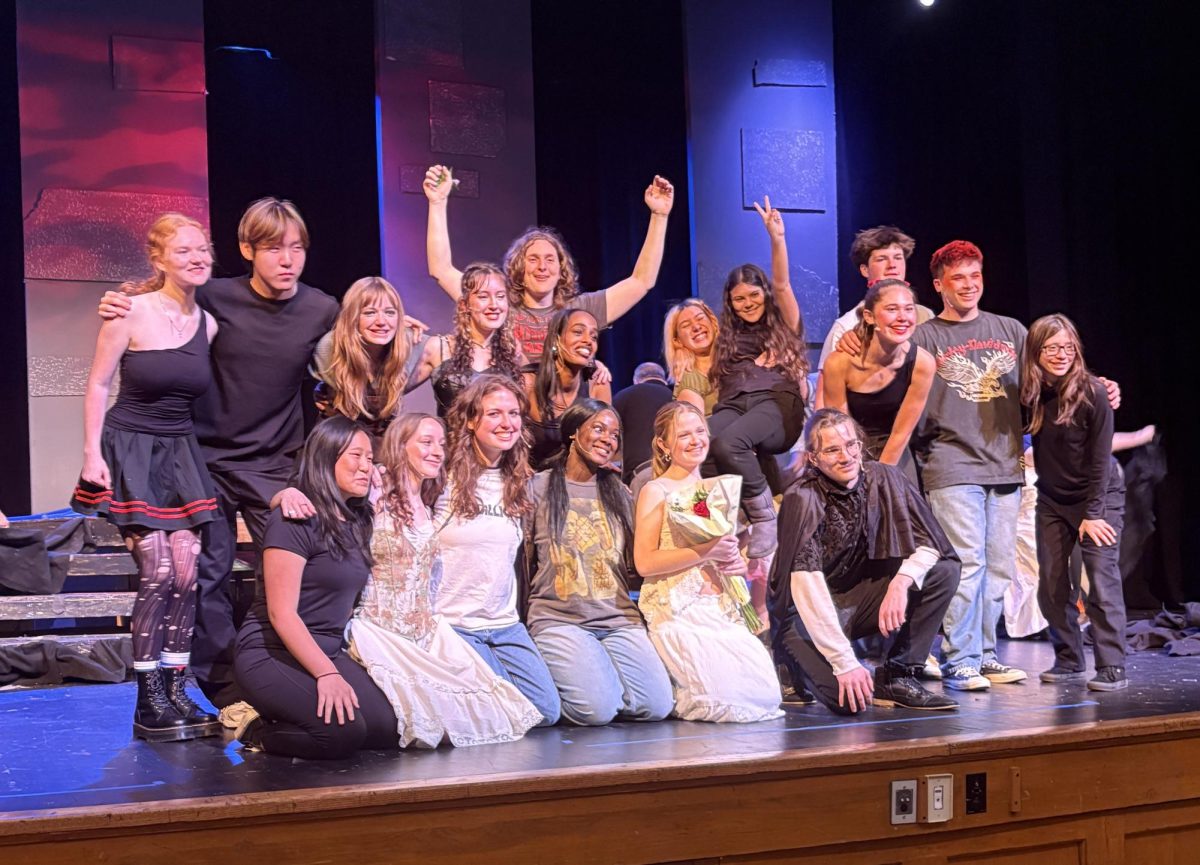
Belmont’s take on the classic scene where the doomed lovers decide to get married. (via Belmont CPMA)
The end of the world is not inherently inevitable, and can be put off, and maybe even prevented. “Romeo and Juliet” takes it a step further. Maybe, after the world has ended, we can still begin anew.
“A glooming peace this morning with it brings,” Prince Escalus says in Act V, scene iii, the play’s final scene.
The tragedy is not inevitable, but rather, the effect of dozens of actions taken by dozens of characters along the way. This production is about more than just two lovers, but also the people around them who enable, pressure, and encourage them along different paths.
The Doomsday Clock also provides a framework for the rest of the production of “Romeo and Juliet.” Costume designer Sydney Tripp writes “Setting Romeo and Juliet in a different time period in itself is not a new concept; however, Traci’s exact vision was so precise and genius that I had to get to work on costumes immediately.”
The costuming of this production does a great job of fitting in with the eras of the 40s and 50s and also of helping the audience understand the story. The Capulets and their staff are dressed in shades of blue, grey, and black, while the Montagues and their allies wear red, yellow, and brown. This simple choice provides a visual guide for viewers who might have a difficult time tracking characters and their names.
When Tybalt kills Mercutio, and Romeo kills Tybalt in return, it is simple to track that a blue-vested Capulet has slain a yellow-dressed Montague, and that a red-shirted Montague has sought vengeance.
This visual cue provides not only ease of understanding, but a glimpse into the character’s interiors. When Romeo is banished and renounces his name, he no longer appears in red, but in gray and blue, the colors of the Capulets. These costuming choices do a lot in the way of modernizing and contextualizing the play.
Another highly-debated aspect of “Romeo and Juliet” is the snappy shift in tone, from teenage romance, dancing and merriment, and the teasing of cousins and friends to murder, horror, and suicide. The artistic abilities of Belmont’s production team fully shine when visualising this tension and other literary devices throughout the play.
When Romeo and Juliet first lock eyes while dancing at the Capulets’ feast, the lighting, sound, and choreography change in an instant, from a lively group dance to a slow and eerie waltz, spotlights shining on the lovers and darkness covering the rest of the party as the clock makes its first move towards midnight.
Later on, when Capulet is angry with his daughter for her opposition to his plan to marry her to Paris, his wife steps in and he hits her across the face.
Then, after the lovers are dead and reparations are being made between the families, he kisses her on the cheek, and she flinches in the exact same way as when he had hit her. This is a powerful visual representation of how quickly the mood of the story, and its characters, can change. While their attitudes can be fickle, the results of their actions are very permanent.
The Belmont production of “Romeo and Juliet” is an artistic rendering of what was intended as entertainment with a moral lesson at the end. Through decisions in setting, costuming, acting, and characterization, the Belmont production team brings to life not only a memorable, funny, and romantic show, but one that asks the audience to reflect on the commonly-invoked trope of inevitability both in the story and in real life, and what we may be overlooking when we frame “Romeo and Juliet” as a single narrative with a single driving motivation.