by Charlie Hall ’27
March 4, 2024
The opinions expressed here are strictly those of the writer and the people interviewed and do not reflect the views of University School of Nashville or the Peabody Press.
It’s been a little over a semester since USN’s new grade book policy of hidden averages went into effect. USN is an academically heavy school, and one of the goals of this change was to reduce student anxiety caused by grades.
“I think what was happening was some students were getting really dependent on looking at their grades multiple times a day, and that can lead to some really negative behaviors academically…by closing gradebooks and making [students] work in a holistic manner, the hope was that [students] would work at what was in front of [them] instead of how is this one thing going to affect the entire semester,” high school math teacher Jason Shuster said, “It became unhealthy for some students, this was the minority, not the majority.”
So does the school need to change this in the interest of the majority of students?
Years of results from students in the Authentic Connections surveys showed how stressed students are over their grades.
“High school students worry about grades more than anything else in their lives,” Jeff Edmonds, assistant head of high school for academics, said. This was the reasoning for hiding averages.
“Tracking the day-to-day movement of that average generates more stress than understanding,” he added.
“I felt more anxious because that’s how my brain works… There could be an assignment bringing my grades down and I wouldn’t know about it for a long time,”Jack Barocas ‘27 says on the new grade book policy. “The reasoning behind people caring too much about their grades doesn’t apply to me, for somebody like me who has trouble caring about their grades. If I can’t see that average score, it makes it more difficult to put more effort in and show some interest.”
While it is still possible that students can go to a teacher or advisor to see their averages, it adds an obstacle to access information that was previously a click away.
“It seemed inconvenient to go see my advisor all the time,” Jack Fruin ‘27 said on why students didn’t take advantage of seeing their averages from an advisor. Fruin considers himself as part of the minority that benefited positively because of the hidden averages.
“It puts less stress on the students from their parents, and they sort of had an idea of what their grade was,” he said.
Even though Fruin felt positive about the new gradebook policy he still believes that more frequent snapshots would benefit everyone. That was a shared opinion among students.
“[I would argue for] more snapshots, more often,” Ayla Acra ‘27 said.
More ideas that students thought could work were to only hide the averages during the school week to stop kids from being hyperfocused in the grade book during the day.
It seems that the school intends to reduce stress from the minority of students constantly looking at the gradebook works.
Acra was part of that group of students saying, “I used to check maybe three times a week or after a quiz…It gave me less stress than when we always saw our [averages].”
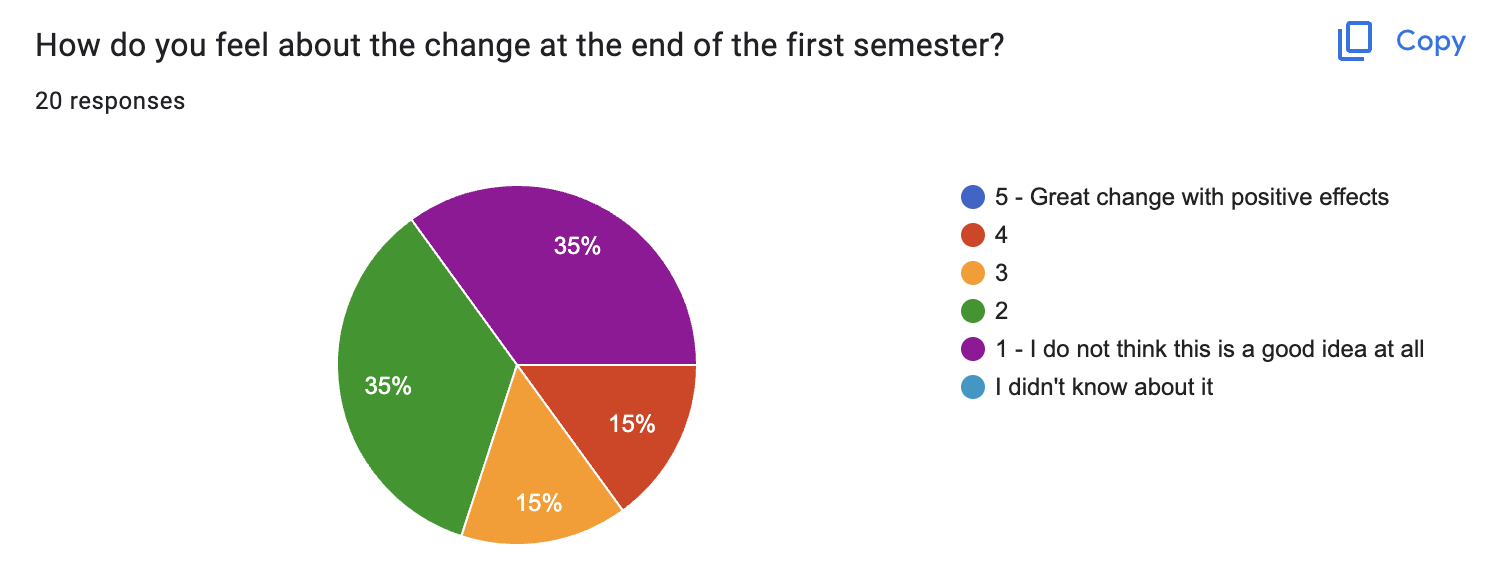
The Peabody Press distributed a survey was asked of 40 students at random, and received 20 responses, about the visibility of cumulative averages. The students rated how they felt after the change at the end of the first semester 1-5 (5 being a good idea and 1 being a bad idea). More than 60% of the respondents ranked a 1 or 2, and only 15% said it was a 4 or higher.
They were also asked how many times they went to see their grades from a teacher or advisor, the average was two times during the first semester. Only 11% never reached out.
The students also shared ideas for what they would do if they were in charge of the gradebook. The overall consensus was more snapshots, or people choosing whether they want it to be visible.
There are many directions the school could take from here but it is clear that there needs to be a change in the future in some form.
Edmonds understands this and is expecting to adjust the policy moving forward. Recently, he assembled a focus group of class representatives to solicit their feedback.
“Students trust us. For a new policies, [we] won’t get it right the first time. Changes are coming,” Edmonds said.
Students, unsurprisingly, have thoughts on what that change should look like.
“I would have a snapshot during or close to the exam period, as I found myself spending a lot of time calculating what my grade was in the class and what I needed to get on the exam based on that calculation, rather than actually studying for my exams,” Caroline Keiper ‘25 wrote on the survey about what she would do if in the position to change the grade book without removing it entirely.