The opinions expressed here are strictly those of the writers and do not reflect the views of the Peabody Press or University School of Nashville.
With students out of the school building for the foreseeable future, now seems like the right time to reflect on the schedule changes put into effect last August. When the schedule was first introduced to students at the end of last school year, there was a lot of discussion surrounding some of the adjustments made by the Use of Time Committee.
At the beginning of this year, I didn’t think that the late 8:25 start would affect much or change my habits. With siblings in middle school, sleeping in wasn’t an option; they still start at 7:55. In the mornings, however, before the first class, there is more time to talk to friends and finish up work. The later start took a while to get used to, but I’ve learned how to use it to my advantage.
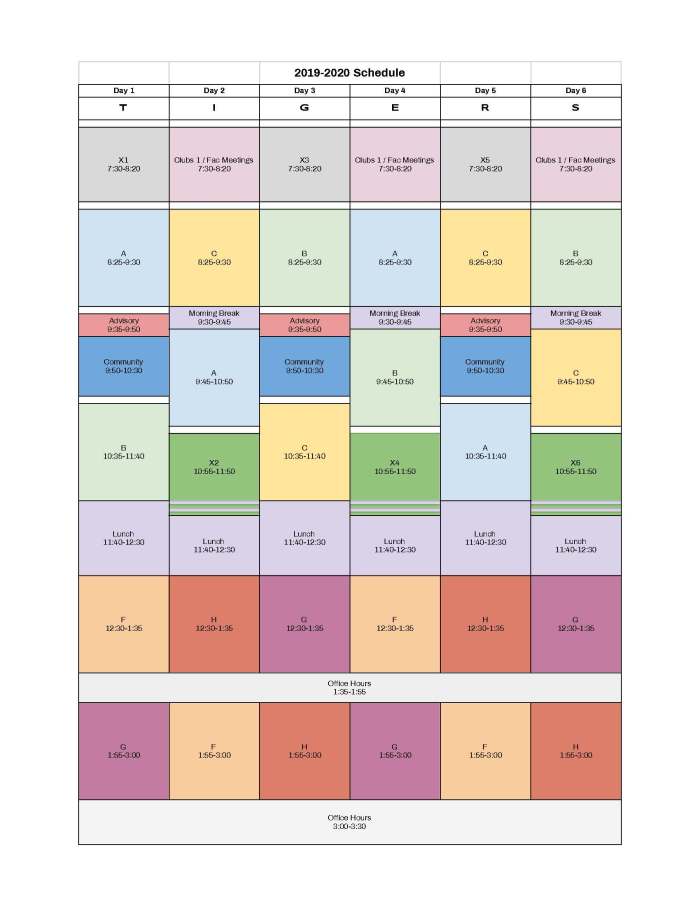
For the first quarter of the year, it seemed like I often heard complaints about how classes had been cut short with the new schedule.
In 2018-2019, for every 30 class meetings, we had 1800 minutes (30 hours) of instructional time for each class last year. This year, we have slightly over 1950 minutes (32.5 hours) of instructional time in 30 class meetings. However, it takes us longer in actual calendar days to get 30 class meetings, because each class meets less frequently. Last year, a “normal” month (4 weeks of 5 days) would have 16 class meetings (4 per week), where this year we have 13-14 class meetings in the same time frame.
Another way to look at it: Last year, we had four hours (240 minutes) of class time per week for each class. That is an average of 48 minutes per day. Now, with the six day schedule, we have four hours and twenty (260 minutes) minutes per six-day cycle, or an average of 43.3 minutes per day. That’s a difference of about five minutes per class per day.
Still, as the year went on, everyone seemed to adjust.
Before we put this schedule into practice, another thing I was worried about was the rotating schedule. I was worried that I would never know what day it was, and that I would show up to the wrong class. While I’ll admit that I’ve definitely walked into the wrong class on multiple occasions, that would have happened no matter what. I don’t really ever know what day it is, but it’s easy enough to just check my phone in between classes to see my schedule, ask someone with the same classes as me, or simply rely on my muscle memory to take me to the right class. The new schedule doesn’t include any days where all six classes meet, which made Mondays and Fridays stressful last year.
The new schedule has much more time in between classes than before. In previous years, it was hard to get to each teacher to ask questions after school with tutorial lasting only 30 or 40 minutes. For many students, sports start at 3:30, and incorporating time to change and get to the bus or car to drive to the river campus or an away game, there were only 10 or 15 minutes left, on a good day, to ask teachers for any help. Before school was also not much of an option to ask for help, with school starting at 7:55. The new schedule allows students to meet with teachers at several points throughout the day including before school, morning break, community time, and office hours, both before the last class and after school. These frequent breaks also set aside time for students to slow down amid the business and stress of school work, and spend time talking with friends and classmates. Clubs also have more times to hold meetings–they were limited in years past to meet during lunch or after school.
Community Time has also been beneficial. While we would have grade-wide meetings after school last year, now they’re built into the middle of the day, so they can’t run too long. When we have them free, I get to hang out with my friends and get time to relax between classes. I’ll admit, I was skeptical about it at first, especially since I didn’t know what community time was going to be used for, but it’s been really useful to me so far.
A downside to the new schedule may be for students who are enrolled in a block elective. Having X free leaves them with a free period only every other day. On T, G, and S days, community time replaces X, but is often filled with meetings or assemblies of some sort. The old schedule had both D and E free with a block elective, which gave these students the same amount of free period, more or less, as students with block periods free.
Another issue with the new X period is that students have fewer class options for non-academics. One of the main goals of the new schedule was to focus more on taking breaks between academic classes and focus more on allowing students to learn in the best environment possible, so this seems counterintuitive. For me, I had to choose between taking an art class and taking journalism, when I could have taken both last year. I decided to take an art class first semester and journalism second, but the old schedule would have allowed both. I probably won’t take any art classes next year, even though I enjoy them, because there’s no room in my schedule. When I take art during a block period, I have to have X free, but it just isn’t as often or as long as having a block free, so it doesn’t feel worth it.
Despite these drawbacks, the new schedule has more positive aspects than negative. The six day rotation, frequent and longer breaks between classes, community time, and more have all been useful to both teachers and students. After watching it play out for almost a year, I think we can say that the Use of Time Committee did a good job working to benefit our community and our schedule.



Quinton Walker • Apr 16, 2020 at 11:19 am
Julia + Latham–
Thanks for the great work on the article. It’s nice to know through your journalistic viewpoint that the new schedule and use of time work has been worth it. I appreciate, also, the balance of the article, citing some of the drawbacks to the schedule for the year. Thanks for taking the time to write a balanced and thoughtful piece!