The opinions expressed here are strictly those of the writer and do not reflect the views of University School of Nashville or the Peabody Press.
As USN students prepare for exams, stress starts to be norm. Studying and worrying about grades becomes the status quo. But as Assistant Head of High School Jeff Edmonds said in our last assembly of the semester on December 4, “Exam week asks a different question: How well can you bring the learning together?”. So if it’s time to focus on learning, why are we so worried about grades?
Before a test, teachers often give their students tips on how to remember pieces of information: acronyms that stand for concepts, specific facts to write down as soon as we get it, and other mnemonic devices.
These tips, while welcome, make me feel a bit disillusioned with the education system. I always wonder what we’re really learning here at USN.
In one sense, the instructors are definitely teaching us important concepts about science, math, history, and anything else we’re taking classes on. I now know a whole lot more about chemistry than I did six months ago.
But in another, we only learn what we need to in order to pass a test. The memory tricks don’t help us learn concepts, they help us learn specific things that we need to know to get a good grade.
Those specific things do have some value, though. Whether a student learns because of grades or because they want to learn doesn’t really matter as long as they’re learning. But according to students at USN, grades aren’t the only source of motivation.
To find out where motivation was coming from, the Peabody Press took to the halls of USN and asked 12 high schoolers across multiple grades some questions about academics at USN. 10 of them told us that they felt motivated to learn at USN, with six of those 10 citing interest in school subjects. Three said that learning was what they were here to do, and two more (one of which also said interest motivated them) said that grades were their primary motivation.
Even for the students who weren’t motivated by grades, stress caused by grades was ubiquitous. 10 of the 12 students said that they had been experiencing stress due to school recently. Four of these students stated that grades were a primary source of stress. Those who didn’t listed exams and tests as their main stressors, essentially an extension of grade-based stress.
Finally, eight of the 12 said that they would still be equally motivated to learn if grades were not a part of the learning system, and two more said that they would be motivated to a lesser degree. Interestingly, only six of them expressed a desire to actually get rid of grades.
Of course, a 12-person survey isn’t comprehensive, but almost every student at USN takes the Authentic Connections survey twice a year. The data from this survey presents a more comprehensive image of how USN students feel about grades.
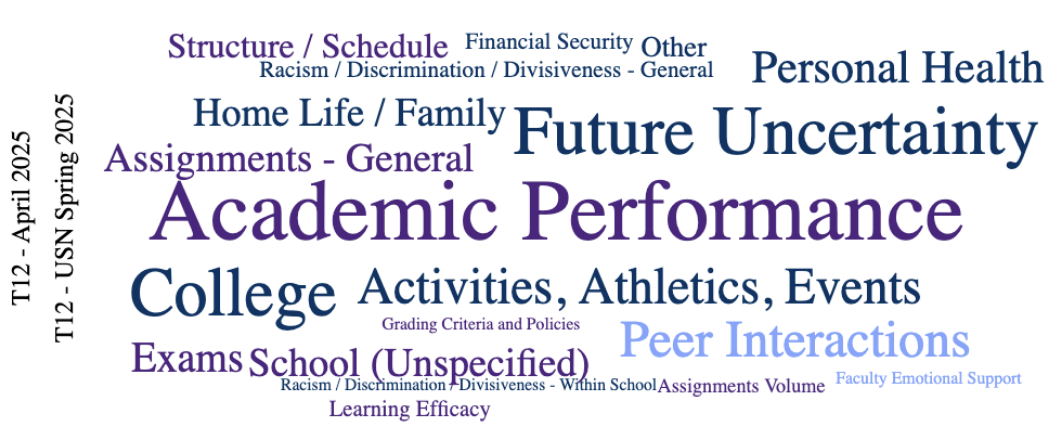
First is the free answering section. In response to the question “These days, what are you most worried about?”, students tended to answer something concerning their academic performance.

Students also answered questions about the emphasis placed on grades with a mix of responses. While there was some variation throughout grades, about 50% of students answered that too much or far too much emphasis was being placed on grades.
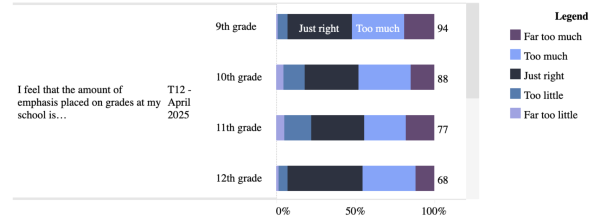
Take a step back and think about those responses. Both one-on-one interviews and a survey taken by almost all of the high school found that for most students, grades were the most stressful thing about school at USN. Additionally, half of all students want USN to get rid of grades, or at least reduce how much we rely on them.
Surely, a system that actively stresses students to the point that many of them want to get rid of it should be considered a bad system. But four students responded that they would be less motivated to learn without any grades at all; so abolishing grades completely would definitely lower productivity among students.
The solution is to find a system that specifically rewards learning, not just test performance. A good example of this is the Mastery Transcript.
Launched in 2017, the Mastery Transcript Consortium is an association of schools that works to promote learning based on what students actually know, rather than what their grades say. Their transcript model allows for more flexible goals for students, focused on actual understanding of subjects.
While a complete overhaul of the grading system might not be viable for USN, we’re already shifting away from the test-based approach in English.
The Fall 2026 English 10 exam will be not a test or an essay, but a graded discussion. Students will be put in a room and discuss everything that they’ve learned so far in English 10 in relation to all the materials they’ve discussed. A significant portion of the grade will also be preparatory work students do to prepare for the discussion.
This kind of exam rewards not just knowing raw information, but actively using skills taught in the class. Applying this approach to other classes at USN could take some of the pressure off students while using grades based on what they actually learned, rather than just the facts they can memorize.
History classes also apply skills like document analysis in tests and exams, but this can be extended: science classes could incorporate lab experiments and data collection, and math classes might work on logical reasoning. Language classes might have more of a focus on real-world conversational skills, rather than writing sentences on a page.
Of course, I’m not an expert on learning. But the data makes it clear that the current system doesn’t work–it creates unnecessary stress while providing minimal benefits. A solution like the one suggested above could be adapted however teachers see fit to create an environment that actually facilitates learning, and not just rote memory.