by Bronson Schmidt ’25
September 26, 2023
The opinions expressed here are strictly those of the writer and do not reflect the views of University School of Nashville or the Peabody Press.
In the first few weeks of school, we’ve already seen a lot of big changes roll out. Dress code reforms, attendance repercussions, and grading policies have all been tweaked by higher-ups in the USN ecosystem. In this transformative landscape, the grading policy changes are a great example of USN’s polarizing reactions to change, and how communication affects them.
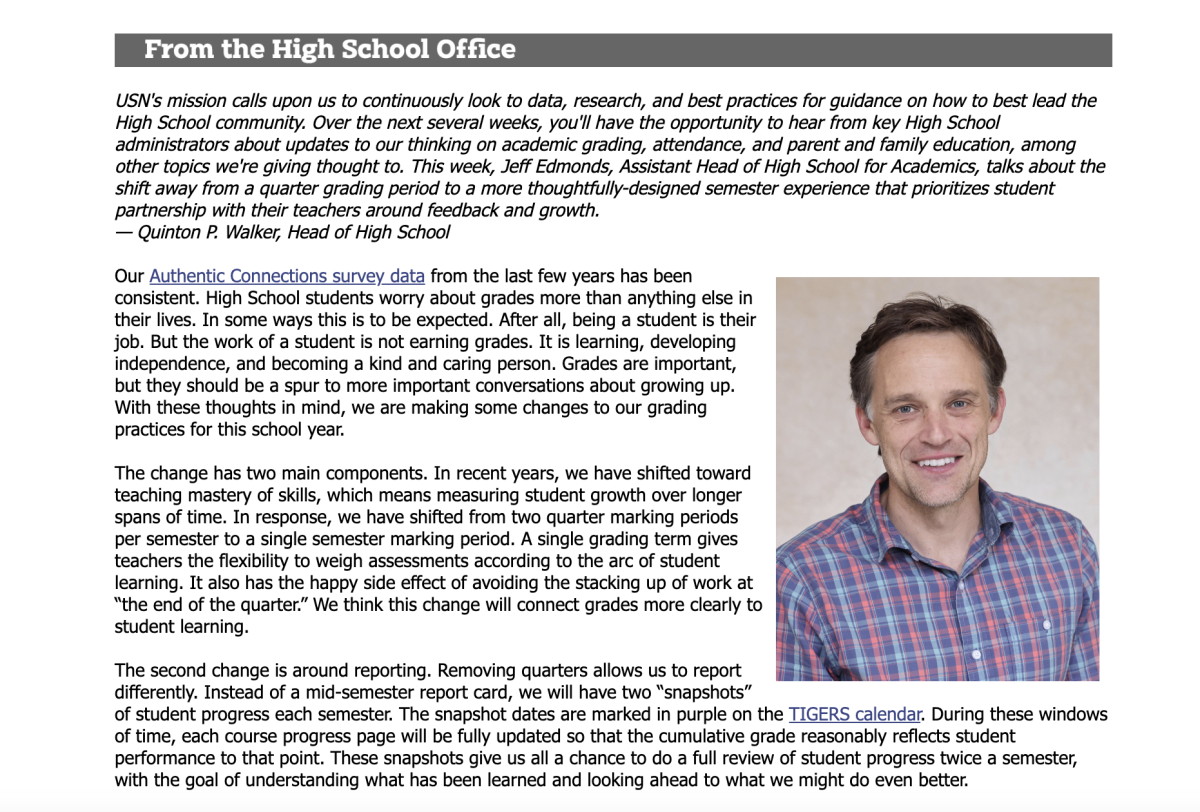
In a nutshell, students are no longer allowed to view their cumulative average in their progress page, instead only knowing their grade by asking a teacher or waiting until a “snapshot”; these snapshots come three times per semester, replacing quarters as a new way to hold students and teachers accountable for finishing and grading assignments.
To gauge student opinion, a random sample of the student body was selected to poll in order to avoid group bias. 24 of the 40 students polled submitted responses. When prompted on support of these new changes, results showed that 20.8% were neutral, 12.5% didn’t support the changes, and 62.5% supported some aspects and disputed others. Out of all students polled 0% fully supported them, a fact which may imply more about students’ ability to accept change rather than how ineffective these changes are.
These changes were implemented to incentivize punctual teacher grading, and, importantly, to reduce student stress levels. While these changes arguably help reduce student stress, the scattered and miscommunicated implementation of these changes inadvertently increased student stress level.
Many students, at times, have been obsessed with refreshing their progress page. After all, all of our work as students goes into increasing our cumulative average. But sometimes, we can become a little too attached to that number.
“I feel that a lot of students focus a lot on grades and they use grades as a means to to define themselves, instead of looking at them as a snapshot into a certain day at a certain time,” said Tamara Berthel, the freshman and sophomore class dean and science teacher. Berthel has been at USN since before the gradebooks opened virtually in 2015.
This attitude can be very damaging to student mental health—instead of focusing on learning in class, students may focus on their average as an objective measure of progress.
“I really think that the more we can tie grading grade specifically to learning, and students can see that connection, you know, the less stress and anxiety they’re going to have because they’re learning something they can control,” said Jeff Edmonds, assistant head of academic affairs. Edmonds was a primary voice in these changes and their implementation.
The more students define themselves as their cumulative averages, the less incentivized they are to learn. Instead, students feel pushed to study only for their grades. This is a problem because there are so many factors that muddle representations of our progress in class.
“At any given day, at any given time a student just has so much […] you may have a headache, you may have something going on at home, you may have something that’s distracting you, whatever. And I feel like having one little benchmark in the process can really throw students off,” Berthel said.
This is why the new snapshot system seems so promising; teachers can rework their grading system so that when these snapshots come around, averages will be most reflective of the students’ progress—especially when viewed in conversation with teachers. There was a lot wrong with the previous quarter system as well.
“I kept getting asked by teachers, ‘Hey, can I weigh the second quarter more?’…and then I would look at the gradebook. And I will see…this kid’s quarter grade. They only had one test this whole quarter. I would see the way the math was messed up,” Edmonds said.
These changes will incentivize teachers to not grade everything right before the end of the quarter while also moving towards a less stressful future for students.
All of this revolves around reducing student stress, be it through less anxiety, more clarity, and less guessing. However, the communication of these changes arguably accomplished the exact opposite.
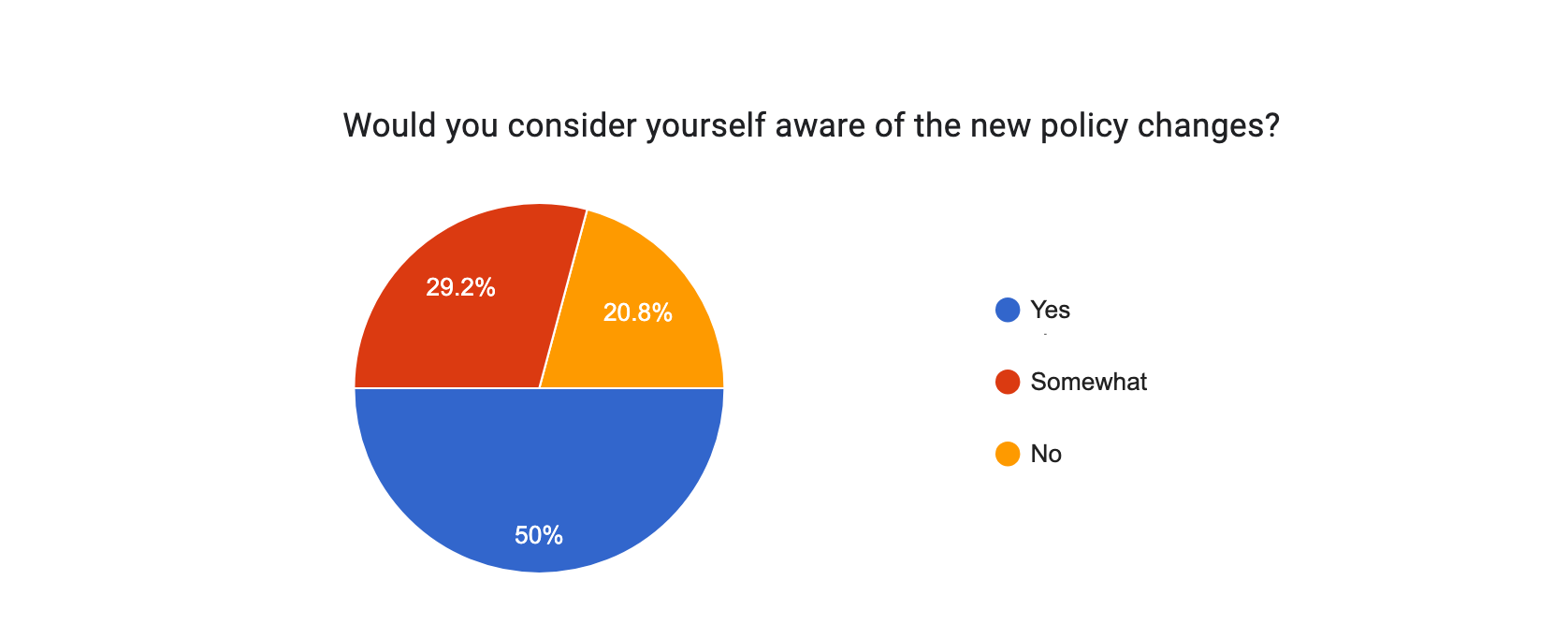
The same polling of the student body showed that 52.2% of students knew about the policy changes, leaving 30.4% confused and 17.4% completely unaware of changes at all. More data reveals why this might be the case.
When asked where they heard of these changes, 82.6% of students said they’d heard just through word of mouth. No one had read this information through Tigers on Edgehill, the newsletter that Edmonds published on August 18.
This data shows that administration can’t rely on students to seek out this information on their own. And announcements like the dress code policy and unexpected assemblies can just cause more confusion.
Learning by word of mouth has the risk of confusion and misunderstanding, which isn’t helping anyone. Perhaps this is the reason for so much student discontent; while 65.2% of students had mixed feelings on the matter, none polled fully supported these changes. Their original grievances may have come more from a place of misunderstanding rather than a problem with the actual changes.
But then again, I don’t think there’s a surefire way to appease every student with one method of communication—or even multiple ways. Not only were the changes covered in Tigers on Edgehill, but they were also covered in the May 2023 issue of the Peabody Press.
“I think USN is a place where change is hard. I think that we as faculty… get dialed into something that [we] feel like works and we are very hesitant to change,” Berthel said. “And so oftentimes, that is more challenging, like when we opened cumulative averages [in 2015]. The first time we did a lot of coaching around what a cumulative average meant.”
The hesitance to accept change can lead to tricky situations when coupled with this miscommunication. This is something that’s been seen in the attendance policy assembly on August 24, and now with student discontent regarding grades.
However, there is hope for a clearer future. Berthel has been at USN during transitional periods of technology and grading systems, and her recollection of how the school would “coach” what those averages mean offers a different, very direct approach at communicating. This concept of easing the school into new waters by coaching, communicating, and giving time is something that I hope we get to see more as the school year continues.