by Alice Littlehale ’26
April 2025
The opinions expressed here are strictly those of the writer and do not reflect the views of University School of Nashville or the Peabody Press.
Few people saw the headline, as it was quickly buried under the others rapidly being posted.
But there is one action the Department of Government Efficiency (DOGE) has taken in recent months that has received comparatively little attention relative to their mass-firing campaigns, demands for lists detailing government workers’ tasks, and misinformation about how much money they have saved the American public. However, it may prove to be more telling about the Trump administration’s future than any of their other overhauls.
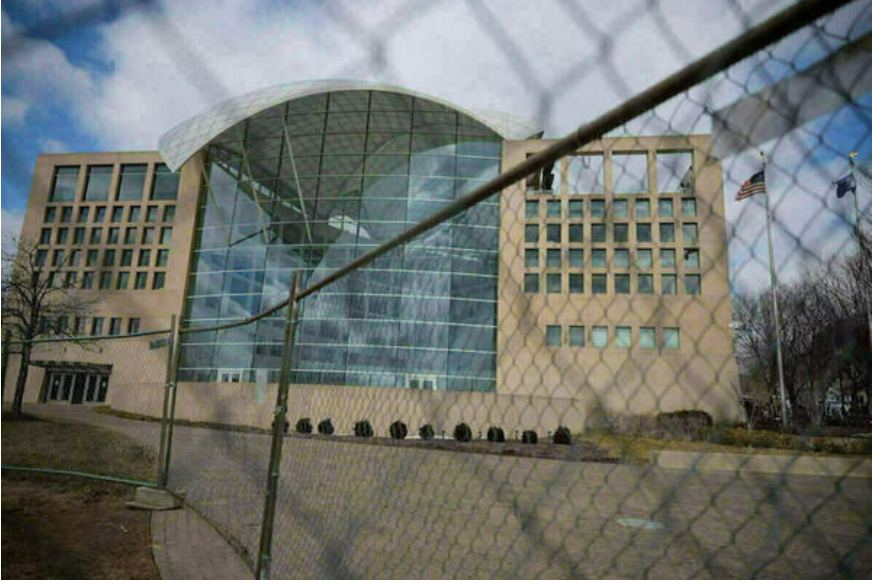
The United States Institute of Peace has existed since 1984, when it was established by an act of Congress signed into law by President Reagan. Its founding mission was to be a peace academy, where American leaders could study the art of peacemaking. It was specifically independent from the government and nonpartisan, and served as a concession to the anti-nuclear movement.
Core to USIP’s mission is its research: studying peace and conflict around the globe. It operates programs in combat zones, offers grants, and operates a training academy and public education center. It is not allowed to accept donations of any kind, as it receives 55 million dollars a year in federal funding.
Just over one month ago, DOGE employees stormed its doors at its DC headquarters and locked its workers out. The Trump administration fired the board chair, George Moose, who refused to leave his office and was then removed by police.
The Trump administration claims that it is within the executive branch’s authority to fire board members, while the former USIP board is suing because they claim they are directly funded by Congress and therefore are not within the President’s jurisdiction.
According to NPR, there is, in fact, a clause in the USIP’s rules that states that the President is able to appoint or remove board members, but only with the consent of a majority of the board or multiple Senate subcommittees.
Moose, USIP’s now-former CEO, previously worked as an ambassador to a variety of nations. He also served as the Assistant Secretary of State for African Affairs during the 1994 Rwandan Genocide. He regularly meets with students and tells them about his regrets surrounding this tragedy, his understanding of the issues at play at the time, and his now lifelong commitment to promoting peace across the globe. He helps them understand the complex decision making that goes into foreign policy-and how to fight for peace in that process.
He was specifically and directly removed from his position as USIP board chair by DOGE.
The Heritage Foundation, the architect of Project 2025, has criticized the USIP in the past. The group has claimed that USIP’s employees and board members overwhelmingly donate to liberal causes when it is meant to be a non-partisan organization, and that they are not clear enough about what they do with their federally allocated funding. Perhaps that critique is part of the reason the Trump administration is attempting to shut the organization down, but there is likely another trend that this action exemplifies.
President Trump does not believe in soft power.
‘Soft power’ is a term used in international relations when countries use cultural or economic incentives to promote their interests rather than strict military force. The United States has often used soft power to ensure that people in other parts of the world feel favorably about America, and therefore are more motivated to help its interests. Soft power helps countries solve conflicts without needing to resort to war.
One example of this soft power is through media and propaganda, like international news programs that paint the US in a positive light. Another that has been utilized frequently in the past is foreign aid. For example, during the Cold War, the US and the Soviet Union often competed to provide rebuilding countries with supplies. This, in turn, would make those countries more loyal towards that respective nation and therefore align with their respective economic system.
The Marshall Plan, for example, was a United States initiative allocating funding to Western Europe in hopes of containing communism in that region. It was successful in helping Europe rebound, and because the only condition of the aid was that it be used to purchase American goods, boosted the American economy and established markets for American goods abroad.
Conservatives have long questioned the necessity of the United States Agency for Foreign Development (USAID). A popular refrain rings, “Why should taxpayers pay for people thousands of miles away?” The answer lies in soft power.
The reason the United States spends the most on foreign aid of any country (although foreign aid spending is a relatively low percent of the US GDP compared to other developed countries) is not simply out of selflessness, but also to promote American ideals and interests abroad. When other countries appreciate America, they are more likely to let it place military bases within their borders, make trade deals, and avoid war.
Foreign aid only accounts for 1.2% of the US budget, according to the Pew Research Center, compared to defense spending which accounts for 23%. The USAID had missions in over one hundred countries before it was dismantled. Much of their work helps Americans even more directly than just ensuring other countries like the United States: 27% of their budget goes towards economic development, 14.2% goes to peace and security, and 22.3% goes to health initiatives.
Having an economically strong world is good for Americans. Having a healthy world–one without the spread of pandemics and contagious diseases–is good for Americans. Having a peaceful world is good for Americans.
The Trump administration, however, does not see it this way. In his first inaugural address, President Trump declared what he called an “America First” approach to foreign policy. His time as a businessman shines through in his beliefs: other countries are taking advantage of America, that the world is a zero-sum game, and he needs to get us a better deal.
He has said that Ukraine has not been thankful enough for the aid it has received in its war effort, as well as that other European countries have not contributed enough to the Russo-Ukrainian War. Never mind the fact that the Ukranians are opposing one of America’s largest and most motivated enemies. Russia has launched a coordinated attack aimed at undermining American democracy and sowing discord and discontent in the American public, according to a declassified report from the National Intelligence Council. Preventing Vlaidimir Putin from spreading his power further across Europe should be imperative for America.
In his first address to a joint session of Congress on February 28, 2017, President Trump said, “My focus is on building the most powerful military of the future.” He has also repeated the Reagan-era slogan “peace through strength.”
It remains to be seen if America can be truly strong with military force alone, and without the bulwark of the many federal organizations promoting peace, health, and democracy abroad that have helped shape the global environment Americans have enjoyed in the past.
Shuttering the USIP is a small action in a long line of the decisions the President is making in the first 100 days of his second term. However, the trend it signifies may prove to be the most influential part of his term: an approach to foreign policy that plans to involve soldiers before diplomats.
In the conflict-ridden world of today, the impact of this choice will surely reverberate for decades to come.